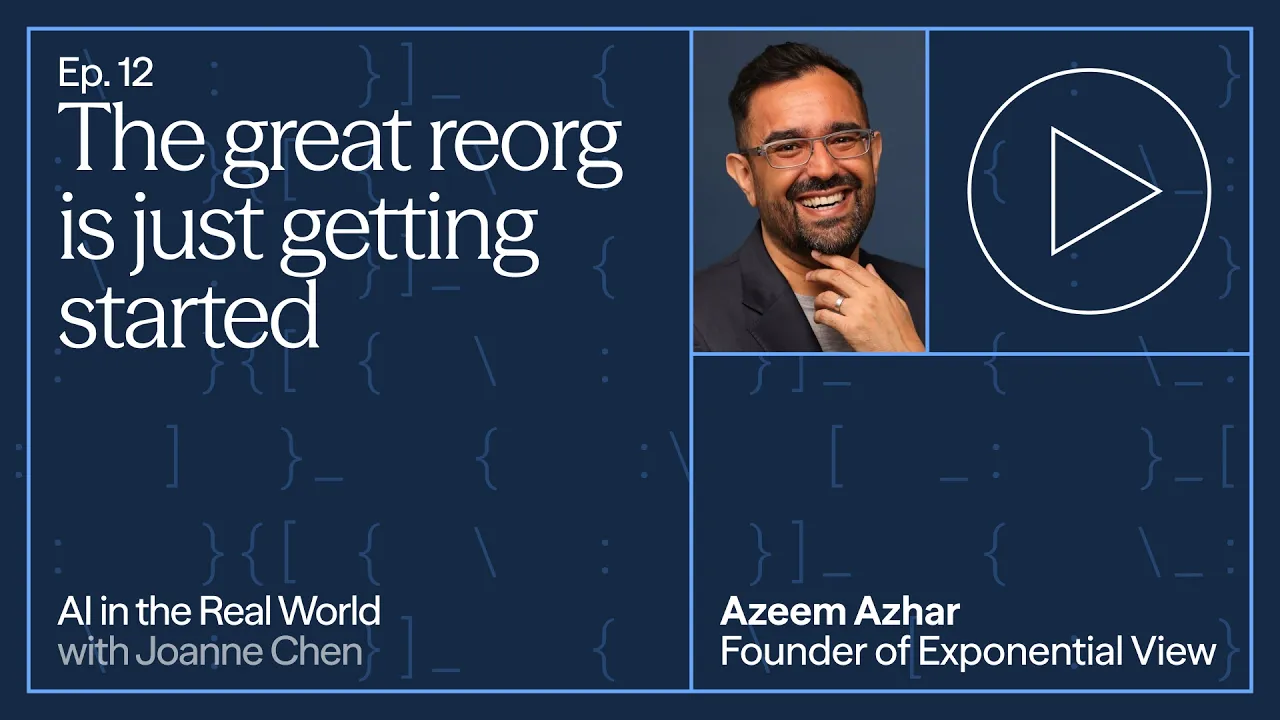
The great reorg is just getting started, with Azeem Azhar, founder of Exponential View

Posted

0 MIN READ
0 MIN READ

Show Outline

Listen and Subscribe on youtube

In this episode, Joanne is joined by Azeem Azhar, founder of Exponential View, to unpack what it will take for AI to move from individual productivity gains to true org-level transformation.

The conversation builds on Joanne and Leo’s recent essay on the great reorg, which argues that AI’s full impact will only arrive when companies redesign how work gets done from first principles. 

Today, AI is already helping individuals work faster, but many organizations are struggling to translate that into gains at the team or company level. Azeem calls this problem “congestion.” When one part of the company speeds up, the next downstream process becomes the bottleneck. As AI takes on more work inside organizations, it reveals where they are too slow, too rigid, or too dependent on processes built around human constraints.

Joanne and Azeem explore what it will take to build AI-native companies, from new human roles like system architects, validators, and accountability owners to new tools designed for agents rather than humans.

For founders, Azeem argues that the most important metric may be cycle time: how quickly a company can learn from customers, ship, adapt, and repeat. The org chart is being redrawn, and the companies that thrive will be the ones that learn how to collaborate with agents instead of simply bolting AI to old workflows.

What we covered:

  • 00:00 Cold open: Why this moment favors startups

  • 00:28 The great reorg, explained

  • 02:16 AI’s productivity paradox

  • 03:36 Congestion as the new bottleneck

  • 06:30 What congestion looks like in practice

  • 09:16 Bottlenecks across compute, healthcare, and drug discovery

  • 13:44 The new human roles in AI-native organizations

  • 15:33 The growing importance of accountability as agents do more work

  • 22:09 The future of expertise

  • 27:27 Are you managing the agents, or are the agents managing you?

  • 31:28 What remains human in venture capital

  • 33:08 Throwing out old assumptions about process

  • 37:12 Designing for agents, not humans

  • 39:19 Cycle time as a key AI-native metric

  • 44:15 The mental model that stalls AI adoption in large orgs 

  • 48:27 Azeem’s advice for early-stage founders

  • 51:19 New startup opportunities in the great reorg

  • 55:08 What changes in the next three years

Read the transcript:

Azeem Azhar: Three and a half years on, the very best things I've seen come out of AI have been things that came out of the Bay Area — out of startups, out of early-stage companies, out of founders. Not things that came from the existing companies that are the backbone of America's economy.

Joanne Chen: We're a little biased here as well. Our view at this moment absolutely favors startups, because they're building from scratch. But welcome, Azeem, to AI in the Real World. Thanks for being here. My partner Leo and I wrote a piece called "The Great Reorg," where we argue that AI's full gains will only come from companies redesigning how work gets done from first principles. We're huge fans of Exponential View and wanted to talk with you about this, since I know it's a topic you've been thinking about as well.

Azeem: Thank you for writing that, it's a really inspiring and thought-provoking piece. I'm also a big fan of Foundation Capital. You invested in one of the companies I was an angel investor in about twenty years ago, I believe it was called Powerset. It was acquired by Microsoft.

Joanne: For sure, Powerset was one of the earliest machine learning and AI companies from way back when, and there've been some great alumni who came out of it. I'm glad you found that connection between us. So, fast-forward to today, a lot has changed. LLMs came onto the scene in 2022, and it feels like every organization has been experimenting with AI, maybe for the first time. I'm curious what you've seen, and what's resonated with you about the Great Reorg.

Azeem: When I read your essay, it really resonated. Ot described, practically, things I've been experiencing myself. I think one of the things you and Leo did was go talk to maybe twenty or thirty companies and observe what they were doing and how they were behaving. What a lot of us are realizing now — and history should have prepared us for this — is that it's one thing to make individuals more productive with a new technology like AI. It's one thing to get AI working at the task level: summarizing inbound requests, reviewing pull requests, whatever it happens to be. It's another thing entirely to turn that into productivity at the level of a team, let alone a company.

I was talking a few weeks ago in New York to the VP of engineering at a large infrastructure company with around a thousand engineers. He said, "Everyone's on Claude Code, a handful of people are on Codex, and everyone's about twice as productive, but I don't see it showing up across the whole group of a thousand people." There's this strange math going on: as individuals, we're all running much faster, but somehow as a team, we're moving at the same speed.

Joanne: Right, and we're not seeing those numbers show up in GDP growth either, at least not yet. There's a lot of data still to come, in my opinion. Why do you think that is, why isn't it showing up in company-level productivity at this point?

Azeem: We don't really have a word for it — I call it congestion. Individuals are becoming really productive and producing more output, more code, for instance. But that output still has to make its way downstream into whatever process comes next, and if that downstream process can't accommodate the volume, it gets blocked.

It's the kind of congestion you'd get if you widened a highway from four lanes to eight but didn't add any more toll booths. You're still pushing everyone through the same three or four booths. That's the mental model I use. When people get faster and produce more, there's a narrowing further down the pipe, and I think that causes two different problems. One is simply that the queue fills up. The other is that the way decisions get made at the next stage was never designed for this volume of output. That's a slightly different issue than just having a backlog — it's more like a budget cycle. You allocate your annual or quarterly budget with certain assumptions about how many things you'll need to decide on. If that number goes up rapidly, even if you can assess each item quickly, the risk and return assumptions behind the budget just weren't built for that scale or diversity. I think that's what's causing the thing you identified: productivity gains that aren't showing up at the corporate level, let alone in the economy's productivity statistics.

Joanne: Can you give some examples of this bottleneck, both the volume of decisions and the bottleneck to actually realizing the gains inside an organization? I have some thoughts, but I'm curious what you're seeing.

Azeem: I'll talk about something specific that happens on my own team. We're about half a dozen researchers, and we produce analysis that goes out through a single channel right now: email. The whole system was fine-tuned to deliver three or four emails to a few hundred thousand people each week, and honestly, even getting that fourth email out at high quality used to be a strain.

What's happened with these new AI tools and agentic workflows is that we can generate much higher-quality analysis — we're ingesting far more data, building and testing many more models against it. So now we have an extraordinary backlog of analyses: what does demand for HBM memory look like over the next three to five years, where are the bottlenecks in the chip supply chain, not just at TSMC, but at the layers before it, or what are we seeing in Main Street's adoption of AI tools. We can do this research at a much higher quality and in much larger volume than ever before, and we're just not able to distribute it, because our old distribution channel is an email three or four times a week — we can't suddenly send twenty-five emails a week. So we're genuinely struggling with how our business has to change, given this new level of output. If we were a manufacturer, we'd be piling up great widgets in the warehouse because we don't have enough trucks to get them to the retailer. That's our example of congestion.

The decision-making problem you mentioned is less of an issue for us, because we're a small team with a flat structure: ultimately I make those calls. But we definitely have the logistics and congestion problem. I'm curious, though. You talked to thirty or forty companies for your research. What did you see that was slowing people down?

Joanne: That's a good question. Coincidentally, one of our companies, Cerebras, which makes chips, went public last week, and Cerebras has had very strong growth historically because of exactly the bottleneck you're describing: there's tremendous demand for inference, compute, and AI workloads. That's one clear example.

But there are other bottlenecks AI is starting to solve. Take our company Tenner, which helps process patient paperwork: prior authorization, eligibility, benefits, and so on. That's been a huge bottleneck for the healthcare system and for patients. My own experience trying to see a doctor, especially a specialist, has been full of bottlenecks, most of them administrative. As a result, doctors are leaving a lot of money on the table because they can't see patients efficiently. Tenner is resolving some of that by automating the scheduling, intake, and paperwork around the healthcare system.

Azeem: Going back to Cerebras, there's an interesting bottleneck connected to them too. One of Cerebras's major industrial customers is GSK, the pharma company, and GSK is one of the leaders in using ML (before we called it AI) in drug discovery. We're doing a much more efficient job finding candidate molecules in that pipeline, identifying them faster and with greater precision. But they're hitting the next bottleneck: how do you get a drug through the approval cycle more quickly?

The naive answer is to blame the FDA or the European Medicines Agency for moving too slowly, like Luddites. But that's not the nuanced reality. Regulators are willing to move quickly. It's that the process of safety testing and patient recruitment across the different trial phases is genuinely complicated to speed up. So that bottleneck slows down all the good work happening upstream. I say it doesn't really have villains, because there's no one sitting there saying, "No, this has to move at the old pace." It's that the external organizational structures of all the different participants have to figure out how to come together, how to handle patient recruitment, for instance, in a way that matches the speed of what's happening upstream.

I think that's really common inside companies too, especially the older companies that your startups either sell to or compete with. The bulk of the U.S. economy is older companies with layers of middle management and structures that have worked, more or less, for decades. That's quite different from a Silicon Valley startup that can reinvent itself five or six times before it's five years old.

Joanne: Right, and that's a great segue into the great reorg, because the way we describe bottlenecks is really about how organizations are designed. As AI gets used by everyone, the bottlenecks will move, as you're describing, and as they move, they tend to get resolved by people. That's why every company is going through a reorganization of humans and machines.

We laid out four roles we think will matter — hypotheses about what will be important for humans to do. I'm curious how this matches what you're seeing. The first is the chief accountability officer, because someone still has to take the fall and own the outcome. If you're in a Waymo and it crashes, who do you blame? We used to blame a human driver; now we have to blame a machine, so someone has to be the accountability officer. Second are system architects, who design the system of agents. Third are relationship builders, because humans are emotional beings who want to be with other emotional beings. And fourth are validators — the subject matter experts checking whether an AI made the right call. Does that match what you're seeing, or would you map it differently?

Azeem: It matches where I think roles are heading. Ultimately you need what I call the liability sponge — you call it the chief accountability officer — someone who soaks up the legal risk. There are also elements that, even in a redesigned system, still have to happen person to person: the handshake, the human touch. And then, as you say, there are the validators.

The two I find most interesting are the liability sponge and the validator, for different reasons. On liability: right now, everyone on my team has effectively agreed, not in a formal contract, but as terms of how we work at Exponential View, that they stand behind whatever goes out under their name. This started when hallucinations were a real problem. We never had hallucinations at Exponential View, because if a piece of material went out saying, for argument's sake, that San Francisco is the capital of France — a GPT-3.5-level error — no one could call that a hallucination. They'd have to say, "I, Bob, wrote that San Francisco is the capital of France, and I take responsibility for it." So we're a zero-hallucination company, maybe the first.

It's actually gotten harder as the models have improved, because they're still prone to mediocrity. The models are like a really boring index-bond fund. They reflect something, but without the distribution of outcomes that real excellence has. As the models have gotten smarter, it's gotten harder for people to notice when they've let something unacceptable through. So we've wrestled with that idea of accountability, and our current approach — everyone takes personal responsibility for what goes out under their name — will need to become more sophisticated.

I'll go further: I think companies will want to move that liability risk off their balance sheets, and we'll see a line of business that's essentially "liability as a service." Someone willing to look at your business and say, "You don't want to hold the tail risk of a self-driving car crash, we'll take that risk." It looks a lot like insurance. In fact, when shipping insurance first started in the coffee houses of 17th-century London, the famous Lloyd's of London, there were people called "names": wealthy individuals who underwrote the risk and absorbed the heavy losses when a ship ran aground, but made money the rest of the time through premiums.

I'd imagine that as we move further into this AI world, companies will look for ways to offload legal liability, including criminal liability, to the extent it still applies, and intermediaries will emerge to take on that risk and repackage it for people willing to take a small premium in exchange for being the one who's on the hook if an AI system goes wrong. What do you think?

Joanne: We're already seeing companies pitch exactly that story — "if your agents misbehave, we'll be the insurer that underwrites the risk." The challenge has been underwriting itself: how do you actually price that risk over time? I don't think there's enough data yet to do it profitably.

The other part of accountability we see is in functional leadership. If you're running product and engineering, and we're seeing those roles merge, since product used to be separate from engineering, someone is responsible for the output of that function: managing the humans, managing the agents, and owning the combined output. Right now that's a person, and I believe it will continue to be.

Azeem: In some sense, isn't that just the CFO's job, or the CFO's organization? That's ultimately where risk gets bundled up in a company; it's why the CFO holds the controls and owns the liabilities.

Joanne: I think you're right about who ends up holding the risk. I also think the education system that trains future chief accountability officers needs to change, to produce more interdisciplinary people who are good at managing both people and system design, and who are willing to take on risk for their organization. Right now, kids are taught to follow the rules, perform well on exams, go to McKinsey, do something else for two years, and check boxes. That path may not produce the kind of leadership these organizations will need.

Azeem: What you're describing is part of a broader challenge. This great reorg is going to call on more generalist skills, which isn't what career ladders have rewarded for the last thirty years.

Get insights directly to your inbox.

Set your newsletter preferences:

Set your newsletter preferences:

Joanne: Do you think specialization disappears, or does it just take a different shape? We talked about validators a moment ago, they're effectively specialists checking the work. How do you think about that role?

Azeem: The validator role pulls in two opposite directions. You need hyper-specialists, because they're the only ones who can actually check the AI's work. But if AI is doing most of the work, how does someone become an expert validator if they can never get the junior job that used to teach them the craft? Those are the two tensions.

My sense is that we'll go through the same historical pattern we always have: abstracting up what quality control even means, moving toward statistical approaches and contractual agreements between parts of a process. Think about how cars were made. Between 1895 and 1920 is a useful analogy. Cars used to be made artisanally, by blacksmiths or carriage-makers, true craftsmen. Quality control back then was the expert eye of someone walking around a machine they'd assembled over a week, and every car was a little different because there was no need for consistent tolerances. A master craftsman could just bend a panel into shape if it didn't quite fit, look at it, and say, "That's right," and the car would roll out.

When we moved to the assembly line, and Ford became the ultimate systems engineer, he was the systems architect, and he hired systems architects. Quality control shifted to statistical sampling: you can't inspect every single item, so you check some of them, and you trust that quality holds at the level of the specification, because the system will break if a component doesn't meet spec.

I think we're rethinking that question of validation again right now. At Exponential View, the parallel we draw is between level-three and level-four self-driving. It's not one incremental step, it's an entirely different way of looking at the world. We're sitting in this odd moment that's a bit like going from level two, where teams work well together internally, to level three or four, where the whole organization works together. That's a completely different step. One of the biggest things that makes validation hard is exactly that question: where does it happen, and how do you make sure the fast output of one team, once it connects to another team, gets accommodated in a seamless, high-quality way? I'm sure we'll get there, but I think that's one of the biggest reasons we see so few companies, outside of the Anthropics and OpenAIs of the world, that genuinely look like AI-native companies.

Joanne: That makes a lot of sense and it's fascinating to look at the org designs of Anthropic and OpenAI, which still carry a lot of historical nods to org structures we already know. One last question on this: we have a phrase internally: "Are you managing the agents, or are the agents managing you?" There might be a circular aspect to that. How do you see it playing out?

Azeem: When I started using Claude Code seven or eight months ago, I actually changed my sleeping cycle. Back in November or December of last year, I could only get it to run for three or four hours at a stretch, so I'd stay up late to get a final payload running overnight, then get up early to check on it and start the next one before going back to bed for a couple more hours. My Oura ring data would more than testify to how rough that was.

One thing I've discovered as the agents have gotten better, especially in a fairly generalist role — I run a small research team, we write, I make investments, both public and private — is that the work is heterogeneous, and I find it hard to systematize, because my weeks have never looked the same day to day, let alone week to week. I think I've hit something close to a ceiling on how well I can work with agents until I figure out the right mental model.

But for people whose jobs look similar day to day, week to week, month to month, what really determines their day is the overarching process, whether that's a manager calling an all-hands meeting, or now, a set of agentic requirements: human in the loop, approve, reject, approve, reject. Those are all points on a spectrum of humans living inside processes defined by someone else. If we want to get the most out of humans, we probably don't want them doing machine-like work, we want them doing judgment work, the kind the systems architects and relationship experts do, rather than just responding to a process. I'm curious, your work is also very different day to day. Do you think venture capital has its own assembly-line moment coming because of AI?

Joanne: I think the repeated work is definitely getting automated. We do a lot of top-of-funnel outreach to entrepreneurs, write a lot of content, respond to a lot of emails, write rejection emails, much of that is now handled by agents. Can an AI decide what to invest in? No, not yet. Can it narrow a stack of decks down to the ten we should really meet? I think so, at this point.

My hope is to spend nearly all my time on human-to-human conversations, with founders, with people like you, with execs, recruiting for portfolio companies, having dinner with entrepreneurs while they talk through half-formed ideas, and have everything else behind the scenes automated. I wonder, too, as more process gets automated, what's left, and what do people actually do? That's going to be interesting to figure out. I wonder if there will even be as much process once that shift happens.

Azeem: That triggers a thought about what assumptions we need to throw out as we think through this great reorg. You made the point that processes exist to organize work in a particular way, and the reason we organized it that way was because of certain constraints, constraints on my time and energy. After sixty hours of work in a week, I'm not as effective as I was in the first hour. In your case, maybe it's eighty hours. But we're building systems that don't have that limitation, they're consistently effective basically all the time. So what embedded assumption have we been making about what a process needs to look like?

Here's an analogy: Claude Code has been a hugely successful product. It went from zero to multi-billion-dollar revenue in six or seven months, and it's electrifying the software industry right now; GitHub commit volume is going through the roof because of it. I remember hearing Boris, the architect of Claude Code, say a couple of things: one, that he hasn't personally written code for it in a while, and two, that it's a genuinely huge, sprawling lump of code, not a neatly refactored, modular codebase. Why would you refactor it, when it's so cheap to have machines go find the bugs in the spaghetti while you keep adding features? It really turns around the question of what it even means to produce great software compared to a year ago.

So I have this open question I haven't fully answered: which of our assumptions are based on truly deep, foundational constraints, and which are just inherited habit? It's hard for us, like goldfish in a tank, to imagine there's a world outside the bowl. That's something we have to think about as we figure out what kinds of organizations will shape the future. After hearing the Claude Code story, I went back to my team and asked, how much time are we spending refactoring? Should we even be doing that, if the people building Claude Code apparently don't? I wonder how true that is of other things in your business. Do you still run the same kind of stage-gated pipeline as you move a deal from consideration through diligence to offer to close? Is that even the right model once we really understand what AI can do?

Joanne: That's a good point, it's both a shift in what's possible and a shift in mental models. We have this process because we collectively agreed to it internally, but we could agree to a different one, as long as everyone buys in.

One set of startups we're starting to see are building for an "agentic customer" rather than a human one. Right now most products are built for humans to interact with. There's a UI, a way for a person to engage. But as human engagement decreases, those products have to be redesigned for an agentic third party instead. I met a company doing email. Cmail is built for you and me to read, but what if we stop reading email and agents read it instead? How does that change the product? I suspect a lot of solutions are going to get redesigned for an agentic world, and that will naturally eliminate parts of the process we engage with today.

As a brainstorm, we use Affinity internally as our CRM. We pull it up, look at every stage of the pipeline, and decide where to focus. But will we even need to do that over time, or will it just be obvious which companies deserve our attention, with some kind of agentic moderator asking each investor what they need to contribute to get a deal closed? I can see that happening.

Azeem: As you say, maybe that's not a process investors will need once AI systems do a better job. One thing I think you could actually measure, and this is something I talk to large companies about too, is cycle time. Within Silicon Valley and founder-led companies, cycle time is everything: how fast you go through the OODA loop, take feedback, adjust your proposition, and go again. That's not embedded in Main Street at all, it's something they're still coming to grips with.

My hypothesis is that the thing worth measuring is the cycle time of a full loop. If you're putting AI into a company, instead of looking at one-way workflows — X comes in, gets transformed into Y — you want to look at a full lifecycle, because it only speeds up if every part of it speeds up. Otherwise you run into an Amdahl's Law problem: the slowest part of the chain sets the pace. My own cycle time as an individual has gotten really fast, the time to idea is much quicker. But has the team's cycle time gotten faster, or is it constrained somewhere else? We're getting better at it, but we're still figuring it out.

The challenge is that a company that's been through the great reorg, whatever its scale, should have a cycle time that's much faster than it used to be, that gets you to what I'd call phase three. Phase two is individual teams working well; phase three is the whole company working that fast. Phase four is the economy, which is the thing you mentioned at the start, that it's not showing up in the GDP statistics yet. If you're a fast-moving, agentically native firm that's been through the great reorg, your cycle, from customer need to proposing a new product to getting in front of the customer to capturing value to surfacing new needs, runs very quickly. And the bottlenecks end up living outside your organization: your suppliers, your KYC provider, whoever's extending you credit. That's where you'll need to push outward and tell your suppliers they need to move faster, because right now they're the ones slowing your business down. That might be something we can actually start to measure. We're not at the point yet where many companies run at the speed of AI, but when they do, they'll be running up against companies that are moving too slowly. And what I like about that story is that we've been through it before.

We both remember a world before digital KYC, before Stripe, before Shopify, getting any of that infrastructure in place used to be incredibly slow and painful. What we know is that entrepreneurs figure it out; they build the pieces that let everyone move faster. I don't know yet what the equivalent looks like for Main Street, because Main Street doesn't necessarily have the language to talk to companies moving at that speed. But as companies do go AI-native, I think we'll see that cycle time accelerate.

Joanne: I love that, the speed of AI. We'll have to talk about that more. I think the AI-native companies, the startups built after ChatGPT launched, are able to develop products faster precisely because their cycle time is shrinking, and as a result, revenue is growing faster than we've ever seen for enterprise companies, because they can sell more. That's happening at the startup level for at least some of them. Now, on Main Street, there's been a lot of reaction: layoffs, acquisitions, vendor partnerships, a lot of marketing language about reorganization. What's actually happening there, in your view?

Azeem: I've really struggled to find great examples of large companies doing things with AI that match what we're seeing in startups. JPMorgan is the one carrying a lot of weight right now, they're genuinely pleased with how it's helped grow their business. Jamie Dimon has said they've put a few billion dollars in and gotten a few billion back, and it's going well. It's striking how much weight a handful of examples are carrying.

When I was with thirty or forty financial services companies in New York a couple of weeks ago, the general framing was cost-cutting. People weren't talking about speeding up the nature of their business, they were talking about productivity within the frame of the business they already run. That's understandable, but it's a little disappointing, honestly, because, going back to your validator point, most of those four roles, architects, accountability officers, validators, relationship experts, depend on tacit knowledge that exists in a company but isn't written down anywhere. If you go down an aggressive path of cutting headcount, you risk losing that tacit knowledge.

There was a Gallup survey a few days before we recorded this, saying 11% of large American companies claim to be getting results from generative AI. Doomers read that as the glass half empty; others read it as half full. I think 11% after three and a half years of ChatGPT is fast, not Usain Bolt fast, but faster than electricity, faster than the PC. It's not as fast as some people in the Bay Area thought it would be two years ago. The thing to watch is how quickly that 11% climbs past the kink in the hockey stick. Normally, once you hit 11%, you're past the inflection point, though we might not be yet. My gut says we are, and that number will rise faster and faster.

My hypothesis is that companies will need to go through a paring-down before they even think about reorganizing, partly because reorganizing a large company is an incredibly complex social process involving tens of thousands of people whose livelihoods are at stake. It moves very slowly. You go through the shock of headcount reductions, and only after that can you move more quickly. That's just a hypothesis, trying to make sense of the fact that three and a half years on, the best things I've seen come out of AI have come from the Bay Area, from startups, from early-stage companies, from founders. Not from the existing companies that are the backbone of America's economy.

Joanne: We're a little biased here too. Our view right now absolutely favors startups, because they're building from scratch. So, what advice would you give early-stage founders? I know that as an angel investor, you know a lot of them. What would you tell them as they're designing their companies?

Azeem: The first thing I'd say is: don't try too hard to design your organization upfront. Great early startup teams tend to be three or four slightly awkward generalists, and you can't quite tell who's going to end up doing marketing versus product versus finance. That's even more true in a world of AI, since the tools can make all of us above-average marketers.

My advice to founders is fundamentally about cycle time: what have you done to speed up how quickly you put something in front of customers, get feedback, and turn that into something you can put back in front of them? Practically, if you're in B2B, for your current hypothesis, you can find every buyer for your product by name using AI, LinkedIn, and Apollo, and start a drip campaign without hiring a salesperson. You should be able to do that.

You should have a twelve- to twenty-four-hour turnaround, if not faster, from talking to a customer to shipping the feature they asked for, because you've got a transcript of that conversation, an agent listening to it, turning it into tickets that a coding agent picks up, and a few hours later it's back in the customer's hands. These are the kinds of things I push my founders toward, because cycle time has always mattered for startups, but with these generalist AI tools, it matters more than ever.

I've backed around forty companies over the last several years, about fifteen of them before ChatGPT existed. You can really feel the difference in how those companies work compared to the ones founded a year or two later, because thinking in terms of cycle time comes much more naturally to the newer ones.

Joanne: Absolutely. Most of our portfolio was invested pre-ChatGPT. The ones that have thrived in this new environment versus the ones that have struggled really come down to speed of iteration, execution, and adapting. We're also seeing a lot of new opportunities emerge as this great reorg plays out — tools designed for agents first rather than humans, tools that orchestrate fleets of agents, tools that pair with human validators, even AI-native services. For the first time, I think this is a genuinely credible investment category for us. It sounds like you're building your own organization to be AI-native as well. What new opportunities are you seeing as you look for founders to back?

Azeem: I've been thinking a lot about the bottlenecks that emerge as AI scales. The obvious ones are demand for compute, memory, and power. But it's not obvious that the answer to memory demand is exclusively new memory architectures and new chips. I think engineers will also just solve around it, because new memory gets so expensive. Look at DeepSeek, they made their KV cache something like nine times more efficient between versions, because that's a cheaper way to deal with the memory bottleneck than buying more HBM3.

A lot of the startups I've backed over the last year or two are betting that demand will be so great that we'll need solutions to meet it. A couple of chip companies addressing inference, and a company that's essentially a virtualization layer for CUDA, so you can drop models onto different chip architectures without rethinking what you built for CUDA, on the assumption that hyperscalers and neoclouds will end up with more heterogeneous compute fabric.

On the other side, I think there are going to be billions, maybe trillions, of agents in the world within a few years, and we're going to need ways to measure them. Take telemetry from them, understand their behavior and interactions. It's a bit like the "agent mail" problem, how are agents going to communicate with each other? How do we understand and govern, at an abstracted layer, the thousands of agents each of us will eventually have working on our behalf? That has to be done in software, not by me staring across a thousand spreadsheets asking what agent 482 did yesterday.

Joanne: That makes a lot of sense. One last question before we wrap. Looking one to three years out, how do you see this playing out? What would you predict to be true, and what still feels genuinely uncertain to you?

Azeem: What I'd predict to be true: models will be much better than they are now, and adoption will be far deeper. Three years is plenty of time for humans to figure out how to repeat a new way of working. Think about the iPhone and the App Store: by 2014, launching a mobile-first startup wasn't novel anymore, even though it was genuinely novel in 2011, which is part of why a company like Uber did as well as it did. I think we'll see a similar normalization here.

What I'm genuinely uncertain about is whether we'll keep gravitating toward the frontier, best-of-the-best models, or shift toward open-source and non-frontier models for a lot of workloads, because they're more than good enough. You don't need a Nobel laureate to help you screen candidates for a dog walker. The obvious answer is that we'll go more heterogeneous and use cheaper models for most of these tasks, but I'm honestly not sure we will. Even with highly capable non-frontier models available, when people have a choice, they tend to default to the best model they can get. I'm not sure how that settles over the next two or three years.

Joanne: Well, I can't wait to find out. Thank you so much for chatting with me, this was a lot of fun, and I can't wait to see what the future holds.

Azeem: Thank you so much, Joanne. Thank you.

Posted

0 MIN READ

Show Outline

Listen and Subscribe on youtube

In this episode, Joanne is joined by Azeem Azhar, founder of Exponential View, to unpack what it will take for AI to move from individual productivity gains to true org-level transformation.

The conversation builds on Joanne and Leo’s recent essay on the great reorg, which argues that AI’s full impact will only arrive when companies redesign how work gets done from first principles. 

Today, AI is already helping individuals work faster, but many organizations are struggling to translate that into gains at the team or company level. Azeem calls this problem “congestion.” When one part of the company speeds up, the next downstream process becomes the bottleneck. As AI takes on more work inside organizations, it reveals where they are too slow, too rigid, or too dependent on processes built around human constraints.

Joanne and Azeem explore what it will take to build AI-native companies, from new human roles like system architects, validators, and accountability owners to new tools designed for agents rather than humans.

For founders, Azeem argues that the most important metric may be cycle time: how quickly a company can learn from customers, ship, adapt, and repeat. The org chart is being redrawn, and the companies that thrive will be the ones that learn how to collaborate with agents instead of simply bolting AI to old workflows.

What we covered:

  • 00:00 Cold open: Why this moment favors startups

  • 00:28 The great reorg, explained

  • 02:16 AI’s productivity paradox

  • 03:36 Congestion as the new bottleneck

  • 06:30 What congestion looks like in practice

  • 09:16 Bottlenecks across compute, healthcare, and drug discovery

  • 13:44 The new human roles in AI-native organizations

  • 15:33 The growing importance of accountability as agents do more work

  • 22:09 The future of expertise

  • 27:27 Are you managing the agents, or are the agents managing you?

  • 31:28 What remains human in venture capital

  • 33:08 Throwing out old assumptions about process

  • 37:12 Designing for agents, not humans

  • 39:19 Cycle time as a key AI-native metric

  • 44:15 The mental model that stalls AI adoption in large orgs 

  • 48:27 Azeem’s advice for early-stage founders

  • 51:19 New startup opportunities in the great reorg

  • 55:08 What changes in the next three years

Read the transcript:

Azeem Azhar: Three and a half years on, the very best things I've seen come out of AI have been things that came out of the Bay Area — out of startups, out of early-stage companies, out of founders. Not things that came from the existing companies that are the backbone of America's economy.

Joanne Chen: We're a little biased here as well. Our view at this moment absolutely favors startups, because they're building from scratch. But welcome, Azeem, to AI in the Real World. Thanks for being here. My partner Leo and I wrote a piece called "The Great Reorg," where we argue that AI's full gains will only come from companies redesigning how work gets done from first principles. We're huge fans of Exponential View and wanted to talk with you about this, since I know it's a topic you've been thinking about as well.

Azeem: Thank you for writing that, it's a really inspiring and thought-provoking piece. I'm also a big fan of Foundation Capital. You invested in one of the companies I was an angel investor in about twenty years ago, I believe it was called Powerset. It was acquired by Microsoft.

Joanne: For sure, Powerset was one of the earliest machine learning and AI companies from way back when, and there've been some great alumni who came out of it. I'm glad you found that connection between us. So, fast-forward to today, a lot has changed. LLMs came onto the scene in 2022, and it feels like every organization has been experimenting with AI, maybe for the first time. I'm curious what you've seen, and what's resonated with you about the Great Reorg.

Azeem: When I read your essay, it really resonated. Ot described, practically, things I've been experiencing myself. I think one of the things you and Leo did was go talk to maybe twenty or thirty companies and observe what they were doing and how they were behaving. What a lot of us are realizing now — and history should have prepared us for this — is that it's one thing to make individuals more productive with a new technology like AI. It's one thing to get AI working at the task level: summarizing inbound requests, reviewing pull requests, whatever it happens to be. It's another thing entirely to turn that into productivity at the level of a team, let alone a company.

I was talking a few weeks ago in New York to the VP of engineering at a large infrastructure company with around a thousand engineers. He said, "Everyone's on Claude Code, a handful of people are on Codex, and everyone's about twice as productive, but I don't see it showing up across the whole group of a thousand people." There's this strange math going on: as individuals, we're all running much faster, but somehow as a team, we're moving at the same speed.

Joanne: Right, and we're not seeing those numbers show up in GDP growth either, at least not yet. There's a lot of data still to come, in my opinion. Why do you think that is, why isn't it showing up in company-level productivity at this point?

Azeem: We don't really have a word for it — I call it congestion. Individuals are becoming really productive and producing more output, more code, for instance. But that output still has to make its way downstream into whatever process comes next, and if that downstream process can't accommodate the volume, it gets blocked.

It's the kind of congestion you'd get if you widened a highway from four lanes to eight but didn't add any more toll booths. You're still pushing everyone through the same three or four booths. That's the mental model I use. When people get faster and produce more, there's a narrowing further down the pipe, and I think that causes two different problems. One is simply that the queue fills up. The other is that the way decisions get made at the next stage was never designed for this volume of output. That's a slightly different issue than just having a backlog — it's more like a budget cycle. You allocate your annual or quarterly budget with certain assumptions about how many things you'll need to decide on. If that number goes up rapidly, even if you can assess each item quickly, the risk and return assumptions behind the budget just weren't built for that scale or diversity. I think that's what's causing the thing you identified: productivity gains that aren't showing up at the corporate level, let alone in the economy's productivity statistics.

Joanne: Can you give some examples of this bottleneck, both the volume of decisions and the bottleneck to actually realizing the gains inside an organization? I have some thoughts, but I'm curious what you're seeing.

Azeem: I'll talk about something specific that happens on my own team. We're about half a dozen researchers, and we produce analysis that goes out through a single channel right now: email. The whole system was fine-tuned to deliver three or four emails to a few hundred thousand people each week, and honestly, even getting that fourth email out at high quality used to be a strain.

What's happened with these new AI tools and agentic workflows is that we can generate much higher-quality analysis — we're ingesting far more data, building and testing many more models against it. So now we have an extraordinary backlog of analyses: what does demand for HBM memory look like over the next three to five years, where are the bottlenecks in the chip supply chain, not just at TSMC, but at the layers before it, or what are we seeing in Main Street's adoption of AI tools. We can do this research at a much higher quality and in much larger volume than ever before, and we're just not able to distribute it, because our old distribution channel is an email three or four times a week — we can't suddenly send twenty-five emails a week. So we're genuinely struggling with how our business has to change, given this new level of output. If we were a manufacturer, we'd be piling up great widgets in the warehouse because we don't have enough trucks to get them to the retailer. That's our example of congestion.

The decision-making problem you mentioned is less of an issue for us, because we're a small team with a flat structure: ultimately I make those calls. But we definitely have the logistics and congestion problem. I'm curious, though. You talked to thirty or forty companies for your research. What did you see that was slowing people down?

Joanne: That's a good question. Coincidentally, one of our companies, Cerebras, which makes chips, went public last week, and Cerebras has had very strong growth historically because of exactly the bottleneck you're describing: there's tremendous demand for inference, compute, and AI workloads. That's one clear example.

But there are other bottlenecks AI is starting to solve. Take our company Tenner, which helps process patient paperwork: prior authorization, eligibility, benefits, and so on. That's been a huge bottleneck for the healthcare system and for patients. My own experience trying to see a doctor, especially a specialist, has been full of bottlenecks, most of them administrative. As a result, doctors are leaving a lot of money on the table because they can't see patients efficiently. Tenner is resolving some of that by automating the scheduling, intake, and paperwork around the healthcare system.

Azeem: Going back to Cerebras, there's an interesting bottleneck connected to them too. One of Cerebras's major industrial customers is GSK, the pharma company, and GSK is one of the leaders in using ML (before we called it AI) in drug discovery. We're doing a much more efficient job finding candidate molecules in that pipeline, identifying them faster and with greater precision. But they're hitting the next bottleneck: how do you get a drug through the approval cycle more quickly?

The naive answer is to blame the FDA or the European Medicines Agency for moving too slowly, like Luddites. But that's not the nuanced reality. Regulators are willing to move quickly. It's that the process of safety testing and patient recruitment across the different trial phases is genuinely complicated to speed up. So that bottleneck slows down all the good work happening upstream. I say it doesn't really have villains, because there's no one sitting there saying, "No, this has to move at the old pace." It's that the external organizational structures of all the different participants have to figure out how to come together, how to handle patient recruitment, for instance, in a way that matches the speed of what's happening upstream.

I think that's really common inside companies too, especially the older companies that your startups either sell to or compete with. The bulk of the U.S. economy is older companies with layers of middle management and structures that have worked, more or less, for decades. That's quite different from a Silicon Valley startup that can reinvent itself five or six times before it's five years old.

Joanne: Right, and that's a great segue into the great reorg, because the way we describe bottlenecks is really about how organizations are designed. As AI gets used by everyone, the bottlenecks will move, as you're describing, and as they move, they tend to get resolved by people. That's why every company is going through a reorganization of humans and machines.

We laid out four roles we think will matter — hypotheses about what will be important for humans to do. I'm curious how this matches what you're seeing. The first is the chief accountability officer, because someone still has to take the fall and own the outcome. If you're in a Waymo and it crashes, who do you blame? We used to blame a human driver; now we have to blame a machine, so someone has to be the accountability officer. Second are system architects, who design the system of agents. Third are relationship builders, because humans are emotional beings who want to be with other emotional beings. And fourth are validators — the subject matter experts checking whether an AI made the right call. Does that match what you're seeing, or would you map it differently?

Azeem: It matches where I think roles are heading. Ultimately you need what I call the liability sponge — you call it the chief accountability officer — someone who soaks up the legal risk. There are also elements that, even in a redesigned system, still have to happen person to person: the handshake, the human touch. And then, as you say, there are the validators.

The two I find most interesting are the liability sponge and the validator, for different reasons. On liability: right now, everyone on my team has effectively agreed, not in a formal contract, but as terms of how we work at Exponential View, that they stand behind whatever goes out under their name. This started when hallucinations were a real problem. We never had hallucinations at Exponential View, because if a piece of material went out saying, for argument's sake, that San Francisco is the capital of France — a GPT-3.5-level error — no one could call that a hallucination. They'd have to say, "I, Bob, wrote that San Francisco is the capital of France, and I take responsibility for it." So we're a zero-hallucination company, maybe the first.

It's actually gotten harder as the models have improved, because they're still prone to mediocrity. The models are like a really boring index-bond fund. They reflect something, but without the distribution of outcomes that real excellence has. As the models have gotten smarter, it's gotten harder for people to notice when they've let something unacceptable through. So we've wrestled with that idea of accountability, and our current approach — everyone takes personal responsibility for what goes out under their name — will need to become more sophisticated.

I'll go further: I think companies will want to move that liability risk off their balance sheets, and we'll see a line of business that's essentially "liability as a service." Someone willing to look at your business and say, "You don't want to hold the tail risk of a self-driving car crash, we'll take that risk." It looks a lot like insurance. In fact, when shipping insurance first started in the coffee houses of 17th-century London, the famous Lloyd's of London, there were people called "names": wealthy individuals who underwrote the risk and absorbed the heavy losses when a ship ran aground, but made money the rest of the time through premiums.

I'd imagine that as we move further into this AI world, companies will look for ways to offload legal liability, including criminal liability, to the extent it still applies, and intermediaries will emerge to take on that risk and repackage it for people willing to take a small premium in exchange for being the one who's on the hook if an AI system goes wrong. What do you think?

Joanne: We're already seeing companies pitch exactly that story — "if your agents misbehave, we'll be the insurer that underwrites the risk." The challenge has been underwriting itself: how do you actually price that risk over time? I don't think there's enough data yet to do it profitably.

The other part of accountability we see is in functional leadership. If you're running product and engineering, and we're seeing those roles merge, since product used to be separate from engineering, someone is responsible for the output of that function: managing the humans, managing the agents, and owning the combined output. Right now that's a person, and I believe it will continue to be.

Azeem: In some sense, isn't that just the CFO's job, or the CFO's organization? That's ultimately where risk gets bundled up in a company; it's why the CFO holds the controls and owns the liabilities.

Joanne: I think you're right about who ends up holding the risk. I also think the education system that trains future chief accountability officers needs to change, to produce more interdisciplinary people who are good at managing both people and system design, and who are willing to take on risk for their organization. Right now, kids are taught to follow the rules, perform well on exams, go to McKinsey, do something else for two years, and check boxes. That path may not produce the kind of leadership these organizations will need.

Azeem: What you're describing is part of a broader challenge. This great reorg is going to call on more generalist skills, which isn't what career ladders have rewarded for the last thirty years.

Get insights directly to your inbox.

Set your newsletter preferences:

Joanne: Do you think specialization disappears, or does it just take a different shape? We talked about validators a moment ago, they're effectively specialists checking the work. How do you think about that role?

Azeem: The validator role pulls in two opposite directions. You need hyper-specialists, because they're the only ones who can actually check the AI's work. But if AI is doing most of the work, how does someone become an expert validator if they can never get the junior job that used to teach them the craft? Those are the two tensions.

My sense is that we'll go through the same historical pattern we always have: abstracting up what quality control even means, moving toward statistical approaches and contractual agreements between parts of a process. Think about how cars were made. Between 1895 and 1920 is a useful analogy. Cars used to be made artisanally, by blacksmiths or carriage-makers, true craftsmen. Quality control back then was the expert eye of someone walking around a machine they'd assembled over a week, and every car was a little different because there was no need for consistent tolerances. A master craftsman could just bend a panel into shape if it didn't quite fit, look at it, and say, "That's right," and the car would roll out.

When we moved to the assembly line, and Ford became the ultimate systems engineer, he was the systems architect, and he hired systems architects. Quality control shifted to statistical sampling: you can't inspect every single item, so you check some of them, and you trust that quality holds at the level of the specification, because the system will break if a component doesn't meet spec.

I think we're rethinking that question of validation again right now. At Exponential View, the parallel we draw is between level-three and level-four self-driving. It's not one incremental step, it's an entirely different way of looking at the world. We're sitting in this odd moment that's a bit like going from level two, where teams work well together internally, to level three or four, where the whole organization works together. That's a completely different step. One of the biggest things that makes validation hard is exactly that question: where does it happen, and how do you make sure the fast output of one team, once it connects to another team, gets accommodated in a seamless, high-quality way? I'm sure we'll get there, but I think that's one of the biggest reasons we see so few companies, outside of the Anthropics and OpenAIs of the world, that genuinely look like AI-native companies.

Joanne: That makes a lot of sense and it's fascinating to look at the org designs of Anthropic and OpenAI, which still carry a lot of historical nods to org structures we already know. One last question on this: we have a phrase internally: "Are you managing the agents, or are the agents managing you?" There might be a circular aspect to that. How do you see it playing out?

Azeem: When I started using Claude Code seven or eight months ago, I actually changed my sleeping cycle. Back in November or December of last year, I could only get it to run for three or four hours at a stretch, so I'd stay up late to get a final payload running overnight, then get up early to check on it and start the next one before going back to bed for a couple more hours. My Oura ring data would more than testify to how rough that was.

One thing I've discovered as the agents have gotten better, especially in a fairly generalist role — I run a small research team, we write, I make investments, both public and private — is that the work is heterogeneous, and I find it hard to systematize, because my weeks have never looked the same day to day, let alone week to week. I think I've hit something close to a ceiling on how well I can work with agents until I figure out the right mental model.

But for people whose jobs look similar day to day, week to week, month to month, what really determines their day is the overarching process, whether that's a manager calling an all-hands meeting, or now, a set of agentic requirements: human in the loop, approve, reject, approve, reject. Those are all points on a spectrum of humans living inside processes defined by someone else. If we want to get the most out of humans, we probably don't want them doing machine-like work, we want them doing judgment work, the kind the systems architects and relationship experts do, rather than just responding to a process. I'm curious, your work is also very different day to day. Do you think venture capital has its own assembly-line moment coming because of AI?

Joanne: I think the repeated work is definitely getting automated. We do a lot of top-of-funnel outreach to entrepreneurs, write a lot of content, respond to a lot of emails, write rejection emails, much of that is now handled by agents. Can an AI decide what to invest in? No, not yet. Can it narrow a stack of decks down to the ten we should really meet? I think so, at this point.

My hope is to spend nearly all my time on human-to-human conversations, with founders, with people like you, with execs, recruiting for portfolio companies, having dinner with entrepreneurs while they talk through half-formed ideas, and have everything else behind the scenes automated. I wonder, too, as more process gets automated, what's left, and what do people actually do? That's going to be interesting to figure out. I wonder if there will even be as much process once that shift happens.

Azeem: That triggers a thought about what assumptions we need to throw out as we think through this great reorg. You made the point that processes exist to organize work in a particular way, and the reason we organized it that way was because of certain constraints, constraints on my time and energy. After sixty hours of work in a week, I'm not as effective as I was in the first hour. In your case, maybe it's eighty hours. But we're building systems that don't have that limitation, they're consistently effective basically all the time. So what embedded assumption have we been making about what a process needs to look like?

Here's an analogy: Claude Code has been a hugely successful product. It went from zero to multi-billion-dollar revenue in six or seven months, and it's electrifying the software industry right now; GitHub commit volume is going through the roof because of it. I remember hearing Boris, the architect of Claude Code, say a couple of things: one, that he hasn't personally written code for it in a while, and two, that it's a genuinely huge, sprawling lump of code, not a neatly refactored, modular codebase. Why would you refactor it, when it's so cheap to have machines go find the bugs in the spaghetti while you keep adding features? It really turns around the question of what it even means to produce great software compared to a year ago.

So I have this open question I haven't fully answered: which of our assumptions are based on truly deep, foundational constraints, and which are just inherited habit? It's hard for us, like goldfish in a tank, to imagine there's a world outside the bowl. That's something we have to think about as we figure out what kinds of organizations will shape the future. After hearing the Claude Code story, I went back to my team and asked, how much time are we spending refactoring? Should we even be doing that, if the people building Claude Code apparently don't? I wonder how true that is of other things in your business. Do you still run the same kind of stage-gated pipeline as you move a deal from consideration through diligence to offer to close? Is that even the right model once we really understand what AI can do?

Joanne: That's a good point, it's both a shift in what's possible and a shift in mental models. We have this process because we collectively agreed to it internally, but we could agree to a different one, as long as everyone buys in.

One set of startups we're starting to see are building for an "agentic customer" rather than a human one. Right now most products are built for humans to interact with. There's a UI, a way for a person to engage. But as human engagement decreases, those products have to be redesigned for an agentic third party instead. I met a company doing email. Cmail is built for you and me to read, but what if we stop reading email and agents read it instead? How does that change the product? I suspect a lot of solutions are going to get redesigned for an agentic world, and that will naturally eliminate parts of the process we engage with today.

As a brainstorm, we use Affinity internally as our CRM. We pull it up, look at every stage of the pipeline, and decide where to focus. But will we even need to do that over time, or will it just be obvious which companies deserve our attention, with some kind of agentic moderator asking each investor what they need to contribute to get a deal closed? I can see that happening.

Azeem: As you say, maybe that's not a process investors will need once AI systems do a better job. One thing I think you could actually measure, and this is something I talk to large companies about too, is cycle time. Within Silicon Valley and founder-led companies, cycle time is everything: how fast you go through the OODA loop, take feedback, adjust your proposition, and go again. That's not embedded in Main Street at all, it's something they're still coming to grips with.

My hypothesis is that the thing worth measuring is the cycle time of a full loop. If you're putting AI into a company, instead of looking at one-way workflows — X comes in, gets transformed into Y — you want to look at a full lifecycle, because it only speeds up if every part of it speeds up. Otherwise you run into an Amdahl's Law problem: the slowest part of the chain sets the pace. My own cycle time as an individual has gotten really fast, the time to idea is much quicker. But has the team's cycle time gotten faster, or is it constrained somewhere else? We're getting better at it, but we're still figuring it out.

The challenge is that a company that's been through the great reorg, whatever its scale, should have a cycle time that's much faster than it used to be, that gets you to what I'd call phase three. Phase two is individual teams working well; phase three is the whole company working that fast. Phase four is the economy, which is the thing you mentioned at the start, that it's not showing up in the GDP statistics yet. If you're a fast-moving, agentically native firm that's been through the great reorg, your cycle, from customer need to proposing a new product to getting in front of the customer to capturing value to surfacing new needs, runs very quickly. And the bottlenecks end up living outside your organization: your suppliers, your KYC provider, whoever's extending you credit. That's where you'll need to push outward and tell your suppliers they need to move faster, because right now they're the ones slowing your business down. That might be something we can actually start to measure. We're not at the point yet where many companies run at the speed of AI, but when they do, they'll be running up against companies that are moving too slowly. And what I like about that story is that we've been through it before.

We both remember a world before digital KYC, before Stripe, before Shopify, getting any of that infrastructure in place used to be incredibly slow and painful. What we know is that entrepreneurs figure it out; they build the pieces that let everyone move faster. I don't know yet what the equivalent looks like for Main Street, because Main Street doesn't necessarily have the language to talk to companies moving at that speed. But as companies do go AI-native, I think we'll see that cycle time accelerate.

Joanne: I love that, the speed of AI. We'll have to talk about that more. I think the AI-native companies, the startups built after ChatGPT launched, are able to develop products faster precisely because their cycle time is shrinking, and as a result, revenue is growing faster than we've ever seen for enterprise companies, because they can sell more. That's happening at the startup level for at least some of them. Now, on Main Street, there's been a lot of reaction: layoffs, acquisitions, vendor partnerships, a lot of marketing language about reorganization. What's actually happening there, in your view?

Azeem: I've really struggled to find great examples of large companies doing things with AI that match what we're seeing in startups. JPMorgan is the one carrying a lot of weight right now, they're genuinely pleased with how it's helped grow their business. Jamie Dimon has said they've put a few billion dollars in and gotten a few billion back, and it's going well. It's striking how much weight a handful of examples are carrying.

When I was with thirty or forty financial services companies in New York a couple of weeks ago, the general framing was cost-cutting. People weren't talking about speeding up the nature of their business, they were talking about productivity within the frame of the business they already run. That's understandable, but it's a little disappointing, honestly, because, going back to your validator point, most of those four roles, architects, accountability officers, validators, relationship experts, depend on tacit knowledge that exists in a company but isn't written down anywhere. If you go down an aggressive path of cutting headcount, you risk losing that tacit knowledge.

There was a Gallup survey a few days before we recorded this, saying 11% of large American companies claim to be getting results from generative AI. Doomers read that as the glass half empty; others read it as half full. I think 11% after three and a half years of ChatGPT is fast, not Usain Bolt fast, but faster than electricity, faster than the PC. It's not as fast as some people in the Bay Area thought it would be two years ago. The thing to watch is how quickly that 11% climbs past the kink in the hockey stick. Normally, once you hit 11%, you're past the inflection point, though we might not be yet. My gut says we are, and that number will rise faster and faster.

My hypothesis is that companies will need to go through a paring-down before they even think about reorganizing, partly because reorganizing a large company is an incredibly complex social process involving tens of thousands of people whose livelihoods are at stake. It moves very slowly. You go through the shock of headcount reductions, and only after that can you move more quickly. That's just a hypothesis, trying to make sense of the fact that three and a half years on, the best things I've seen come out of AI have come from the Bay Area, from startups, from early-stage companies, from founders. Not from the existing companies that are the backbone of America's economy.

Joanne: We're a little biased here too. Our view right now absolutely favors startups, because they're building from scratch. So, what advice would you give early-stage founders? I know that as an angel investor, you know a lot of them. What would you tell them as they're designing their companies?

Azeem: The first thing I'd say is: don't try too hard to design your organization upfront. Great early startup teams tend to be three or four slightly awkward generalists, and you can't quite tell who's going to end up doing marketing versus product versus finance. That's even more true in a world of AI, since the tools can make all of us above-average marketers.

My advice to founders is fundamentally about cycle time: what have you done to speed up how quickly you put something in front of customers, get feedback, and turn that into something you can put back in front of them? Practically, if you're in B2B, for your current hypothesis, you can find every buyer for your product by name using AI, LinkedIn, and Apollo, and start a drip campaign without hiring a salesperson. You should be able to do that.

You should have a twelve- to twenty-four-hour turnaround, if not faster, from talking to a customer to shipping the feature they asked for, because you've got a transcript of that conversation, an agent listening to it, turning it into tickets that a coding agent picks up, and a few hours later it's back in the customer's hands. These are the kinds of things I push my founders toward, because cycle time has always mattered for startups, but with these generalist AI tools, it matters more than ever.

I've backed around forty companies over the last several years, about fifteen of them before ChatGPT existed. You can really feel the difference in how those companies work compared to the ones founded a year or two later, because thinking in terms of cycle time comes much more naturally to the newer ones.

Joanne: Absolutely. Most of our portfolio was invested pre-ChatGPT. The ones that have thrived in this new environment versus the ones that have struggled really come down to speed of iteration, execution, and adapting. We're also seeing a lot of new opportunities emerge as this great reorg plays out — tools designed for agents first rather than humans, tools that orchestrate fleets of agents, tools that pair with human validators, even AI-native services. For the first time, I think this is a genuinely credible investment category for us. It sounds like you're building your own organization to be AI-native as well. What new opportunities are you seeing as you look for founders to back?

Azeem: I've been thinking a lot about the bottlenecks that emerge as AI scales. The obvious ones are demand for compute, memory, and power. But it's not obvious that the answer to memory demand is exclusively new memory architectures and new chips. I think engineers will also just solve around it, because new memory gets so expensive. Look at DeepSeek, they made their KV cache something like nine times more efficient between versions, because that's a cheaper way to deal with the memory bottleneck than buying more HBM3.

A lot of the startups I've backed over the last year or two are betting that demand will be so great that we'll need solutions to meet it. A couple of chip companies addressing inference, and a company that's essentially a virtualization layer for CUDA, so you can drop models onto different chip architectures without rethinking what you built for CUDA, on the assumption that hyperscalers and neoclouds will end up with more heterogeneous compute fabric.

On the other side, I think there are going to be billions, maybe trillions, of agents in the world within a few years, and we're going to need ways to measure them. Take telemetry from them, understand their behavior and interactions. It's a bit like the "agent mail" problem, how are agents going to communicate with each other? How do we understand and govern, at an abstracted layer, the thousands of agents each of us will eventually have working on our behalf? That has to be done in software, not by me staring across a thousand spreadsheets asking what agent 482 did yesterday.

Joanne: That makes a lot of sense. One last question before we wrap. Looking one to three years out, how do you see this playing out? What would you predict to be true, and what still feels genuinely uncertain to you?

Azeem: What I'd predict to be true: models will be much better than they are now, and adoption will be far deeper. Three years is plenty of time for humans to figure out how to repeat a new way of working. Think about the iPhone and the App Store: by 2014, launching a mobile-first startup wasn't novel anymore, even though it was genuinely novel in 2011, which is part of why a company like Uber did as well as it did. I think we'll see a similar normalization here.

What I'm genuinely uncertain about is whether we'll keep gravitating toward the frontier, best-of-the-best models, or shift toward open-source and non-frontier models for a lot of workloads, because they're more than good enough. You don't need a Nobel laureate to help you screen candidates for a dog walker. The obvious answer is that we'll go more heterogeneous and use cheaper models for most of these tasks, but I'm honestly not sure we will. Even with highly capable non-frontier models available, when people have a choice, they tend to default to the best model they can get. I'm not sure how that settles over the next two or three years.

Joanne: Well, I can't wait to find out. Thank you so much for chatting with me, this was a lot of fun, and I can't wait to see what the future holds.

Azeem: Thank you so much, Joanne. Thank you.

Get insights directly to your inbox.

Set your newsletter preferences:

Set your newsletter preferences: