
The Great Reorg: A Human’s Guide

Posted

0 MIN READ
0 MIN READ

Show Outline

For the last two years, the AI conversation at most companies has been about individual productivity: who's using it, how much faster they're moving, and what it means for their role. That conversation is still very much alive. Alongside it, another is emerging: What happens when you use AI to make an entire organization more productive?

We talked to 25 companies, from 50-person startups to enterprises with 1,000s of employees, about exactly that. We expected to hear about specific tools and workflow improvements. What we found instead was rapidly unfolding structural change: teams rebuilding from scratch, roles merging in ways that would have seemed implausible eighteen months ago, and headcount projections that reflected fundamentally new ways of working.

A few data points:

Teams are getting dramatically smaller.

  • A 120-person engineering team at one company is planning to cut down to 25.

  • Another running 30+ microservices has gone from 0.75 engineers per service to a projected 0.1: a single engineer overseeing what used to require eight people.

The roles that remain are changing shape.

  • Organizations need fewer deep specialists and more people who can work fluidly across functions. One company we spoke to with an expert-to-generalist ratio of 1:6 today is targeting 1:25 within twelve months and 1:100 eventually.

  • At another, three traditional roles — product, engineering, and design — have collapsed into two: product builders who combine UX and product thinking, and product implementers who orchestrate coding agents and own system design.

The bar for staying is rising.

  • At a 1,000-person company, there's now a mandate called "My First Pull Request": every PM, designer, and non-engineer must ship code using AI tools. 

  • At that same company, 25-30% of product meetings now open with working prototypes instead of slide decks. The expectation has shifted from pitching ideas to demonstrating them.

  • Another large company is asking every employee, across engineering and GTM, to reinterview for their role by building an app that makes them better at their job. The distance between having an idea and seeing it work is shrinking to near zero, and the ability to close that gap is fast becoming the baseline expectation for every role. 

We believe these are early signals of a much larger shift: from organizations where individuals use AI to move faster, to organizations rebuilt around AI to move faster as a whole. Drawing on our research with the people actually driving these changes, this piece is our attempt to map that transition: which roles stay human, which move to agents, and what the org of the future actually looks like.

From more productive people to more productive orgs

This shift is hard to make, and most companies aren't there yet. It's a pattern we've seen before.

When factories first switched from steam to electricity in the 1890s, the initial productivity lift was limited. Most manufacturers kept the same factory architecture and simply swapped in the new source of power. It was only later, in the 1910s and 1920s, when manufacturers redesigned the factory around electricity — distributing power more flexibly across the floor, reorganizing workflows, and creating new roles for both workers and machines — that the gains began to materialize.

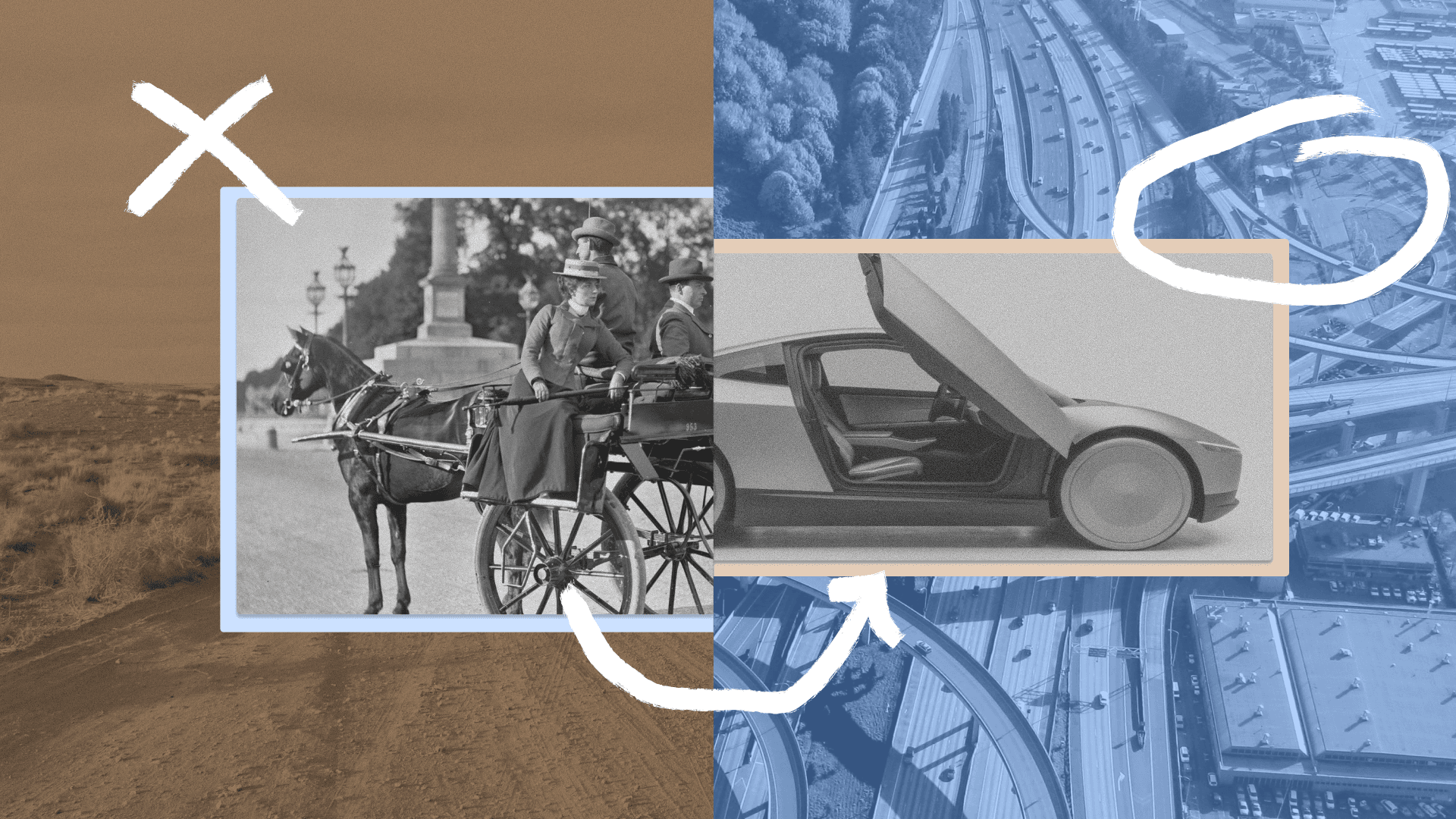
The same was true of the car. Its basic utility was immediate: it could move people farther and faster than a horse. But the larger transformation it promised required the built environment to be redesigned around it. Early automobiles entered streets built for pedestrians and horses, in cities organized around walking distance and rail. Over time, roads were paved and widened, and traffic systems and parking were added. Eventually, highways, suburbs, and new land-use patterns reshaped urban life around the assumption of widespread car ownership.

In both cases, the technology on its own was just one part of the breakthrough. The true transformation happened once people architected the surrounding system around it.

Most companies are still in the equivalent of the cars-on-dirt-roads phase of AI. AI is making many individuals meaningfully faster. But faster individuals do not automatically add up to a more productive organization, especially when the underlying structure — how decisions get made and how work flows — was built for a pre-AI world.

Are you managing the agents, or are the agents managing you?

In the emerging org, both of these shifts are happening at once. 

One set of humans is moving up the stack: designing systems, setting guardrails, and owning outcomes. At the same time, many humans are finding their work increasingly coordinated by software: scheduled, routed, and evaluated by agents rather than people. In some cases, AI can offer more consistent and personalized guidance than a human manager can.

It’s important to note that providing guidance and building relationships are different things. Guidance delivers information: the right feedback at the right time, a personalized learning path, or a well-timed nudge. A relationship creates the trust, social bonds, and sense of belonging that connects people to their work and motivates them to their best. For now, and likely for a long time, workplace relationships are still built by humans, for humans.

Taken together, these two shifts produce a flatter org chart, with fewer layers, fewer people, and a more sophisticated operating system beneath it.

The roles that remain human

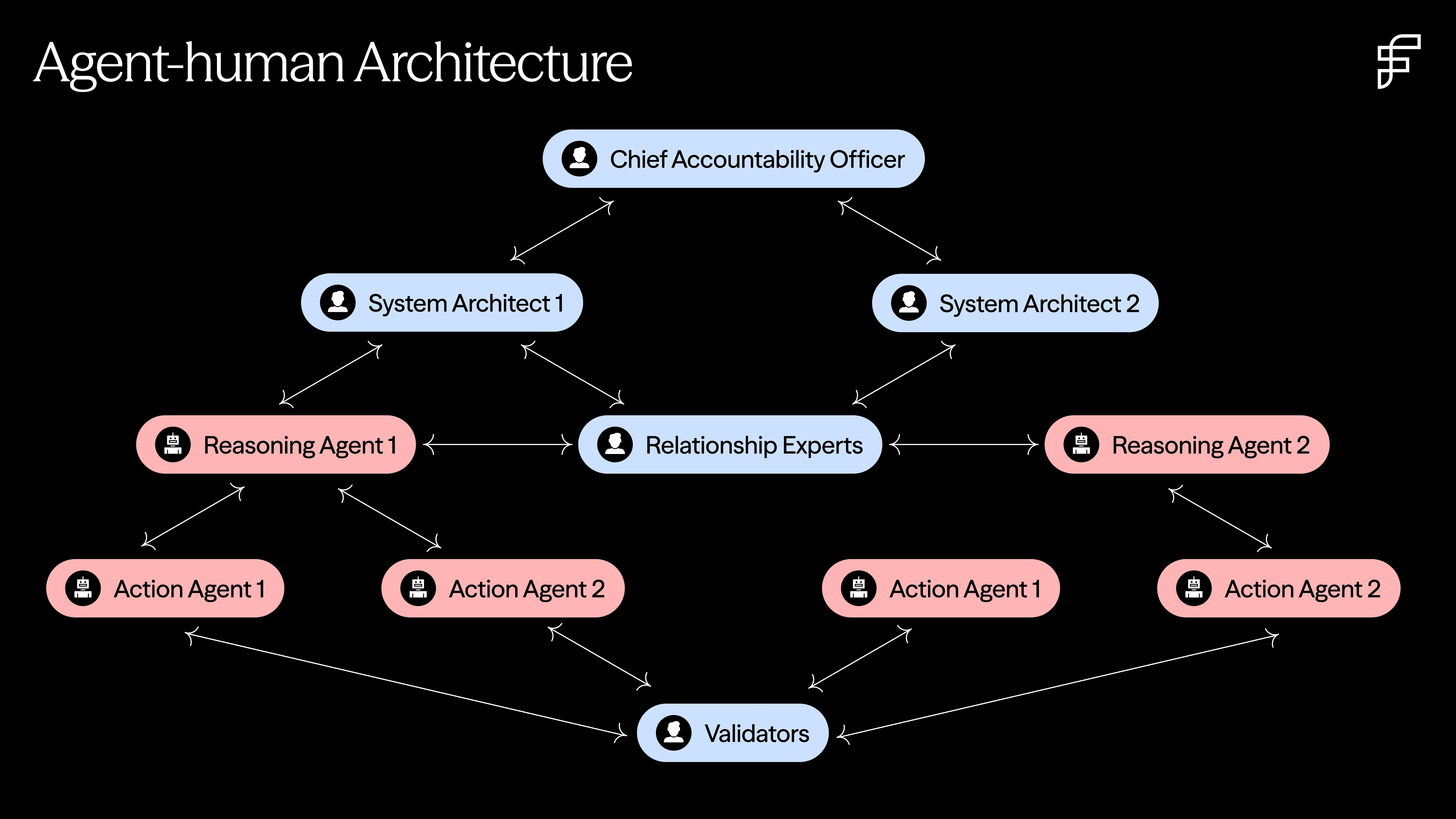
We see four broad human roles becoming more important as agents take on more of the work.
Chief accountability officers

At the very top are people who shoulder responsibility: executives who own outcomes and remain accountable when things go wrong. This includes the CFO who signs the filing, the General Counsel who appears in court, and the CTO who's accountable when the system goes down at 3 a.m. As long as regulators, courts, and boards are run by humans (and they will be for a long time), organizations need a human interface to them. Accountability is a uniquely human function, and it becomes more valuable, not less, as agents do more of the work.

This is also where we're seeing the most consolidation. To give one example, CTO and CPO roles are merging as engineering and product converge. There will be fewer distinct titles, but the ones that remain will carry significantly more weight.

Systems architects

These are the designers of the agentic org. They decide how humans and agents work together: what agents can do autonomously, what requires human approval, how performance is measured, and what the escalation paths look like when something breaks. In engineering, that means designing CI/CD pipelines and code evaluation frameworks. In GTM, it means building lead scoring models and attribution frameworks. In G&A, it means architecting compliance pipelines and financial controls.

This is the role with the steepest learning curve and the most leverage in the emerging org.

Relationship experts

These are people focused entirely on the human interface: enterprise salespeople who build trust over dinner, account managers who navigate client politics, HR leaders who coach employees and build culture, and recruiters who understand what a candidate actually wants. These roles remain human because the fundamental unit of trust between organizations is still human-to-human.

In a world where more of the analytical and operational work is automated, that human layer of trust, judgment, and interpretation becomes more differentiated, not less.

Validators

This is arguably the most important new role of this new era, and the most fast changing.

We're still in the early days of agent-human collaboration. Agents can already do a meaningful share of the work, but in most domains they still cannot be trusted to operate entirely on their own. That creates a new role for humans: reviewing, validating, and signing off on what the AI system produces.

In digital contexts, companies are hiring “validation engineers”: people who review agent-generated code, check AI-produced analyses, and verify that automated outputs meet quality standards. In physical and regulated contexts, they look more like domain experts: a doctor who reads the room, the security specialist who spots an edge case, or the policy expert who understands not just the letter of the law, but its spirit. 

In both cases, validators operate at the boundary between what the system can do and what still requires human judgment in physical, regulated, or high-stakes settings.

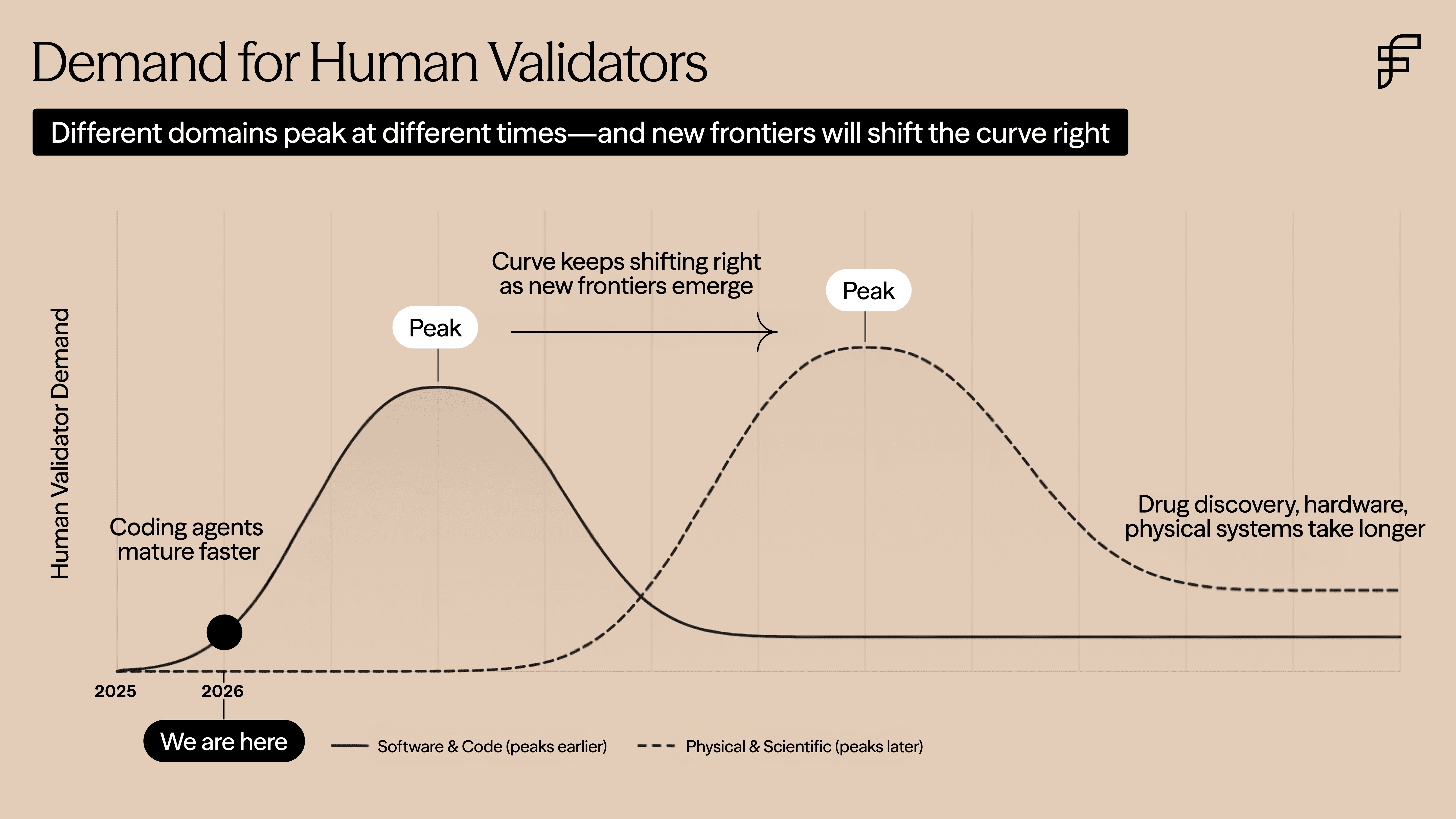
Our expectation is that demand for validators will follow a bell curve. Right now, demand is still ramping, as most companies are just beginning to deploy agents at scale. Over the next two to four years, demand will peak as agents handle more work but still aren't reliable enough to run autonomously. As these systems accumulate enough data to self-improve and self-correct, the need for human review will decline.
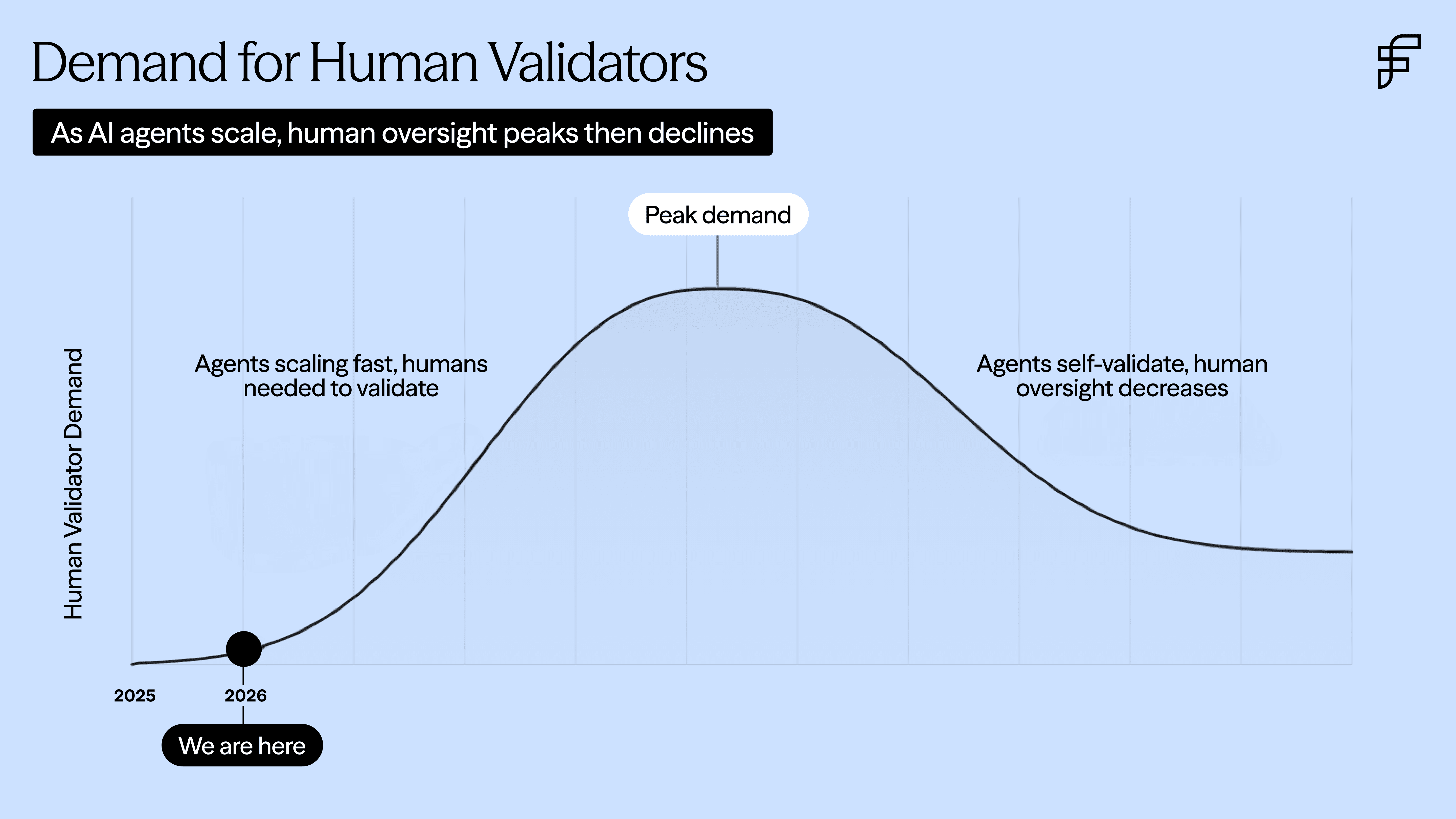
That decline doesn't mean validators disappear. The curve keeps shifting right as new domains like drug discovery, scientific research, and physical system design open up. Each new domain creates a new wave of validator demand.

This brings us to an important risk in the shift to an agent-heavy workforce: the one-generation problem. Today's validators are experts because they did the IC work themselves. But if agents handle all the junior analyst work, all the first-draft code, and all the entry-level deliverables, how does the class of 2035 build that expertise? They may never get the reps.

The validator pool is a one-generation asset unless we deliberately replenish it. It's a Russian doll: at the very end of this curve, if there are no more validators and experts, that's AGI. We don't think that happens. Humans keep evolving, the frontier keeps moving, and new domains keep creating new demands for human expertise. But the gap between "current experts retire" and "new experts emerge" is real, and it's worth taking seriously.

Four types of companies, four different futures

The great reorg will not look the same everywhere. We've found it useful to group companies along two dimensions: what they produce (product or service) and how they deliver value (digitally or in the physical world). These axes determine how much work AI can touch, and how quickly.

The human-agent balance differs by quadrant. So does the shape of the reorg: where AI enters the workflow, what part of the value chain it can absorb, and whether it changes the core work itself or focuses on everything that surrounds it.


Product

Service

Digital

e.g. Salesforce, ServiceNow, Figma

e.g. BPOs, agencies, consulting, law firms 

Physical

e.g. laptops, TVs, cars

e.g. doctors, cleaning, truck drivers, hospitality

Digital product orgs: smaller teams, higher leverage

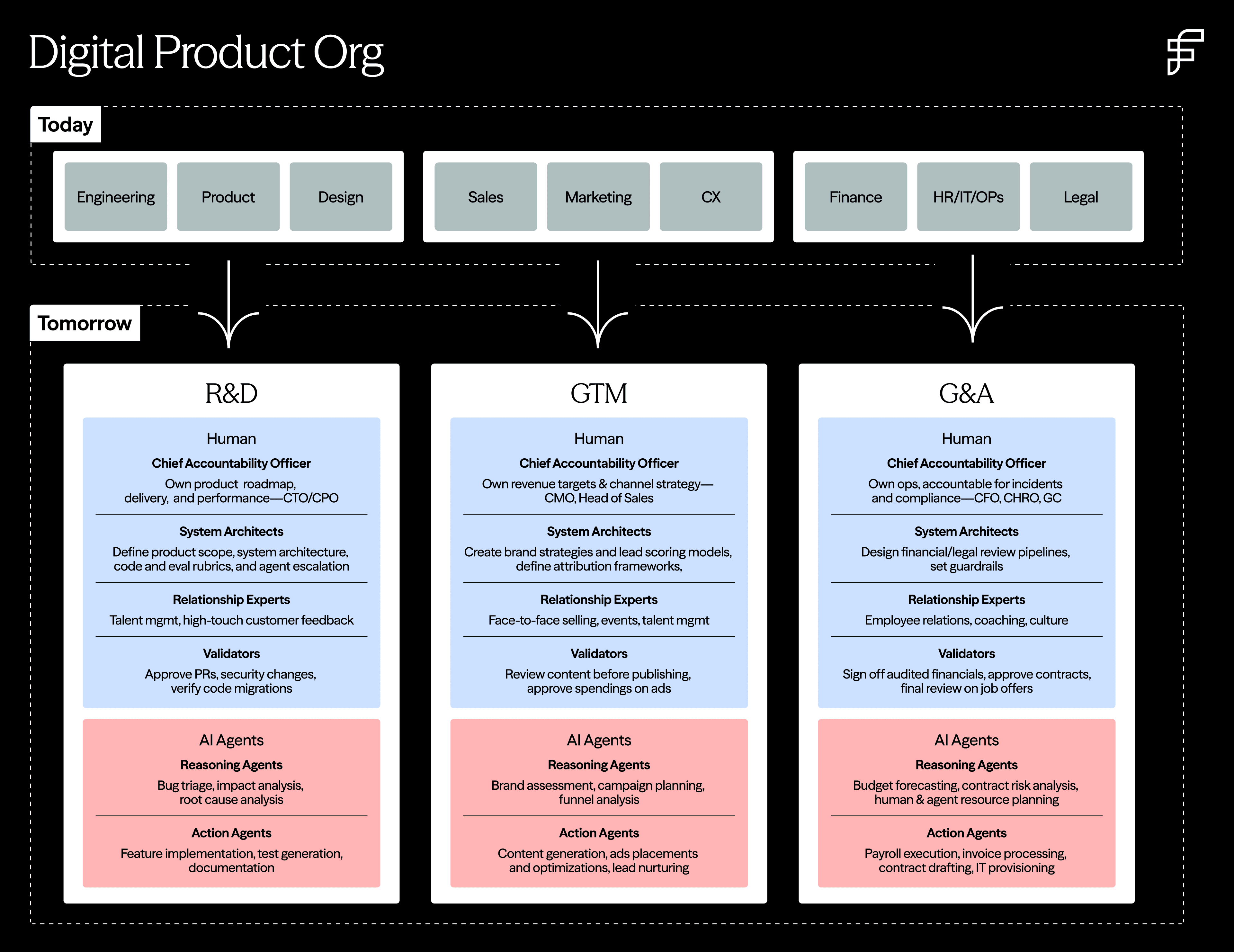
This is where the great reorg is most visible today. The legacy org structure for digital product teams — engineering, product, design, sales, marketing, CX, finance, HR, legal — is built around specialization. Each function exists because doing it well historically required dedicated people who focused on little else. So you built separate teams for each function, with handoffs and coordination structures to stitch the work back together.

AI tools upend this logic. People are able to act as generalists and are shifting into the higher-order roles described above: setting direction, designing systems, owning relationships, and validating outputs. Nine functions are collapsing into three: R&D, GTM, and G&A.

Within each function, a leaner human layer works alongside an agent layer that drafts, executes, and analyzes, with humans reviewing and approving the outputs. In R&D, reasoning agents triage bugs, run impact analyses, and investigate root causes, while action agents implement features, generate tests, and write and update documentation. In GTM, reasoning agents plan campaigns, analyze funnels, and develop brand strategy, while action agents generate content, place and optimize ads, and nurture leads. In G&A, reasoning agents forecast budgets, assess contract risk, and plan resourcing, while action agents run payroll, process invoices, draft contracts, and provision IT.

The result is a company that scales with the work rather than with headcount. The roles that stay human are more senior, more cross-functional, and more accountable than before.
Digital services orgs: agents do the work

This is the quadrant under the most immediate pressure. In digital product companies, agents help build the product. In digital services companies, the product is the work itself — and increasingly, agents are doing it. The AI system drafts the memo, processes the claim, analyzes the data, reviews the document, and produces the deliverable. Large human delivery teams shrink, and what remains is a human layer wrapped around an agentic core. 

Two human roles become especially important. The first is the relationship expert: the person who wins trust, manages the client, navigates politics, and remains the face of the service. The second is the accountability officer: the person who stands behind the output when the client is unhappy or something goes wrong.

Selling services still requires humans, even when delivering them increasingly doesn't. A buyer doesn't sign a seven-figure engagement because the AI demo went well: they sign because they trust the person across the table. That's why the human wrapper in digital services is narrower than in any other quadrant: fewer people doing the work itself, more people owning the human relationships and accountability around it.

This is also why AI-native challengers are such a threat to incumbents here. A new entrant can design the human-agent division of labor from scratch — no legacy delivery floor to restructure, no existing workforce to retrain — and compete on a cost and speed advantage that will be difficult to close.

Physical product orgs: the biggest greenfield

Physical product companies are often described as the least affected by AI. We think that undersells the opportunity.

Designing, prototyping, manufacturing, and testing physical products still requires interaction with atoms, not just bits. That makes the timeline longer and the tooling stack much less mature than in software. There's Claude Code for software development, but no equivalent universal stack yet for physical products. But that's also what makes the opportunity so large: most of the value is still ahead.

The org structure here looks similar to digital products, with the same four human roles distributed across R&D, GTM, and G&A, plus a fourth function — Supply Chain Management — that reflects the complexity of bringing physical products to market. 

The work those roles govern, however, looks quite different from digital products. System designers define how AI integrates into physical design and manufacturing processes, not just software pipelines. Validators approve prototypes and sign off on safety certifications, rather than only reviewing code.

On the agent side, agents compress the most time-intensive parts of the physical development cycle — including design feasibility, simulation, supply chain optimization, and quality control — while action agents handle the documentation and logistics work that currently consumes significant engineering bandwidth. The result is a smaller human team taking on more complex and ambitious work than before.

Physical services orgs: agents handle the overhead

In physical services, the human is the product, and the human relationship is what keeps customers sticky. A cleaner has to show up at your house. A doctor has to examine you, listen to you, and talk you through your options. A truck driver has to be behind the wheel, at least for now. The transformation here isn't about replacing the human as the service provider, but about everything that surrounds them.

Of all four quadrants, this is where "managed by agents" goes the furthest. The coordination overhead that currently surrounds service workers (scheduling, routing, paperwork, and dispatch logistics) is what agents are moving into fastest. That frees humans to focus on the work itself rather than the administrative and ops scaffolding around it.

The timelines vary significantly within this category. Truck driving has a clear path to full automation. Hospitality is a different story. In restaurants, hotels, and care settings, human interaction is central to the service. People want to feel looked after by another person, and that preference is unlikely to change, regardless of what agents can do.

Opportunities for startups

For founders and investors, the great reorg is a roadmap. Every structural shift in how organizations work produces a new generation of startups, and this one is no different

We see a few big opportunities:

1. Tools for human system architects

Every prior shift in how work gets done produced a new generation of purpose-built tools — each one helping humans interact with increasingly powerful machines more intuitively. Coding languages evolved from machine code to C++ to Python to natural language, and each layer made the builder more productive. Non-engineering tools followed the same pattern — Jira for PMs, Figma for designers, HubSpot for sales — with each one optimized for a human doing a specific kind of work.

The most powerful machine humans now need to interact with is no longer a codebase or a design file — it's a fleet of autonomous agents. And just as every prior generation of technology demanded new tools to make it usable, agents demand their own: orchestration platforms, workflow builders, and observability dashboards that let humans architect, monitor, and course-correct these systems at scale.

Arize is building one such tool. Their agent engineering platform gives human system designers the visibility and evaluation tools to understand what their agents are actually doing and improve them over time. As agent deployments scale, the ability for humans to see inside the system and course-correct becomes as essential as the agents themselves.

2. Platforms for human validators

If validator demand is about to surge, we’ll need infrastructure that makes human validation efficient, scalable, and economically viable. This includes tools that help validators check, verify, and provide feedback to agents, along with marketplaces that connect agents that need human input with pools of qualified validators.

Early versions of this are already emerging. One company in our network started as a human-facing market research platform: you'd come to them to run qualitative studies. Now they're evolving into an agent-facing validator pool. When an AI agent needs human feedback on its output, it calls human validators from their pool, their feedback flows back to the agent, and the agent iterates. Whoever aggregates the human validator pool at scale owns a category.

Turing is one example of what this infrastructure looks like in practice. Their pool of engineering experts serves as a human validation layer for the problems models still can't solve reliably, helping leading AI labs review outputs, catch edge cases, and push the frontier further.

3. Agent-native tools and infrastructure

All software in use today was built for humans. When agents use these tools (through MCP, API wrappers, or browser automation), they're navigating abstractions designed for human cognition. The overhead is measurable: an MCP tool schema can consume ~55,000 tokens just to load, while the equivalent CLI command costs ~200. Across complex workflows, this translation tax compounds fast.

Agent-native architecture skips that overhead entirely, exposing operations directly rather than wrapping them in a human interface.

This is why "incumbent tools plus MCP" isn't the endgame. MCP is becoming the standard connectivity layer, but it doesn't fix the underlying architecture. Bolting it onto Jira or Figma still routes agents through data models built for humans. For simple CRUD against systems of record, that wrapper holds — data gravity is real. But for high-frequency, agent-heavy workflows, tools built around human interaction become obstacles agents have to work around rather than with. Ground-up agent-native tools, built for agents as the primary user with human oversight as a feature, will win on raw performance.

Sixtyfour is an early, practical example. Today, tools like ZoomInfo are static databases built for human analysts to query — they sell data. Sixtyfour sells agent infrastructure: rather than exposing a fixed dataset, it gives agents the tools to proactively research people and companies across the open web and niche, hard-to-reach sources, assembling intelligence that no pre-built database would contain, at scale.

4. AI-native digital services

As we’ve described above, AI-native challengers have a structural advantage here over incumbents: they can design the human-agent division of labor from scratch, without a legacy delivery floor to unwind. The opportunity for startups is to build those challengers: AI-native versions of law firms, accounting firms, consulting firms, and agencies that start with the new org structure from day one.

ConverzAI is an early example. As an AI-native staffing agency, they use agentic voice AI to handle the high-volume work of recruiting (sourcing, screening, and coordinating candidates), while humans focus on the relationship work that still requires a person: understanding what a candidate actually wants, reading whether there's a genuine fit, and navigating the dynamics between candidate and hiring manager.

Tessera Labs is another example. Traditionally, Fortune 500 enterprises rely on large teams of system integrators (SIs) from major consulting firms to execute IT transformations — such as migrating and upgrading SAP environments. These engagements are notoriously slow and expensive, often running years and hundreds of millions of dollars. Tessera rebuilds this from scratch with an agent-first architecture: a coordinated system of specialized AI agents that autonomously handles process mining, data mapping, and harmonization — work that previously required armies of consultants. The result is a dramatically leaner, faster delivery model that doesn't just automate tasks within the old structure, but replaces the structure itself.

5. AI managers of human relationship experts

Across physical and regulated services, the most valuable professionals spend a significant portion of their time on ops and admin work. The opportunity for startups is to build the AI layer that takes on that work.

Tennr is building this layer for healthcare. Their platform automates the referral intake process, including reading faxes, parsing clinical documents, routing patients, and managing prior authorizations. Tennr now processes 10 million documents a month, with their model approved by human reviewers 97% of the time without edits. With Tennr, healthcare practices can handle more patients without growing their back-office teams.

Fulcrum is doing the same for insurance brokerages. For decades, brokerages have relied on offshore BPO partners for the operational work surrounding every client relationship, including reviewing policies for errors, generating certificates of insurance, and processing claims. Fulcrum's AI agents take over that work end-to-end directly within brokers' existing systems.

6. The AI stack for physical products

As we discussed earlier, the equivalent of Claude Code for mechanical engineering doesn't yet exist. And, unlike software, where design decisions live in version-controlled codebases that AI can read and reason over, physical product development is built on scattered context: CAD files, FEA reports, emails, review notes, and institutional knowledge that lives in engineers' heads. 

Tandem is building the knowledge layer that makes AI useful for hardware teams. Their platform integrates with existing CAD tools and captures design decisions in real time as engineers work. It also surfaces relevant requirements, past decisions, and open risks at the moment engineers need them.

7. AI-native physical services

The physical services quadrant is the furthest from full automation, but the direction of travel is clear. The near-term opportunity is in the orchestration layer: the dispatch systems, routing algorithms, scheduling infrastructure, and real-time coordination tools that currently require human ops teams.

The longer-horizon opportunity is robotics. When the physical work itself becomes automatable, the transformation of physical services will be as dramatic as what we're currently seeing in digital services.  SafelyYou is offering AI cameras to keep seniors safe and healthy, and to reduce load from caretakers.

What matters most for humans in the future

So if this is where the world is heading, what should you do about it?

We believe that the humans who thrive in this new world will share a few characteristics.

The most valuable skill in the emerging org is systems thinking: the ability to see how pieces fit together, design workflows, and architect how humans and agents collaborate. It's also the hardest to develop, because it requires both technical fluency and deep understanding of how the business actually works. The best companies we talked to aren't mandating AI adoption through training programs: they're hiring people who already think this way and letting the culture follow.

High agency and a growth mindset are also key. If your instinct is to resist and hope AI doesn't reach your function, you're already behind. The humans who thrive will be the ones who embrace reinvention and constantly experiment with new ways of working.

The org chart is being redrawn. That's unsettling for a lot of people, and understandably so. But it's also an invitation. The humans who lean in, who learn how to collaborate with agents instead of competing against them, who treat this as the beginning rather than the end of something, won't just survive the reorg. They'll be the ones who shape it.

Get insights directly to your inbox.

Set your newsletter preferences:

Set your newsletter preferences:

Posted

0 MIN READ

Show Outline

For the last two years, the AI conversation at most companies has been about individual productivity: who's using it, how much faster they're moving, and what it means for their role. That conversation is still very much alive. Alongside it, another is emerging: What happens when you use AI to make an entire organization more productive?

We talked to 25 companies, from 50-person startups to enterprises with 1,000s of employees, about exactly that. We expected to hear about specific tools and workflow improvements. What we found instead was rapidly unfolding structural change: teams rebuilding from scratch, roles merging in ways that would have seemed implausible eighteen months ago, and headcount projections that reflected fundamentally new ways of working.

A few data points:

Teams are getting dramatically smaller.

  • A 120-person engineering team at one company is planning to cut down to 25.

  • Another running 30+ microservices has gone from 0.75 engineers per service to a projected 0.1: a single engineer overseeing what used to require eight people.

The roles that remain are changing shape.

  • Organizations need fewer deep specialists and more people who can work fluidly across functions. One company we spoke to with an expert-to-generalist ratio of 1:6 today is targeting 1:25 within twelve months and 1:100 eventually.

  • At another, three traditional roles — product, engineering, and design — have collapsed into two: product builders who combine UX and product thinking, and product implementers who orchestrate coding agents and own system design.

The bar for staying is rising.

  • At a 1,000-person company, there's now a mandate called "My First Pull Request": every PM, designer, and non-engineer must ship code using AI tools. 

  • At that same company, 25-30% of product meetings now open with working prototypes instead of slide decks. The expectation has shifted from pitching ideas to demonstrating them.

  • Another large company is asking every employee, across engineering and GTM, to reinterview for their role by building an app that makes them better at their job. The distance between having an idea and seeing it work is shrinking to near zero, and the ability to close that gap is fast becoming the baseline expectation for every role. 

We believe these are early signals of a much larger shift: from organizations where individuals use AI to move faster, to organizations rebuilt around AI to move faster as a whole. Drawing on our research with the people actually driving these changes, this piece is our attempt to map that transition: which roles stay human, which move to agents, and what the org of the future actually looks like.

From more productive people to more productive orgs

This shift is hard to make, and most companies aren't there yet. It's a pattern we've seen before.

When factories first switched from steam to electricity in the 1890s, the initial productivity lift was limited. Most manufacturers kept the same factory architecture and simply swapped in the new source of power. It was only later, in the 1910s and 1920s, when manufacturers redesigned the factory around electricity — distributing power more flexibly across the floor, reorganizing workflows, and creating new roles for both workers and machines — that the gains began to materialize.

The same was true of the car. Its basic utility was immediate: it could move people farther and faster than a horse. But the larger transformation it promised required the built environment to be redesigned around it. Early automobiles entered streets built for pedestrians and horses, in cities organized around walking distance and rail. Over time, roads were paved and widened, and traffic systems and parking were added. Eventually, highways, suburbs, and new land-use patterns reshaped urban life around the assumption of widespread car ownership.

In both cases, the technology on its own was just one part of the breakthrough. The true transformation happened once people architected the surrounding system around it.

Most companies are still in the equivalent of the cars-on-dirt-roads phase of AI. AI is making many individuals meaningfully faster. But faster individuals do not automatically add up to a more productive organization, especially when the underlying structure — how decisions get made and how work flows — was built for a pre-AI world.

Are you managing the agents, or are the agents managing you?

In the emerging org, both of these shifts are happening at once. 

One set of humans is moving up the stack: designing systems, setting guardrails, and owning outcomes. At the same time, many humans are finding their work increasingly coordinated by software: scheduled, routed, and evaluated by agents rather than people. In some cases, AI can offer more consistent and personalized guidance than a human manager can.

It’s important to note that providing guidance and building relationships are different things. Guidance delivers information: the right feedback at the right time, a personalized learning path, or a well-timed nudge. A relationship creates the trust, social bonds, and sense of belonging that connects people to their work and motivates them to their best. For now, and likely for a long time, workplace relationships are still built by humans, for humans.

Taken together, these two shifts produce a flatter org chart, with fewer layers, fewer people, and a more sophisticated operating system beneath it.

The roles that remain human

We see four broad human roles becoming more important as agents take on more of the work.

Chief accountability officers

At the very top are people who shoulder responsibility: executives who own outcomes and remain accountable when things go wrong. This includes the CFO who signs the filing, the General Counsel who appears in court, and the CTO who's accountable when the system goes down at 3 a.m. As long as regulators, courts, and boards are run by humans (and they will be for a long time), organizations need a human interface to them. Accountability is a uniquely human function, and it becomes more valuable, not less, as agents do more of the work.

This is also where we're seeing the most consolidation. To give one example, CTO and CPO roles are merging as engineering and product converge. There will be fewer distinct titles, but the ones that remain will carry significantly more weight.

Systems architects

These are the designers of the agentic org. They decide how humans and agents work together: what agents can do autonomously, what requires human approval, how performance is measured, and what the escalation paths look like when something breaks. In engineering, that means designing CI/CD pipelines and code evaluation frameworks. In GTM, it means building lead scoring models and attribution frameworks. In G&A, it means architecting compliance pipelines and financial controls.

This is the role with the steepest learning curve and the most leverage in the emerging org.

Relationship experts

These are people focused entirely on the human interface: enterprise salespeople who build trust over dinner, account managers who navigate client politics, HR leaders who coach employees and build culture, and recruiters who understand what a candidate actually wants. These roles remain human because the fundamental unit of trust between organizations is still human-to-human.

In a world where more of the analytical and operational work is automated, that human layer of trust, judgment, and interpretation becomes more differentiated, not less.

Validators

This is arguably the most important new role of this new era, and the most fast changing.

We're still in the early days of agent-human collaboration. Agents can already do a meaningful share of the work, but in most domains they still cannot be trusted to operate entirely on their own. That creates a new role for humans: reviewing, validating, and signing off on what the AI system produces.

In digital contexts, companies are hiring “validation engineers”: people who review agent-generated code, check AI-produced analyses, and verify that automated outputs meet quality standards. In physical and regulated contexts, they look more like domain experts: a doctor who reads the room, the security specialist who spots an edge case, or the policy expert who understands not just the letter of the law, but its spirit. 

In both cases, validators operate at the boundary between what the system can do and what still requires human judgment in physical, regulated, or high-stakes settings.

Our expectation is that demand for validators will follow a bell curve. Right now, demand is still ramping, as most companies are just beginning to deploy agents at scale. Over the next two to four years, demand will peak as agents handle more work but still aren't reliable enough to run autonomously. As these systems accumulate enough data to self-improve and self-correct, the need for human review will decline.

That decline doesn't mean validators disappear. The curve keeps shifting right as new domains like drug discovery, scientific research, and physical system design open up. Each new domain creates a new wave of validator demand.


This brings us to an important risk in the shift to an agent-heavy workforce: the one-generation problem. Today's validators are experts because they did the IC work themselves. But if agents handle all the junior analyst work, all the first-draft code, and all the entry-level deliverables, how does the class of 2035 build that expertise? They may never get the reps.

The validator pool is a one-generation asset unless we deliberately replenish it. It's a Russian doll: at the very end of this curve, if there are no more validators and experts, that's AGI. We don't think that happens. Humans keep evolving, the frontier keeps moving, and new domains keep creating new demands for human expertise. But the gap between "current experts retire" and "new experts emerge" is real, and it's worth taking seriously.

Four types of companies, four different futures

The great reorg will not look the same everywhere. We've found it useful to group companies along two dimensions: what they produce (product or service) and how they deliver value (digitally or in the physical world). These axes determine how much work AI can touch, and how quickly.

The human-agent balance differs by quadrant. So does the shape of the reorg: where AI enters the workflow, what part of the value chain it can absorb, and whether it changes the core work itself or focuses on everything that surrounds it.


Product

Service

Digital

e.g. Salesforce, ServiceNow, Figma

e.g. BPOs, agencies, consulting, law firms 

Physical

e.g. laptops, TVs, cars

e.g. doctors, cleaning, truck drivers, hospitality

Digital product orgs: smaller teams, higher leverage

This is where the great reorg is most visible today. The legacy org structure for digital product teams — engineering, product, design, sales, marketing, CX, finance, HR, legal — is built around specialization. Each function exists because doing it well historically required dedicated people who focused on little else. So you built separate teams for each function, with handoffs and coordination structures to stitch the work back together.

AI tools upend this logic. People are able to act as generalists and are shifting into the higher-order roles described above: setting direction, designing systems, owning relationships, and validating outputs. Nine functions are collapsing into three: R&D, GTM, and G&A.

Within each function, a leaner human layer works alongside an agent layer that drafts, executes, and analyzes, with humans reviewing and approving the outputs. In R&D, reasoning agents triage bugs, run impact analyses, and investigate root causes, while action agents implement features, generate tests, and write and update documentation. In GTM, reasoning agents plan campaigns, analyze funnels, and develop brand strategy, while action agents generate content, place and optimize ads, and nurture leads. In G&A, reasoning agents forecast budgets, assess contract risk, and plan resourcing, while action agents run payroll, process invoices, draft contracts, and provision IT.

The result is a company that scales with the work rather than with headcount. The roles that stay human are more senior, more cross-functional, and more accountable than before.

Digital services orgs: agents do the work

This is the quadrant under the most immediate pressure. In digital product companies, agents help build the product. In digital services companies, the product is the work itself — and increasingly, agents are doing it. The AI system drafts the memo, processes the claim, analyzes the data, reviews the document, and produces the deliverable. Large human delivery teams shrink, and what remains is a human layer wrapped around an agentic core. 

Two human roles become especially important. The first is the relationship expert: the person who wins trust, manages the client, navigates politics, and remains the face of the service. The second is the accountability officer: the person who stands behind the output when the client is unhappy or something goes wrong.

Selling services still requires humans, even when delivering them increasingly doesn't. A buyer doesn't sign a seven-figure engagement because the AI demo went well: they sign because they trust the person across the table. That's why the human wrapper in digital services is narrower than in any other quadrant: fewer people doing the work itself, more people owning the human relationships and accountability around it.

This is also why AI-native challengers are such a threat to incumbents here. A new entrant can design the human-agent division of labor from scratch — no legacy delivery floor to restructure, no existing workforce to retrain — and compete on a cost and speed advantage that will be difficult to close.

Physical product orgs: the biggest greenfield

Physical product companies are often described as the least affected by AI. We think that undersells the opportunity.

Designing, prototyping, manufacturing, and testing physical products still requires interaction with atoms, not just bits. That makes the timeline longer and the tooling stack much less mature than in software. There's Claude Code for software development, but no equivalent universal stack yet for physical products. But that's also what makes the opportunity so large: most of the value is still ahead.

The org structure here looks similar to digital products, with the same four human roles distributed across R&D, GTM, and G&A, plus a fourth function — Supply Chain Management — that reflects the complexity of bringing physical products to market. 

The work those roles govern, however, looks quite different from digital products. System designers define how AI integrates into physical design and manufacturing processes, not just software pipelines. Validators approve prototypes and sign off on safety certifications, rather than only reviewing code.

On the agent side, agents compress the most time-intensive parts of the physical development cycle — including design feasibility, simulation, supply chain optimization, and quality control — while action agents handle the documentation and logistics work that currently consumes significant engineering bandwidth. The result is a smaller human team taking on more complex and ambitious work than before.

Physical services orgs: agents handle the overhead

In physical services, the human is the product, and the human relationship is what keeps customers sticky. A cleaner has to show up at your house. A doctor has to examine you, listen to you, and talk you through your options. A truck driver has to be behind the wheel, at least for now. The transformation here isn't about replacing the human as the service provider, but about everything that surrounds them.

Of all four quadrants, this is where "managed by agents" goes the furthest. The coordination overhead that currently surrounds service workers (scheduling, routing, paperwork, and dispatch logistics) is what agents are moving into fastest. That frees humans to focus on the work itself rather than the administrative and ops scaffolding around it.

The timelines vary significantly within this category. Truck driving has a clear path to full automation. Hospitality is a different story. In restaurants, hotels, and care settings, human interaction is central to the service. People want to feel looked after by another person, and that preference is unlikely to change, regardless of what agents can do.

Opportunities for startups

For founders and investors, the great reorg is a roadmap. Every structural shift in how organizations work produces a new generation of startups, and this one is no different

We see a few big opportunities:

1. Tools for human system architects

Every prior shift in how work gets done produced a new generation of purpose-built tools — each one helping humans interact with increasingly powerful machines more intuitively. Coding languages evolved from machine code to C++ to Python to natural language, and each layer made the builder more productive. Non-engineering tools followed the same pattern — Jira for PMs, Figma for designers, HubSpot for sales — with each one optimized for a human doing a specific kind of work.

The most powerful machine humans now need to interact with is no longer a codebase or a design file — it's a fleet of autonomous agents. And just as every prior generation of technology demanded new tools to make it usable, agents demand their own: orchestration platforms, workflow builders, and observability dashboards that let humans architect, monitor, and course-correct these systems at scale.

Arize is building one such tool. Their agent engineering platform gives human system designers the visibility and evaluation tools to understand what their agents are actually doing and improve them over time. As agent deployments scale, the ability for humans to see inside the system and course-correct becomes as essential as the agents themselves.

2. Platforms for human validators

If validator demand is about to surge, we’ll need infrastructure that makes human validation efficient, scalable, and economically viable. This includes tools that help validators check, verify, and provide feedback to agents, along with marketplaces that connect agents that need human input with pools of qualified validators.

Early versions of this are already emerging. One company in our network started as a human-facing market research platform: you'd come to them to run qualitative studies. Now they're evolving into an agent-facing validator pool. When an AI agent needs human feedback on its output, it calls human validators from their pool, their feedback flows back to the agent, and the agent iterates. Whoever aggregates the human validator pool at scale owns a category.

Turing is one example of what this infrastructure looks like in practice. Their pool of engineering experts serves as a human validation layer for the problems models still can't solve reliably, helping leading AI labs review outputs, catch edge cases, and push the frontier further.

3. Agent-native tools and infrastructure

All software in use today was built for humans. When agents use these tools (through MCP, API wrappers, or browser automation), they're navigating abstractions designed for human cognition. The overhead is measurable: an MCP tool schema can consume ~55,000 tokens just to load, while the equivalent CLI command costs ~200. Across complex workflows, this translation tax compounds fast.

Agent-native architecture skips that overhead entirely, exposing operations directly rather than wrapping them in a human interface.

This is why "incumbent tools plus MCP" isn't the endgame. MCP is becoming the standard connectivity layer, but it doesn't fix the underlying architecture. Bolting it onto Jira or Figma still routes agents through data models built for humans. For simple CRUD against systems of record, that wrapper holds — data gravity is real. But for high-frequency, agent-heavy workflows, tools built around human interaction become obstacles agents have to work around rather than with. Ground-up agent-native tools, built for agents as the primary user with human oversight as a feature, will win on raw performance.

Sixtyfour is an early, practical example. Today, tools like ZoomInfo are static databases built for human analysts to query — they sell data. Sixtyfour sells agent infrastructure: rather than exposing a fixed dataset, it gives agents the tools to proactively research people and companies across the open web and niche, hard-to-reach sources, assembling intelligence that no pre-built database would contain, at scale.

4. AI-native digital services

As we’ve described above, AI-native challengers have a structural advantage here over incumbents: they can design the human-agent division of labor from scratch, without a legacy delivery floor to unwind. The opportunity for startups is to build those challengers: AI-native versions of law firms, accounting firms, consulting firms, and agencies that start with the new org structure from day one.

ConverzAI is an early example. As an AI-native staffing agency, they use agentic voice AI to handle the high-volume work of recruiting (sourcing, screening, and coordinating candidates), while humans focus on the relationship work that still requires a person: understanding what a candidate actually wants, reading whether there's a genuine fit, and navigating the dynamics between candidate and hiring manager.

Tessera Labs is another example. Traditionally, Fortune 500 enterprises rely on large teams of system integrators (SIs) from major consulting firms to execute IT transformations — such as migrating and upgrading SAP environments. These engagements are notoriously slow and expensive, often running years and hundreds of millions of dollars. Tessera rebuilds this from scratch with an agent-first architecture: a coordinated system of specialized AI agents that autonomously handles process mining, data mapping, and harmonization — work that previously required armies of consultants. The result is a dramatically leaner, faster delivery model that doesn't just automate tasks within the old structure, but replaces the structure itself.

5. AI managers of human relationship experts

Across physical and regulated services, the most valuable professionals spend a significant portion of their time on ops and admin work. The opportunity for startups is to build the AI layer that takes on that work.

Tennr is building this layer for healthcare. Their platform automates the referral intake process, including reading faxes, parsing clinical documents, routing patients, and managing prior authorizations. Tennr now processes 10 million documents a month, with their model approved by human reviewers 97% of the time without edits. With Tennr, healthcare practices can handle more patients without growing their back-office teams.

Fulcrum is doing the same for insurance brokerages. For decades, brokerages have relied on offshore BPO partners for the operational work surrounding every client relationship, including reviewing policies for errors, generating certificates of insurance, and processing claims. Fulcrum's AI agents take over that work end-to-end directly within brokers' existing systems.

6. The AI stack for physical products

As we discussed earlier, the equivalent of Claude Code for mechanical engineering doesn't yet exist. And, unlike software, where design decisions live in version-controlled codebases that AI can read and reason over, physical product development is built on scattered context: CAD files, FEA reports, emails, review notes, and institutional knowledge that lives in engineers' heads. 

Tandem is building the knowledge layer that makes AI useful for hardware teams. Their platform integrates with existing CAD tools and captures design decisions in real time as engineers work. It also surfaces relevant requirements, past decisions, and open risks at the moment engineers need them.

7. AI-native physical services

The physical services quadrant is the furthest from full automation, but the direction of travel is clear. The near-term opportunity is in the orchestration layer: the dispatch systems, routing algorithms, scheduling infrastructure, and real-time coordination tools that currently require human ops teams.

The longer-horizon opportunity is robotics. When the physical work itself becomes automatable, the transformation of physical services will be as dramatic as what we're currently seeing in digital services.  SafelyYou is offering AI cameras to keep seniors safe and healthy, and to reduce load from caretakers.

What matters most for humans in the future

So if this is where the world is heading, what should you do about it?

We believe that the humans who thrive in this new world will share a few characteristics.

The most valuable skill in the emerging org is systems thinking: the ability to see how pieces fit together, design workflows, and architect how humans and agents collaborate. It's also the hardest to develop, because it requires both technical fluency and deep understanding of how the business actually works. The best companies we talked to aren't mandating AI adoption through training programs: they're hiring people who already think this way and letting the culture follow.

High agency and a growth mindset are also key. If your instinct is to resist and hope AI doesn't reach your function, you're already behind. The humans who thrive will be the ones who embrace reinvention and constantly experiment with new ways of working.

The org chart is being redrawn. That's unsettling for a lot of people, and understandably so. But it's also an invitation. The humans who lean in, who learn how to collaborate with agents instead of competing against them, who treat this as the beginning rather than the end of something, won't just survive the reorg. They'll be the ones who shape it.

Get insights directly to your inbox.

Set your newsletter preferences:

Get insights directly to your inbox.

Set your newsletter preferences:

Set your newsletter preferences: