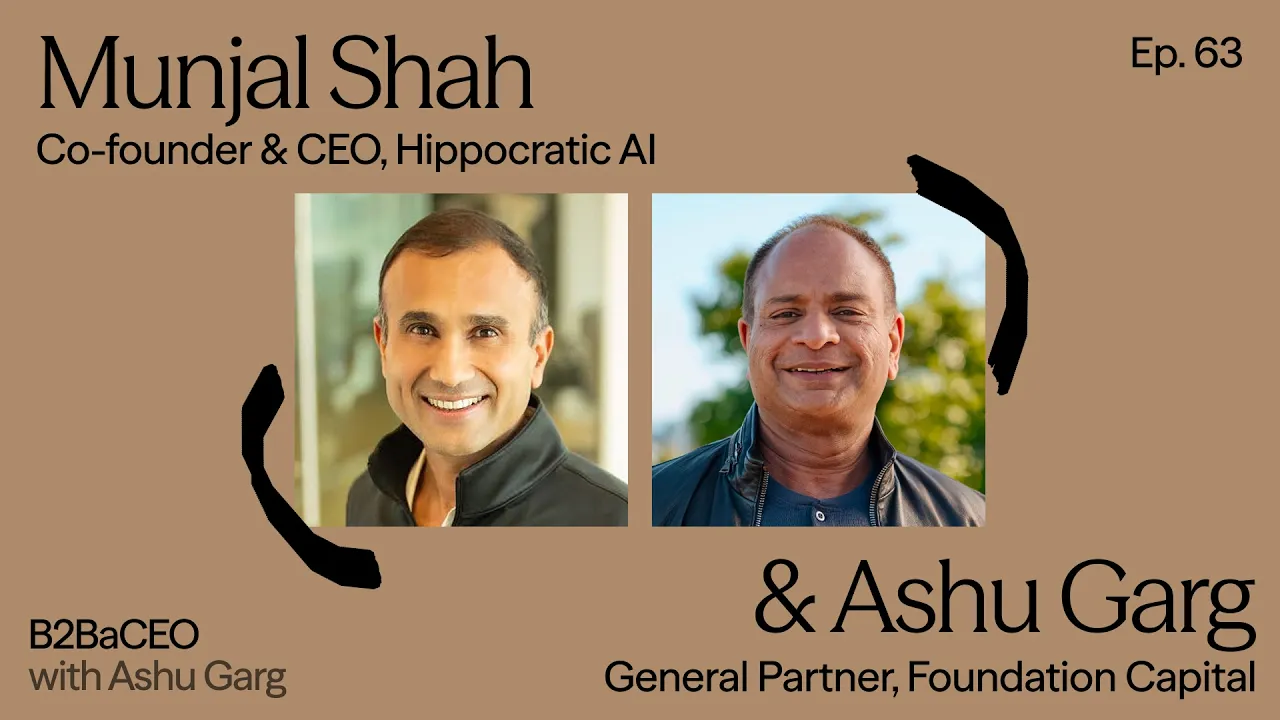
Why vertical AI apps will win | Munjal Shah, Co-founder and CEO, Hippocratic AI

0 MIN READ
0 MIN READ

Show Outline

Posted

Healthcare has always been built on scarcity. Throughout human history, there have never been enough doctors and nurses to meet demand, so care gets rationed. Today, we’re entering a platform shift as AI pushes the cost of clinical work toward zero.

Munjal Shah, co-founder and CEO of Hippocratic AI, joins me to talk about building safe clinical AI agents, why vertical apps will beat one-size-fits-all models, and his biggest lessons as a four-time founder.

Hippocratic AI builds clinical voice agents that talk to patients by phone for health systems, payers, and pharma companies, and has already handled over 290M patient interactions. Safety was a priority for Munjal, and the company waited 18 months to ship until its agents tested safer than human nurses. 

As a founder, Munjal has ridden each major platform shift. He sold his first company to Alibaba and his second to Google. His next venture, a decade-long healthcare startup, didn’t succeed. Rather than end on a loss, he started Hippocratic weeks after seeing ChatGPT. “Wait and wait and wait until you see a forest fire, and then start a company,” he advises.

As a founder, Munjal argues for building a bigger founding team even at the cost of more equity. He also makes the case that AI safety is an engineering problem, and that the companies shipping AI should own the risks of what they ship.

We end with his hard-earned advice for founders building in AI: find a corner of the market where the big players’ design constraints don’t fit and run into the vertical as fast as you can. The best openings are in the “troughs,” the places where today’s frontier models still fall short.

What we covered:

00:00 – Cold open
00:55 – What Hippocratic AI does
01:25 – Munjal’s founder journey
05:13 – Why founders should wait for their “forest fire” moment
08:15 – Lessons learned across four startups
14:23 – Creating culture by design
16:10 – If you don’t think it’s safe, don’t ship it
23:52 – Why AI labs’ messaging feels contradictory
25:30 – Second-order effects and why AI predictions miss them
26:30 – Saving $400K by moving to open source.
31:50 – Why vertical AI will win
35:15 – Targeting the “troughs” in jagged AI intelligence
37:12 – The Copilot, Autopilot, Infinite Pilot framework
39:40 – The abundance revolution

Read the transcript:

Munjal: I used to think the key to building a company is to find product-market fit. If you take this forest analogy, you're looking for the place in the forest where a big tree's fallen down and the sunlight can now hit the ground again. But the problem with that is, as soon as you grow your tree, you quickly hit the other trees that didn't fall down around you. You saw this with enterprise SaaS. You have so many companies you can barely tell them apart.

But then I realized, actually, once every seven to 10 years there's just a forest fire, and it burns every last big tree, and almost anything you plant's going to work. The opportunities to create companies are not equal at all epochs of the technology journey. There's way more opportunity when a forest fire comes through. That was mobile, that was SaaS, that was social on the consumer side, that was the internet, and now that's gen AI.

Ashu: Welcome to the pod, Munjal.

Munjal: Hey, thanks for having me. I'm so excited we could do this.

Ashu: Tell us a little bit about Hippocratic AI.

Munjal: At Hippocratic AI, we build clinical voice agents that talk to patients on the phone. We do that for health systems, payers, and pharma clients. Our goal is really to bring healthcare abundance to the world by enabling more people to have access to healthcare.

Ashu: Super cool. We'll come back to the details of that story in a minute, but before we zoom in, take us back to your founder journey. I think this is your third, or perhaps even... I've known you for three startups.

Munjal: It's my fourth. The first one, I built a company that we eventually sold to Alibaba. The second one was a company I built and sold to Google. The day after I sold that company, I was on a run, ended up with chest pains, and ended up in the ER. So what should have been the best day of my work career ended up not so good. Then I lost 40 pounds, changed my health, and said, "If I'm gonna build another company, I'm gonna do a healthcare company." I spent 10 years building a healthcare company, more than a software or AI company, where the previous ones had been AI, and I realized, man, healthcare is hard. That company did not end up as successful. And honestly, after all of that, I said, "Gosh, am I really gonna end on a loss? Am I gonna stop building companies and just ride my bike and do the things I love?" And I said, "No. No way I'm ending on a loss. I'm gonna build one more company. But I'm gonna go back to my roots and focus on building an AI company that happens to be in healthcare, rather than the other way around." Then I saw ChatGPT and said, "This is the AI I've been waiting for my whole life." So we started the company in February, March of '23.

Ashu: I remember telling you to take a few months off, and I think you started the company within weeks.

Munjal: Yeah. Actually, I think I was working on ideas partly in your office. You guys had been nice enough to give us a little space. I just recognized that this was the next wave and I had to jump on it. When opportunity knocks, you don't really get the luxury of saying, "No, come back later. I'm not ready for you yet." When opportunity knocks, you've gotta run.

About Ashu

Ashu is a Partner at Foundation Capital, investing in enterprise software with a focus on AI, data infrastructure, and cybersecurity. An early investor in Databricks, Cohesity, Eightfold, and Anyscale, he helps technical founders find product-market fit and scale. Previously, he held leadership roles at Microsoft, McKinsey & Company, and Cadence Design Systems.

Ashu: Let's drill into the why now a little bit. Clearly there was something you saw at that moment in time. You'd had a passion for healthcare since your prior company. But what was it that told you that now is the time, and that even waiting a couple of months was the wrong thing to do?

Munjal: Well, there's the answer I was thinking at the time, and then there's the answer I give now, because you always figure things out a little along the way. When we started, I just knew the world had never seen AI this smart, this general, and this flexible. We had seen classifier AI, which is what I call an idiot savant. It did the one thing you trained it to do, and it couldn't do anything else unless you trained it again. Instead, for the first time, we had this general intelligence that could do lots of different things with just the change of a prompt. That wowed me, and frankly it wowed the whole world. I wasn't the only one who had that insight. But I knew we should apply it to healthcare, and that somebody needed to. It wasn't any more complex than that when we started. Further down the journey, we realized other insights that led us to building clinical voice agents for healthcare, and all the other decisions you need to make to fine-tune an idea. But the beginning was just, "Oh my God, there is this new capability in the world, and we need to run."

Ashu: And it was the general-purpose ability, which really resonates. You and I have both been around machine learning for more than 20 years, but it's always been so narrow...

Munjal: And brittle.

Ashu: ...and costly, and the constraints were hard. Post-ChatGPT and LLMs, everything changed, and you saw that.

Munjal: I've also learned throughout my career what I call my forest fire analogy. I used to think the key to building a company is to find product-market fit. If you take this forest analogy, you're looking for the place in the forest where a big tree's fallen down and the sunlight can now hit the ground again, because otherwise the big trees block it out. But the problem with that is, as soon as you grow your tree, you quickly hit the other trees that didn't fall down around you. You saw this with enterprise SaaS. You have so many companies you can barely tell them apart.

Ashu: Yeah.

Munjal: But then I realized, actually, once every seven to 10 years there's just a forest fire, and it burns every last big tree, and almost anything you plant's going to work. If I were to give my younger self one piece of advice, I would say wait and wait and wait until you see a forest fire, and then start a company. The opportunities to create companies are not equal at all epochs of the technology journey. There's way more opportunity when a forest fire comes through. That was mobile, that was SaaS, that was social on the consumer side, that was the internet, and now that's gen AI.

Ashu: As context for the next couple of questions, could you take 30 seconds and talk about where the company is today? It's only been three and a half years since you started Hippocratic, and then we can compare and contrast the success you've had here with earlier experiences and what you've done differently.

Munjal: Yeah, I'll give you the different metrics. The company today is about 300 people. We've raised about $450 million. We launched the product only about 21 months ago, and we'll talk about why we didn't ship for the first 18 months when we got into safety. We've seen tremendous uptake. We sell a clinical agent for one-tenth the price of the human equivalent, so it hasn't been tough to get things moving, although later we should talk about the counterintuitive insight we found on which use cases are working and which aren't. We've now done 290 million patient interactions. We've sold to 50 health systems. We've got five of the top seven payers and seven of the top 20 pharma companies. It's been quite the journey building out the company and rolling it out, and to your point, we've done that without any significant safety issues, which is really the standard we hold ourselves to.

Ashu: It feels like a decade compressed into three and a half years, which in some ways is what we're experiencing across the AI universe.

Munjal: Oh, it's so crazy. You say, "Wow, it seems like you've gone so fast," and I sit in my office every day going, "Why are we going so slow?"

Ashu: I have companies that have gone from zero to $10 million in a year, and when I've taken them out to other investors for fundraising, the question is, "Why haven't they gone from zero to $100 million in a year?"

Munjal: Right. Yeah.

Ashu: Just because one or two companies have. It's definitely a crazy time. It'd be great for you to share some of the lessons from your prior three experiences that have shaped your approach this time. What's the same, and what are you doing differently?

Munjal: When I look at what I did the same and differently, startups one, two, and four have commonalities: go after tech, build deep tech, always keep innovating at the technology level, and try to find ways to improve the product at every layer of the stack. Don't just build an application, so to speak. Actually find deep tech you can build. All three of those also rode a megatrend, to my forest fire analogy. The first one was the internet in general. The second one was the rise of digital photos, which allowed for a whole new level of image search and merchandising. And the fourth one, obviously, is gen AI. So first: ride a wave, because you can never paddle your surfboard fast enough. You need a megatrend to push you along. That's a commonality across the ones that succeeded.

The other one is to build a deep technical team that can really innovate at multiple layers in the stack. Weirdly, there's a lot of talk about "follow your passion." In that third one, I followed my passion. I had a personal experience that drove it. It made for a great founder story. It just didn't make for a great business. So I'd counterintuitively say: follow a good technology platform shift with a mission you care about, but don't necessarily go all in on your passion, because sometimes it can lead you astray. I know that isn't always a popular thing to hear, but that's my experience.

Ashu: For all of us who grew up in technology, we forget how lucky we are that we get to deal with bits and bytes. The moment you get into the world of atoms, and that's not to say there aren't opportunities, the world of atoms is very different.

Munjal: That's right.

Ashu: The real world has very different unit economics and very different incumbent advantages that we don't always appreciate sitting in Silicon Valley.

Munjal: Yeah, there's a reason the Mag 7 is, what, 30% of the market cap of the entire stock market, and all of tech is about 50%. This is where a lot of the value is going to be created, and if you buck that trend, it's really hard. Another thing I'd carry through across all four: build the best founding team you can. I also did something counterintuitive here. I always built larger founding teams. Even though it meant sharing more equity, my view was that you're not optimizing for ownership, you're optimizing for probability of success, and it's really hard to hire people who care at the same level a founder or co-founder does. So I always ask, "Can you get a founding team big enough to get you to the first milestone without hiring risk?" If you can, even if you have to give up some extra equity, that's okay. These things are either worth something or worth nothing, and that matters more than exactly how much you own.

Ashu: Very well said. In particular, a lot of people have this notion of being a solo founder, and there are successful solo founders, no doubt about it. But everything is so much easier when you have three or four people or more, like Databricks' founders, who really feel founder-level ownership of the company and its success.

Munjal: I've done 50-plus angel investments. Some have turned out extremely well. In zero cases have my solo-founder ones turned out well. I'm sure it does work; obviously it does. But I always believe your first test is: can you get somebody else to join you on a journey when you have nothing to offer them? You can't pay them. You can't do anything for them. If you can't persuade at least one or two people, it doesn't bode well for all the persuading you'll have to do as you build a company.

Ashu: Very well said. I want to build on this. So many of the founders who listen to this pod are very technical, first-time founders, learning to become CEOs and learning to build companies. What are some other lessons about building culture, leadership, and team that you think are relevant, especially today?

Munjal: Get the absolute smartest people to join you. Hire people smarter than you, and really do not compromise. It's always a downward slope from the founding team, so get the absolute best. The founding team for the company I sold to Google: one of the guys, Vineet, who actually introduced you and me, was number one on the IIT entrance exam out of the whole country. The other, Burak, was number four on the college entrance exam out of the whole country of Turkey. They published it in the newspaper. And then he finished his Stanford PhD in the fastest time in the history of the CS department up to that point. These were my two co-founders. Even in this one, my co-founder Subbu did his undergrad at IIT, did his PhD at Max Planck, and was the lead author on the Orca instruction-tuning paper, one of the earliest and most seminal fine-tuning papers for LLMs. And Meenesh, my co-founder on the clinical side, is a Johns Hopkins-trained doctor and one of the smartest people I know. He and I actually grew up together. He was running El Camino Hospital, down the street from us, as COO, and had been an ER doc for many years. In his own right, he was quite accomplished in the medical field. That's the set of folks you need to build a company like Hippocratic, and I'd always recommend you find the absolute best you can.

Ashu: I couldn't agree more. That starting point is the raw material: find the best raw material you can in terms of people. Let's assume someone's done that. What else has worked for you in building culture and growing as a leader? Some of those lessons are probably mistakes you made a couple of companies ago.

Insights for technical founders on the path to CEO.

Learn how to build and scale an enduring company from Ashu and leading founder-CEOs.

Munjal: Yeah. Look at how I named this company. We didn't call it "something Health." We called it Hippocratic, after the Hippocratic Oath. People ask, "How committed are you to safety?" I say, "I named it Hippocratic. I made the tagline 'Do no harm.' I don't know how else to say it." People say, "Here are our company values." I say, "The number one thing anybody knows about your company is its name." If you can get the values into the name, it almost self-reinforces. It's like any good religion. Religions have the values they impart, and then they have ceremonies to reinforce those values. So at Hippocratic, every single employee, on their first day of work, in front of the whole company, has to take the Hippocratic Oath. It's a modified version that says "Put patients first," but it's not dissimilar. 

We have that bit of ceremony on purpose, because when you make a commitment in front of people, it has a different gravitas than signing a piece of paper in DocuSign, or just saying, "Yeah, I agree with the values I see on the wall." We took that very seriously from day one. We talk about it. We keep telling stories about it. We play de-identified patient calls so people can hear the voice of what patients are struggling with. That's part of how you do it.

The CEO's job is also to keep driving those values, so I always make sure that's safety. But I've also set up the company structurally around safety. Meenesh, as clinical lead, is the safety lead, and he can pull the ripcord and stop the company at any time. He can go directly to the board, around me, on any safety issue. So we've set up a number of systems. We decided not to launch the product for 18 months, until it was as safe as a human. We could have chosen otherwise, but we said, "I don't care what commercial or competitive disadvantage this puts us at. We're not shipping until we're as safe as a human." And we had a way to benchmark that. It was our biggest testament.

Ashu: Startups are all about speed and beating the competition to market, and you chose not to. You chose to focus on safety. And you made a very interesting comment: you decided to create a benchmark of what safety means against a human, a registered nurse or whoever the human equivalent of your AI agent would be. Tell me more about that.

Munjal: Our way of testing the product and making it safe had four parts. First, we chose the scope, what we call our Goldilocks zone. We wanted it to be the scope of an RN, a registered nurse, who does not diagnose and does not prescribe. We said, "Don't be a doctor." We also said, "Don't just do admin," because that would be too easy for everybody to copy. So scope is one thing. We also said we're not going to do kids under two, high-risk pregnancies, mental health, et cetera. Second, we said, "Build more than one LLM." Our system is actually 31 LLMs that work together: the main LLM talks, and 30 supervise. It's a very unique architecture, and we patented it. We've been able to benchmark and show that it's safer than one LLM, no matter how big that LLM is. Third, we said we'd be the only ones to do output testing. Output testing says you don't know whether an LLM is safe just because of what you trained it on.

People always ask, "What did you train your model on, so I can decide it's safe?" I say, "What does that tell you? These are black boxes. They do all kinds of things." The FDA doesn't approve your drug because you followed a certain process to make it. It looks at the output of your drug. So we built a framework: hire 7,000 U.S.-licensed nurses through a gig app we built. Verify their nursing license and physician numbers. Have them call the AI, act as a patient, test every use case and every new model, and mark every error it makes. One out of 50 times, put a human nurse on the other end of the line, have them mark the errors the human makes, and only ship when the AI is safer than the human. 

We've now spent $40 million of the money we've raised on output testing. It's a hefty investment, and every new model and every new use case goes through it. On top of that, we listen to the first thousand calls of every new use case and call the patient back within an hour. We sample half a percent to 1% of all calls. We taught the model to hand off to a human using the Schmitt-Thompson Protocol, which is used in 95% of nurse triage call centers. We've now handed off to humans 32,000 times out of 290 million patient interactions across about 16 to 17 million calls. We engineered the heck out of this, with redundancy after redundancy, to really make sure. That's how you ensure safety: you engineer it.

Ashu: Everything you said really resonates. It really is a product and engineering problem. At the same time, you hear all this noise about AI doom, and you hear Dario and others talking about it as if it's almost a sentient being. Personally, I find that a little crazy and very unproductive. Zooming out from what you're doing as a company, I'd love your perspective on this debate. What do you think has gone right, and what are people getting completely wrong?

Munjal: When I hear this debate, it drives me crazy, to be honest, because if you don't think it's safe, just stop shipping it. You have a choice. It's only your financial greed that makes you keep going. When I raised money from the first VCs that put money into Hippocratic, they asked, "When are you gonna ship?" There's actually an interview from our very beginnings where the reporter asks, "When are you gonna ship this?" and I say, "When it's safe." We go even further: we're liable if our products hurt patients, and we have the normal insurance agreements.

Part of why we've raised so much money is so we have a quarter-billion-dollar balance sheet; we're good for the money if somebody comes after us. We really believe it. So you have to think about it, and you have to engineer it, like we did with output testing and multiple models. We even have models checking models checking models to make sure it's safe. We've taken this approach from day one, and I see no reason why other CEOs can't take the same approach, with one caveat: vertical is different from horizontal, and the agentic world is different from the general LLM world. We should come back to those two. But in general, you're in charge, it's your product, and you should figure out how to make it safe.

Ashu: Let's talk about the horizontal LLM world. My take is that even there, you've got to take ownership of the product. I think of safety like a car. The manufacturer has to make sure the brakes work. If the driver falls asleep and doesn't press the brakes, that's on them. Certainly there's gray in that line, and with a car it's easier to specify what a safe brake is versus an unsafe one, so there's a lot to be figured out. But conceptually, the line should be very, very clear. So what am I missing?

Munjal: I think you're spot on. I think there are two reasons. One, some folks are making hyperbole out of it on purpose. Two, we haven't balanced the pros and cons. In most safety debates, we look at both the benefit and the risk. We never just look at the risks, and I don't think we've quantified the benefits nearly as well here. Cars have a benefit: I get places faster. They have a risk: I could crash. CT scans have a benefit, but too many of them can give me cancer. We don't ban all CT scans because occasionally they cause cancer. Chemotherapy practically kills you, and yet we're okay with it because the benefits outweigh the risks. Chemotherapy is technology. CT scans are technology. Cars and airplanes are technology. These are all innovations where we've balanced the benefits to society against the costs. Sure, some things are more existential at greater scale, and I think that's part of what they're arguing. But there are ways to engineer this, and the companies building it can and should take responsibility. As a society, we will tolerate, and need to tolerate, some room for error, because the benefits are massive.

Ashu: Very well said. It also feels like sometimes the AI labs themselves are trying to have it both ways. On one hand, they're talking about how they're something like the next East India Company, about to take over the world. On the other hand, they're saying, "There are all these things that can go wrong, and if they go wrong, it's not our fault."

Munjal: You're right, there's a weird paradox in their conversation, and I think it comes across to most of us as disingenuous. We're just like, "This doesn't make sense." If you don't believe it's safe, don't ship it. It's as if there's some invisible hand making you ship it. I don't quite follow. They've also made comments like, "All jobs will be gone in six months." I wish there was a bond you had to pay every time you made a prediction that scared the heck out of everybody. You shouldn't get to make crazy predictions about the world without paying up if you're wrong. 

Ever since I read my first analyst report saying some new market would be $12 billion by 2020, and it turned out not to be true, I've thought, "Wait a minute. Was there any penalty for that guy making that prediction?" No. So a futurist without a bond, a kind of surety bond or bail bond, doesn't make sense. There's never a cost to being wrong, and yet you're genuinely scaring people. People are genuinely choosing different careers because of what you said. I think Dario said all white-collar jobs would be gone by a certain date. If I remember right, that date has come and gone, and they're not gone. Or at least all entry-level jobs. Okay, we're still hiring entry-level people. So I think we should be a little more careful and a little more accountable.

One of my theories is that humans are very good at predicting first-order effects, but not the second and third. We can predict the first Star Wars, but not The Empire Strikes Back. Here's one example. When the tractor came out in the last Industrial Revolution, we all would have concluded that the people who'd get filthy rich, the equivalent of today's billionaires, would be the people who owned good, fertile farmland. Did that happen? No. Why? A second-order effect. Everybody made food, and the price of food crashed. Farmers ended up some of the poorest people in the world unless they industrialized. So the first prediction turned out to be completely untrue. I think the same thing is happening here. We can predict A, but we can't predict the counter-reaction B, or the counter to the counter, C.

Ashu: I think you're right. There are a lot of second-order effect issues. And as you rightly pointed out, there's no cost to being wrong, so why not be hyperbolic? With that, I'm gonna switch gears and talk a little about open models, because part of what I'm excited about is that open models will hopefully level the playing field. I'm curious about your perspective on open models in general and how you're using them at Hippocratic.

Munjal: I think they're the key to democratization and to avoiding a duopoly in AI. Thank God open source exists, and thank God it's as good as it is. Otherwise, what world would we be in right now? Every startup trying to compete with OpenAI would have been crushed. There'd be no way to build a vertical model, because you'd first have to spend $200 million building your own foundation model to build on, and then spend another $200 million every single year to keep up. That wouldn't have been tenable. You couldn't raise that much money as a vertical AI company.

So open source has really empowered a competitive marketplace. It's also putting pressure on the frontier models. In our own company, for internal use, not the product, we went from zero to $600,000 in cloud spend just from people vibe coding, writing better reports, and so on. Now we're down to $200,000, because we moved $400,000 of it to open source. I let the company go crazy with it. I said, "Try it, really learn." We can't be an agentic company without being very agentic internally ourselves. So open source has enabled productivity for us internally, and it's also enabled us to build our product. Hippocratic's 31 models are actually open-source based. We've fine-tuned them, and more recently done reinforcement learning and other kinds of post-training on them. We wouldn't have been able to do that without open-weight access. To use your analogy, the East India Company had a monopoly, and now you have these open-source models attacking that monopoly. I think that's very healthy.

Ashu: How do you see this world evolving over the next couple of years? As you said, we saw revenues for Anthropic and OpenAI explode, especially for coding agents. We're seeing the ability to route some of that activity to open-weight models to balance that out. JEPA has obviously had an explosive start, and my guess is that by next week we'll have 10 of them. So how do you see this playing out, and what advice do you have for other founders in this ecosystem right now?

Munjal: A couple of things. First, I call this the Caterpillar effect, named after Caterpillar the tractor company, not the animal. Everybody thinks this is all one market, but it's really not; we just don't understand the contours of the market yet. GM makes cars, light trucks, convertibles, and SUVs. But GM doesn't compete with Caterpillar, and Caterpillar doesn't compete with GM, because Caterpillar needs a much more reliable, super-ruggedized product. GM would never over-engineer like that; it wouldn't make sense for their normal products. What we've realized is that there's a unique opportunity here to differentiate. In our case, it's voice AI. Healthcare voice AI needs both 500-millisecond latency and intelligence.

All the improvements in LLMs in the last year have come from getting smarter by taking way longer. They all take more than 500 milliseconds to give you an answer now. With Fable, you go get a cappuccino and come back, and maybe it's done. But in voice AI, you normally don't need smart. If I'm taking your order at Taco Bell with a dumb model, it doesn't matter. Okay, you got three tacos instead of two; it's not the end of the world. In healthcare, it does matter. If I ask whether you're short of breath, and you don't say yes or no but say, "Feels like there's an elephant on my chest," and my model can't detect that as a yes, we're in trouble.

We're one of the few places that needs smart and fast because of the voice element, and that's allowed us to differentiate. We do a ton to improve latency. We've built a whole latency stack that's super unique. We've redesigned the kernel, redesigned our NVFP4 usage and how we quantize models, and optimized the LLM for latency instead of throughput. So my first piece of advice is: find your Caterpillar. Find a distinct structure where the big guys aren't focused, because it's a different set of design constraints.

Second, run into the vertical as fast as you can. Going back to the safety question you asked, there's an interesting safety corollary. I did output testing on our models. If I had to do that on a horizontal LLM, I don't think I could. My technique for ensuring safety doesn't work for a horizontal LLM, because there's an infinite number of permutations to test. It probably doesn't even work for shipping a bare LLM. I don't ship an LLM. I ship an agent, which is an LLM with a given prompt, and I can test the heck out of that. I can't easily test a totally freeform LLM where you can put in anything.

So I wonder if the current safety debate will actually drive greater verticalization, not just of LLMs but into vertical agents. I've used Claude Design. It's not very good, actually. It's not the killer you think it is. I wish it were. I hate making slides, and I'd love for it to make my slides, but it doesn't work great. And as I understand it, Harvey's revenues are going through the roof even though Claude Legal, or whatever it's called, came out and OpenAI is doing something similar. It's hard to beat the vertical player in their vertical, because they get so specific, and the rising tide is lifting all vertical boats. So I'd say run into the vertical as fast as you can.

Ashu: Well said, and I'd even generalize it: really understand what customers value. If you're getting something for free, or close to free at $20 or $30 a month, you get what you pay for. My guess is your customers pay you orders of magnitude more than that, and they get what they pay for. Founders have to be very realistic about product trade-offs and make conscious choices. Cost is only one dimension; I talk about price because it's an easy one. As you said, you can choose a very high degree of safety, and then you bound the problem. You choose not to address certain use cases. Founders should truly think that through, and once they've made a set of choices about what the product will and won't do, be thoughtful about how to combine open-weight models with proprietary models and have different models do different things. You can have an open-weight model check a proprietary model, as you're doing in some shape or form.

Munjal: If I built our 31 models on OpenAI, using their equivalent-size model for each of my 31, I'd be in trouble. I charge about $9 to $10 an hour for my product right now. It would cost me $105 an hour in COGS just to run it on proprietary models. Basically, nobody else has chosen a multi-model architecture, because even one model, GPT-4o, used to cost $6 an hour, with the average payload we load, the patient's health record, and everything else that has to go in. Then voice in, voice out, and endpointing add another three bucks. You're at nine bucks an hour with just one model, let alone adding more. That's why nobody did it.

The second thing I'd say is find a place where incrementalism matters. Here's an example. If my voice agent is 2% more accurate than yours and we're taking Taco Bell orders, and you're half my price, nobody buys me; they buy you. If I'm 2% safer on clinical patient safety and you're half my price, everybody buys me. You can't go to your boss and say, "I know a human was $90 an hour and this was $9, but I really needed to save another three bucks, so I killed 2% more people." Nobody does that. And there's a fallacy here.

Everybody's gotta stop with this "God model" language. These are not God models. Here's an example. The other day, our model was talking to a woman about her Pap smear and said, "Ma'am, would you like in-person or telemed for your Pap smear?" Pretty sure you can't do a Pap smear by telemed, but the model had no notion of physicality. This is what Andrej Karpathy calls jagged intelligence. We think that because it can solve a 150-year-old math proof, it's good at everything. It's absolutely not. Most of our post-training now is fixing troughs specific to healthcare, like the Pap smear example. We're about to spend another $100 million on post-training right now just to fix troughs. Everybody says, "The models are getting smarter." I say, "No, they're getting smarter on the evals you have, which measure the peaks." Nobody's measuring the troughs, and nobody realizes that, release after release, the troughs aren't getting better at all. So my advice to founders is not only to find a vertical problem, but to find one with lots of troughs the models aren't good at.

ASHU GARG, JAYA GUPTA

AI’s trillion-dollar opportunity: Context graphs

The last generation of enterprise software created a trillion-dollar ecosystem by becoming systems of record. Salesforce for customers. Workday for employees. SAP for operations. Own the canonical data, own the workflow, own the lock-in.

Ashu: Where do you think the conversation about AI needs to go next?

Munjal: I think it's use cases. Let me share one of our learnings. We have a framework called Copilot, Autopilot, Infinite Pilot. Copilot is use cases that keep humans in the loop. Autopilot is things you do today that AI can do cheaper: cost takeout. Infinite Pilot is things you never thought to do until the cost of a clinician dropped to near zero and you had an infinite supply. We knew intuitively not to go after Copilot. Ten percent more efficiency, you never see. I always say the coffee machine steals your 10%. Autopilot seemed like a good place to start, but it's actually turned out to be very difficult, for reasons I'll get to. And Infinite Pilot has just taken off. Almost all of our success has been in Infinite Pilot use cases, things you never thought to do.

Here's what an Infinite Pilot use case looks like. Take what health systems call "loss to follow-up." Say I want you, Ashu, to get your low-dose CT scan for lung cancer, and you haven't done it. One health system gave us a list of 1,700 patients lost to follow-up. We called them all and persuaded them. They'd already gotten a text, an email, and a physical letter, so the health system was about to give up, which meant they were at zero. We said, "Anything we get is upside." They said, "Sure, go ahead and try." It turned out people just had questions nobody was taking the time to answer. One woman said, "I feel fine. Why do I need it?" "Well, ma'am, you don't feel lung cancer until it's too late. That's not how it works." "I don't like the CT machine. It's very claustrophobic." "Well, ma'am, we have a new open machine, and you can watch Netflix while you're in it with the new headphones they have." "Okay, great." And she agreed.

We convinced 252 people to schedule, 180 actually did it, there were nine significant findings, and three cancers. We saved three lives. We spent $1,700, and we probably generated $2 to $3 million in revenue from the cancer care and CT scans. More importantly, one of those cancers was caught so early that the patient didn't need radiation or chemo, just a resection: surgery to cut it out. What a powerful idea, and every health system has hundreds of these lists. This is a great abundance idea, because you would never have done it otherwise. We need to start having more of these discussions.

Munjal: Now, why doesn't Autopilot work? It turns out there are three reasons. One, it's glass half empty instead of glass half full. If I don't match whatever number the humans would have gotten, then it's, "Well, yes, it's cheaper, but the yield isn't the same. Maybe that's bad for patients." Two, we've seen people throw sand in the gears. As you roll these out, middle managers set up an A/B test but rig it one way or another. Three, because you do it today, there's a lot more workflow integration, retraining, and redesign. You don't have that issue with abundance use cases, because nobody's doing them today. 

And this is the fallacy of the job-loss narrative. I'm just not seeing it. I haven't surveyed every single customer, but I'm almost sure not one nurse has lost her job because of Hippocratic. A, most of the successful use cases are abundance, and B, there's such a shortage that nurses have been redeployed even where there was an efficiency gain. Yet there's this narrative that's just not true, and I think we need to stop having it. I don't think we'll look back on this decade as the gen AI revolution. We'll look back on it as the abundance revolution. For all of human history, healthcare has been premised on scarcity. The word "triage" assumes scarcity. Now, for the first time, we can think with abundance, and we've never been able to do that.

Ashu: Very well said. That's absolutely true of healthcare, and you're going to play a big role in it. Thank you so much, Munjal, for joining us on the podcast, and for being the voice of optimism and reason.

Munjal: Thank you for having me, Ashu. It's been a real pleasure.

0 MIN READ

Show Outline

Posted

Healthcare has always been built on scarcity. Throughout human history, there have never been enough doctors and nurses to meet demand, so care gets rationed. Today, we’re entering a platform shift as AI pushes the cost of clinical work toward zero.

Munjal Shah, co-founder and CEO of Hippocratic AI, joins me to talk about building safe clinical AI agents, why vertical apps will beat one-size-fits-all models, and his biggest lessons as a four-time founder.

Hippocratic AI builds clinical voice agents that talk to patients by phone for health systems, payers, and pharma companies, and has already handled over 290M patient interactions. Safety was a priority for Munjal, and the company waited 18 months to ship until its agents tested safer than human nurses. 

As a founder, Munjal has ridden each major platform shift. He sold his first company to Alibaba and his second to Google. His next venture, a decade-long healthcare startup, didn’t succeed. Rather than end on a loss, he started Hippocratic weeks after seeing ChatGPT. “Wait and wait and wait until you see a forest fire, and then start a company,” he advises.

As a founder, Munjal argues for building a bigger founding team even at the cost of more equity. He also makes the case that AI safety is an engineering problem, and that the companies shipping AI should own the risks of what they ship.

We end with his hard-earned advice for founders building in AI: find a corner of the market where the big players’ design constraints don’t fit and run into the vertical as fast as you can. The best openings are in the “troughs,” the places where today’s frontier models still fall short.

What we covered:

00:00 – Cold open
00:55 – What Hippocratic AI does
01:25 – Munjal’s founder journey
05:13 – Why founders should wait for their “forest fire” moment
08:15 – Lessons learned across four startups
14:23 – Creating culture by design
16:10 – If you don’t think it’s safe, don’t ship it
23:52 – Why AI labs’ messaging feels contradictory
25:30 – Second-order effects and why AI predictions miss them
26:30 – Saving $400K by moving to open source.
31:50 – Why vertical AI will win
35:15 – Targeting the “troughs” in jagged AI intelligence
37:12 – The Copilot, Autopilot, Infinite Pilot framework
39:40 – The abundance revolution

Read the transcript:

Munjal: I used to think the key to building a company is to find product-market fit. If you take this forest analogy, you're looking for the place in the forest where a big tree's fallen down and the sunlight can now hit the ground again. But the problem with that is, as soon as you grow your tree, you quickly hit the other trees that didn't fall down around you. You saw this with enterprise SaaS. You have so many companies you can barely tell them apart.

But then I realized, actually, once every seven to 10 years there's just a forest fire, and it burns every last big tree, and almost anything you plant's going to work. The opportunities to create companies are not equal at all epochs of the technology journey. There's way more opportunity when a forest fire comes through. That was mobile, that was SaaS, that was social on the consumer side, that was the internet, and now that's gen AI.

Ashu: Welcome to the pod, Munjal.

Munjal: Hey, thanks for having me. I'm so excited we could do this.

Ashu: Tell us a little bit about Hippocratic AI.

Munjal: At Hippocratic AI, we build clinical voice agents that talk to patients on the phone. We do that for health systems, payers, and pharma clients. Our goal is really to bring healthcare abundance to the world by enabling more people to have access to healthcare.

Ashu: Super cool. We'll come back to the details of that story in a minute, but before we zoom in, take us back to your founder journey. I think this is your third, or perhaps even... I've known you for three startups.

Munjal: It's my fourth. The first one, I built a company that we eventually sold to Alibaba. The second one was a company I built and sold to Google. The day after I sold that company, I was on a run, ended up with chest pains, and ended up in the ER. So what should have been the best day of my work career ended up not so good. Then I lost 40 pounds, changed my health, and said, "If I'm gonna build another company, I'm gonna do a healthcare company." I spent 10 years building a healthcare company, more than a software or AI company, where the previous ones had been AI, and I realized, man, healthcare is hard. That company did not end up as successful. And honestly, after all of that, I said, "Gosh, am I really gonna end on a loss? Am I gonna stop building companies and just ride my bike and do the things I love?" And I said, "No. No way I'm ending on a loss. I'm gonna build one more company. But I'm gonna go back to my roots and focus on building an AI company that happens to be in healthcare, rather than the other way around." Then I saw ChatGPT and said, "This is the AI I've been waiting for my whole life." So we started the company in February, March of '23.

Ashu: I remember telling you to take a few months off, and I think you started the company within weeks.

Munjal: Yeah. Actually, I think I was working on ideas partly in your office. You guys had been nice enough to give us a little space. I just recognized that this was the next wave and I had to jump on it. When opportunity knocks, you don't really get the luxury of saying, "No, come back later. I'm not ready for you yet." When opportunity knocks, you've gotta run.

About Ashu

Ashu is a Partner at Foundation Capital, investing in enterprise software with a focus on AI, data infrastructure, and cybersecurity. An early investor in Databricks, Cohesity, Eightfold, and Anyscale, he helps technical founders find product-market fit and scale. Previously, he held leadership roles at Microsoft, McKinsey & Company, and Cadence Design Systems.

Ashu: Let's drill into the why now a little bit. Clearly there was something you saw at that moment in time. You'd had a passion for healthcare since your prior company. But what was it that told you that now is the time, and that even waiting a couple of months was the wrong thing to do?

Munjal: Well, there's the answer I was thinking at the time, and then there's the answer I give now, because you always figure things out a little along the way. When we started, I just knew the world had never seen AI this smart, this general, and this flexible. We had seen classifier AI, which is what I call an idiot savant. It did the one thing you trained it to do, and it couldn't do anything else unless you trained it again. Instead, for the first time, we had this general intelligence that could do lots of different things with just the change of a prompt. That wowed me, and frankly it wowed the whole world. I wasn't the only one who had that insight. But I knew we should apply it to healthcare, and that somebody needed to. It wasn't any more complex than that when we started. Further down the journey, we realized other insights that led us to building clinical voice agents for healthcare, and all the other decisions you need to make to fine-tune an idea. But the beginning was just, "Oh my God, there is this new capability in the world, and we need to run."

Ashu: And it was the general-purpose ability, which really resonates. You and I have both been around machine learning for more than 20 years, but it's always been so narrow...

Munjal: And brittle.

Ashu: ...and costly, and the constraints were hard. Post-ChatGPT and LLMs, everything changed, and you saw that.

Munjal: I've also learned throughout my career what I call my forest fire analogy. I used to think the key to building a company is to find product-market fit. If you take this forest analogy, you're looking for the place in the forest where a big tree's fallen down and the sunlight can now hit the ground again, because otherwise the big trees block it out. But the problem with that is, as soon as you grow your tree, you quickly hit the other trees that didn't fall down around you. You saw this with enterprise SaaS. You have so many companies you can barely tell them apart.

Ashu: Yeah.

Munjal: But then I realized, actually, once every seven to 10 years there's just a forest fire, and it burns every last big tree, and almost anything you plant's going to work. If I were to give my younger self one piece of advice, I would say wait and wait and wait until you see a forest fire, and then start a company. The opportunities to create companies are not equal at all epochs of the technology journey. There's way more opportunity when a forest fire comes through. That was mobile, that was SaaS, that was social on the consumer side, that was the internet, and now that's gen AI.

Ashu: As context for the next couple of questions, could you take 30 seconds and talk about where the company is today? It's only been three and a half years since you started Hippocratic, and then we can compare and contrast the success you've had here with earlier experiences and what you've done differently.

Munjal: Yeah, I'll give you the different metrics. The company today is about 300 people. We've raised about $450 million. We launched the product only about 21 months ago, and we'll talk about why we didn't ship for the first 18 months when we got into safety. We've seen tremendous uptake. We sell a clinical agent for one-tenth the price of the human equivalent, so it hasn't been tough to get things moving, although later we should talk about the counterintuitive insight we found on which use cases are working and which aren't. We've now done 290 million patient interactions. We've sold to 50 health systems. We've got five of the top seven payers and seven of the top 20 pharma companies. It's been quite the journey building out the company and rolling it out, and to your point, we've done that without any significant safety issues, which is really the standard we hold ourselves to.

Ashu: It feels like a decade compressed into three and a half years, which in some ways is what we're experiencing across the AI universe.

Munjal: Oh, it's so crazy. You say, "Wow, it seems like you've gone so fast," and I sit in my office every day going, "Why are we going so slow?"

Ashu: I have companies that have gone from zero to $10 million in a year, and when I've taken them out to other investors for fundraising, the question is, "Why haven't they gone from zero to $100 million in a year?"

Munjal: Right. Yeah.

Ashu: Just because one or two companies have. It's definitely a crazy time. It'd be great for you to share some of the lessons from your prior three experiences that have shaped your approach this time. What's the same, and what are you doing differently?

Munjal: When I look at what I did the same and differently, startups one, two, and four have commonalities: go after tech, build deep tech, always keep innovating at the technology level, and try to find ways to improve the product at every layer of the stack. Don't just build an application, so to speak. Actually find deep tech you can build. All three of those also rode a megatrend, to my forest fire analogy. The first one was the internet in general. The second one was the rise of digital photos, which allowed for a whole new level of image search and merchandising. And the fourth one, obviously, is gen AI. So first: ride a wave, because you can never paddle your surfboard fast enough. You need a megatrend to push you along. That's a commonality across the ones that succeeded.

The other one is to build a deep technical team that can really innovate at multiple layers in the stack. Weirdly, there's a lot of talk about "follow your passion." In that third one, I followed my passion. I had a personal experience that drove it. It made for a great founder story. It just didn't make for a great business. So I'd counterintuitively say: follow a good technology platform shift with a mission you care about, but don't necessarily go all in on your passion, because sometimes it can lead you astray. I know that isn't always a popular thing to hear, but that's my experience.

Ashu: For all of us who grew up in technology, we forget how lucky we are that we get to deal with bits and bytes. The moment you get into the world of atoms, and that's not to say there aren't opportunities, the world of atoms is very different.

Munjal: That's right.

Ashu: The real world has very different unit economics and very different incumbent advantages that we don't always appreciate sitting in Silicon Valley.

Munjal: Yeah, there's a reason the Mag 7 is, what, 30% of the market cap of the entire stock market, and all of tech is about 50%. This is where a lot of the value is going to be created, and if you buck that trend, it's really hard. Another thing I'd carry through across all four: build the best founding team you can. I also did something counterintuitive here. I always built larger founding teams. Even though it meant sharing more equity, my view was that you're not optimizing for ownership, you're optimizing for probability of success, and it's really hard to hire people who care at the same level a founder or co-founder does. So I always ask, "Can you get a founding team big enough to get you to the first milestone without hiring risk?" If you can, even if you have to give up some extra equity, that's okay. These things are either worth something or worth nothing, and that matters more than exactly how much you own.

Ashu: Very well said. In particular, a lot of people have this notion of being a solo founder, and there are successful solo founders, no doubt about it. But everything is so much easier when you have three or four people or more, like Databricks' founders, who really feel founder-level ownership of the company and its success.

Munjal: I've done 50-plus angel investments. Some have turned out extremely well. In zero cases have my solo-founder ones turned out well. I'm sure it does work; obviously it does. But I always believe your first test is: can you get somebody else to join you on a journey when you have nothing to offer them? You can't pay them. You can't do anything for them. If you can't persuade at least one or two people, it doesn't bode well for all the persuading you'll have to do as you build a company.

Ashu: Very well said. I want to build on this. So many of the founders who listen to this pod are very technical, first-time founders, learning to become CEOs and learning to build companies. What are some other lessons about building culture, leadership, and team that you think are relevant, especially today?

Munjal: Get the absolute smartest people to join you. Hire people smarter than you, and really do not compromise. It's always a downward slope from the founding team, so get the absolute best. The founding team for the company I sold to Google: one of the guys, Vineet, who actually introduced you and me, was number one on the IIT entrance exam out of the whole country. The other, Burak, was number four on the college entrance exam out of the whole country of Turkey. They published it in the newspaper. And then he finished his Stanford PhD in the fastest time in the history of the CS department up to that point. These were my two co-founders. Even in this one, my co-founder Subbu did his undergrad at IIT, did his PhD at Max Planck, and was the lead author on the Orca instruction-tuning paper, one of the earliest and most seminal fine-tuning papers for LLMs. And Meenesh, my co-founder on the clinical side, is a Johns Hopkins-trained doctor and one of the smartest people I know. He and I actually grew up together. He was running El Camino Hospital, down the street from us, as COO, and had been an ER doc for many years. In his own right, he was quite accomplished in the medical field. That's the set of folks you need to build a company like Hippocratic, and I'd always recommend you find the absolute best you can.

Ashu: I couldn't agree more. That starting point is the raw material: find the best raw material you can in terms of people. Let's assume someone's done that. What else has worked for you in building culture and growing as a leader? Some of those lessons are probably mistakes you made a couple of companies ago.

Insights for technical founders on the path to CEO.

Learn how to build and scale an enduring company from Ashu and leading founder-CEOs.

Munjal: Yeah. Look at how I named this company. We didn't call it "something Health." We called it Hippocratic, after the Hippocratic Oath. People ask, "How committed are you to safety?" I say, "I named it Hippocratic. I made the tagline 'Do no harm.' I don't know how else to say it." People say, "Here are our company values." I say, "The number one thing anybody knows about your company is its name." If you can get the values into the name, it almost self-reinforces. It's like any good religion. Religions have the values they impart, and then they have ceremonies to reinforce those values. So at Hippocratic, every single employee, on their first day of work, in front of the whole company, has to take the Hippocratic Oath. It's a modified version that says "Put patients first," but it's not dissimilar. 

We have that bit of ceremony on purpose, because when you make a commitment in front of people, it has a different gravitas than signing a piece of paper in DocuSign, or just saying, "Yeah, I agree with the values I see on the wall." We took that very seriously from day one. We talk about it. We keep telling stories about it. We play de-identified patient calls so people can hear the voice of what patients are struggling with. That's part of how you do it.

The CEO's job is also to keep driving those values, so I always make sure that's safety. But I've also set up the company structurally around safety. Meenesh, as clinical lead, is the safety lead, and he can pull the ripcord and stop the company at any time. He can go directly to the board, around me, on any safety issue. So we've set up a number of systems. We decided not to launch the product for 18 months, until it was as safe as a human. We could have chosen otherwise, but we said, "I don't care what commercial or competitive disadvantage this puts us at. We're not shipping until we're as safe as a human." And we had a way to benchmark that. It was our biggest testament.

Ashu: Startups are all about speed and beating the competition to market, and you chose not to. You chose to focus on safety. And you made a very interesting comment: you decided to create a benchmark of what safety means against a human, a registered nurse or whoever the human equivalent of your AI agent would be. Tell me more about that.

Munjal: Our way of testing the product and making it safe had four parts. First, we chose the scope, what we call our Goldilocks zone. We wanted it to be the scope of an RN, a registered nurse, who does not diagnose and does not prescribe. We said, "Don't be a doctor." We also said, "Don't just do admin," because that would be too easy for everybody to copy. So scope is one thing. We also said we're not going to do kids under two, high-risk pregnancies, mental health, et cetera. Second, we said, "Build more than one LLM." Our system is actually 31 LLMs that work together: the main LLM talks, and 30 supervise. It's a very unique architecture, and we patented it. We've been able to benchmark and show that it's safer than one LLM, no matter how big that LLM is. Third, we said we'd be the only ones to do output testing. Output testing says you don't know whether an LLM is safe just because of what you trained it on.

People always ask, "What did you train your model on, so I can decide it's safe?" I say, "What does that tell you? These are black boxes. They do all kinds of things." The FDA doesn't approve your drug because you followed a certain process to make it. It looks at the output of your drug. So we built a framework: hire 7,000 U.S.-licensed nurses through a gig app we built. Verify their nursing license and physician numbers. Have them call the AI, act as a patient, test every use case and every new model, and mark every error it makes. One out of 50 times, put a human nurse on the other end of the line, have them mark the errors the human makes, and only ship when the AI is safer than the human. 

We've now spent $40 million of the money we've raised on output testing. It's a hefty investment, and every new model and every new use case goes through it. On top of that, we listen to the first thousand calls of every new use case and call the patient back within an hour. We sample half a percent to 1% of all calls. We taught the model to hand off to a human using the Schmitt-Thompson Protocol, which is used in 95% of nurse triage call centers. We've now handed off to humans 32,000 times out of 290 million patient interactions across about 16 to 17 million calls. We engineered the heck out of this, with redundancy after redundancy, to really make sure. That's how you ensure safety: you engineer it.

Ashu: Everything you said really resonates. It really is a product and engineering problem. At the same time, you hear all this noise about AI doom, and you hear Dario and others talking about it as if it's almost a sentient being. Personally, I find that a little crazy and very unproductive. Zooming out from what you're doing as a company, I'd love your perspective on this debate. What do you think has gone right, and what are people getting completely wrong?

Munjal: When I hear this debate, it drives me crazy, to be honest, because if you don't think it's safe, just stop shipping it. You have a choice. It's only your financial greed that makes you keep going. When I raised money from the first VCs that put money into Hippocratic, they asked, "When are you gonna ship?" There's actually an interview from our very beginnings where the reporter asks, "When are you gonna ship this?" and I say, "When it's safe." We go even further: we're liable if our products hurt patients, and we have the normal insurance agreements.

Part of why we've raised so much money is so we have a quarter-billion-dollar balance sheet; we're good for the money if somebody comes after us. We really believe it. So you have to think about it, and you have to engineer it, like we did with output testing and multiple models. We even have models checking models checking models to make sure it's safe. We've taken this approach from day one, and I see no reason why other CEOs can't take the same approach, with one caveat: vertical is different from horizontal, and the agentic world is different from the general LLM world. We should come back to those two. But in general, you're in charge, it's your product, and you should figure out how to make it safe.

Ashu: Let's talk about the horizontal LLM world. My take is that even there, you've got to take ownership of the product. I think of safety like a car. The manufacturer has to make sure the brakes work. If the driver falls asleep and doesn't press the brakes, that's on them. Certainly there's gray in that line, and with a car it's easier to specify what a safe brake is versus an unsafe one, so there's a lot to be figured out. But conceptually, the line should be very, very clear. So what am I missing?

Munjal: I think you're spot on. I think there are two reasons. One, some folks are making hyperbole out of it on purpose. Two, we haven't balanced the pros and cons. In most safety debates, we look at both the benefit and the risk. We never just look at the risks, and I don't think we've quantified the benefits nearly as well here. Cars have a benefit: I get places faster. They have a risk: I could crash. CT scans have a benefit, but too many of them can give me cancer. We don't ban all CT scans because occasionally they cause cancer. Chemotherapy practically kills you, and yet we're okay with it because the benefits outweigh the risks. Chemotherapy is technology. CT scans are technology. Cars and airplanes are technology. These are all innovations where we've balanced the benefits to society against the costs. Sure, some things are more existential at greater scale, and I think that's part of what they're arguing. But there are ways to engineer this, and the companies building it can and should take responsibility. As a society, we will tolerate, and need to tolerate, some room for error, because the benefits are massive.

Ashu: Very well said. It also feels like sometimes the AI labs themselves are trying to have it both ways. On one hand, they're talking about how they're something like the next East India Company, about to take over the world. On the other hand, they're saying, "There are all these things that can go wrong, and if they go wrong, it's not our fault."

Munjal: You're right, there's a weird paradox in their conversation, and I think it comes across to most of us as disingenuous. We're just like, "This doesn't make sense." If you don't believe it's safe, don't ship it. It's as if there's some invisible hand making you ship it. I don't quite follow. They've also made comments like, "All jobs will be gone in six months." I wish there was a bond you had to pay every time you made a prediction that scared the heck out of everybody. You shouldn't get to make crazy predictions about the world without paying up if you're wrong. 

Ever since I read my first analyst report saying some new market would be $12 billion by 2020, and it turned out not to be true, I've thought, "Wait a minute. Was there any penalty for that guy making that prediction?" No. So a futurist without a bond, a kind of surety bond or bail bond, doesn't make sense. There's never a cost to being wrong, and yet you're genuinely scaring people. People are genuinely choosing different careers because of what you said. I think Dario said all white-collar jobs would be gone by a certain date. If I remember right, that date has come and gone, and they're not gone. Or at least all entry-level jobs. Okay, we're still hiring entry-level people. So I think we should be a little more careful and a little more accountable.

One of my theories is that humans are very good at predicting first-order effects, but not the second and third. We can predict the first Star Wars, but not The Empire Strikes Back. Here's one example. When the tractor came out in the last Industrial Revolution, we all would have concluded that the people who'd get filthy rich, the equivalent of today's billionaires, would be the people who owned good, fertile farmland. Did that happen? No. Why? A second-order effect. Everybody made food, and the price of food crashed. Farmers ended up some of the poorest people in the world unless they industrialized. So the first prediction turned out to be completely untrue. I think the same thing is happening here. We can predict A, but we can't predict the counter-reaction B, or the counter to the counter, C.

Ashu: I think you're right. There are a lot of second-order effect issues. And as you rightly pointed out, there's no cost to being wrong, so why not be hyperbolic? With that, I'm gonna switch gears and talk a little about open models, because part of what I'm excited about is that open models will hopefully level the playing field. I'm curious about your perspective on open models in general and how you're using them at Hippocratic.

Munjal: I think they're the key to democratization and to avoiding a duopoly in AI. Thank God open source exists, and thank God it's as good as it is. Otherwise, what world would we be in right now? Every startup trying to compete with OpenAI would have been crushed. There'd be no way to build a vertical model, because you'd first have to spend $200 million building your own foundation model to build on, and then spend another $200 million every single year to keep up. That wouldn't have been tenable. You couldn't raise that much money as a vertical AI company.

So open source has really empowered a competitive marketplace. It's also putting pressure on the frontier models. In our own company, for internal use, not the product, we went from zero to $600,000 in cloud spend just from people vibe coding, writing better reports, and so on. Now we're down to $200,000, because we moved $400,000 of it to open source. I let the company go crazy with it. I said, "Try it, really learn." We can't be an agentic company without being very agentic internally ourselves. So open source has enabled productivity for us internally, and it's also enabled us to build our product. Hippocratic's 31 models are actually open-source based. We've fine-tuned them, and more recently done reinforcement learning and other kinds of post-training on them. We wouldn't have been able to do that without open-weight access. To use your analogy, the East India Company had a monopoly, and now you have these open-source models attacking that monopoly. I think that's very healthy.

Ashu: How do you see this world evolving over the next couple of years? As you said, we saw revenues for Anthropic and OpenAI explode, especially for coding agents. We're seeing the ability to route some of that activity to open-weight models to balance that out. JEPA has obviously had an explosive start, and my guess is that by next week we'll have 10 of them. So how do you see this playing out, and what advice do you have for other founders in this ecosystem right now?

Munjal: A couple of things. First, I call this the Caterpillar effect, named after Caterpillar the tractor company, not the animal. Everybody thinks this is all one market, but it's really not; we just don't understand the contours of the market yet. GM makes cars, light trucks, convertibles, and SUVs. But GM doesn't compete with Caterpillar, and Caterpillar doesn't compete with GM, because Caterpillar needs a much more reliable, super-ruggedized product. GM would never over-engineer like that; it wouldn't make sense for their normal products. What we've realized is that there's a unique opportunity here to differentiate. In our case, it's voice AI. Healthcare voice AI needs both 500-millisecond latency and intelligence.

All the improvements in LLMs in the last year have come from getting smarter by taking way longer. They all take more than 500 milliseconds to give you an answer now. With Fable, you go get a cappuccino and come back, and maybe it's done. But in voice AI, you normally don't need smart. If I'm taking your order at Taco Bell with a dumb model, it doesn't matter. Okay, you got three tacos instead of two; it's not the end of the world. In healthcare, it does matter. If I ask whether you're short of breath, and you don't say yes or no but say, "Feels like there's an elephant on my chest," and my model can't detect that as a yes, we're in trouble.

We're one of the few places that needs smart and fast because of the voice element, and that's allowed us to differentiate. We do a ton to improve latency. We've built a whole latency stack that's super unique. We've redesigned the kernel, redesigned our NVFP4 usage and how we quantize models, and optimized the LLM for latency instead of throughput. So my first piece of advice is: find your Caterpillar. Find a distinct structure where the big guys aren't focused, because it's a different set of design constraints.

Second, run into the vertical as fast as you can. Going back to the safety question you asked, there's an interesting safety corollary. I did output testing on our models. If I had to do that on a horizontal LLM, I don't think I could. My technique for ensuring safety doesn't work for a horizontal LLM, because there's an infinite number of permutations to test. It probably doesn't even work for shipping a bare LLM. I don't ship an LLM. I ship an agent, which is an LLM with a given prompt, and I can test the heck out of that. I can't easily test a totally freeform LLM where you can put in anything.

So I wonder if the current safety debate will actually drive greater verticalization, not just of LLMs but into vertical agents. I've used Claude Design. It's not very good, actually. It's not the killer you think it is. I wish it were. I hate making slides, and I'd love for it to make my slides, but it doesn't work great. And as I understand it, Harvey's revenues are going through the roof even though Claude Legal, or whatever it's called, came out and OpenAI is doing something similar. It's hard to beat the vertical player in their vertical, because they get so specific, and the rising tide is lifting all vertical boats. So I'd say run into the vertical as fast as you can.

Ashu: Well said, and I'd even generalize it: really understand what customers value. If you're getting something for free, or close to free at $20 or $30 a month, you get what you pay for. My guess is your customers pay you orders of magnitude more than that, and they get what they pay for. Founders have to be very realistic about product trade-offs and make conscious choices. Cost is only one dimension; I talk about price because it's an easy one. As you said, you can choose a very high degree of safety, and then you bound the problem. You choose not to address certain use cases. Founders should truly think that through, and once they've made a set of choices about what the product will and won't do, be thoughtful about how to combine open-weight models with proprietary models and have different models do different things. You can have an open-weight model check a proprietary model, as you're doing in some shape or form.

Munjal: If I built our 31 models on OpenAI, using their equivalent-size model for each of my 31, I'd be in trouble. I charge about $9 to $10 an hour for my product right now. It would cost me $105 an hour in COGS just to run it on proprietary models. Basically, nobody else has chosen a multi-model architecture, because even one model, GPT-4o, used to cost $6 an hour, with the average payload we load, the patient's health record, and everything else that has to go in. Then voice in, voice out, and endpointing add another three bucks. You're at nine bucks an hour with just one model, let alone adding more. That's why nobody did it.

The second thing I'd say is find a place where incrementalism matters. Here's an example. If my voice agent is 2% more accurate than yours and we're taking Taco Bell orders, and you're half my price, nobody buys me; they buy you. If I'm 2% safer on clinical patient safety and you're half my price, everybody buys me. You can't go to your boss and say, "I know a human was $90 an hour and this was $9, but I really needed to save another three bucks, so I killed 2% more people." Nobody does that. And there's a fallacy here.

Everybody's gotta stop with this "God model" language. These are not God models. Here's an example. The other day, our model was talking to a woman about her Pap smear and said, "Ma'am, would you like in-person or telemed for your Pap smear?" Pretty sure you can't do a Pap smear by telemed, but the model had no notion of physicality. This is what Andrej Karpathy calls jagged intelligence. We think that because it can solve a 150-year-old math proof, it's good at everything. It's absolutely not. Most of our post-training now is fixing troughs specific to healthcare, like the Pap smear example. We're about to spend another $100 million on post-training right now just to fix troughs. Everybody says, "The models are getting smarter." I say, "No, they're getting smarter on the evals you have, which measure the peaks." Nobody's measuring the troughs, and nobody realizes that, release after release, the troughs aren't getting better at all. So my advice to founders is not only to find a vertical problem, but to find one with lots of troughs the models aren't good at.

ASHU GARG, JAYA GUPTA

AI’s trillion-dollar opportunity: Context graphs

The last generation of enterprise software created a trillion-dollar ecosystem by becoming systems of record. Salesforce for customers. Workday for employees. SAP for operations. Own the canonical data, own the workflow, own the lock-in.

Ashu: Where do you think the conversation about AI needs to go next?

Munjal: I think it's use cases. Let me share one of our learnings. We have a framework called Copilot, Autopilot, Infinite Pilot. Copilot is use cases that keep humans in the loop. Autopilot is things you do today that AI can do cheaper: cost takeout. Infinite Pilot is things you never thought to do until the cost of a clinician dropped to near zero and you had an infinite supply. We knew intuitively not to go after Copilot. Ten percent more efficiency, you never see. I always say the coffee machine steals your 10%. Autopilot seemed like a good place to start, but it's actually turned out to be very difficult, for reasons I'll get to. And Infinite Pilot has just taken off. Almost all of our success has been in Infinite Pilot use cases, things you never thought to do.

Here's what an Infinite Pilot use case looks like. Take what health systems call "loss to follow-up." Say I want you, Ashu, to get your low-dose CT scan for lung cancer, and you haven't done it. One health system gave us a list of 1,700 patients lost to follow-up. We called them all and persuaded them. They'd already gotten a text, an email, and a physical letter, so the health system was about to give up, which meant they were at zero. We said, "Anything we get is upside." They said, "Sure, go ahead and try." It turned out people just had questions nobody was taking the time to answer. One woman said, "I feel fine. Why do I need it?" "Well, ma'am, you don't feel lung cancer until it's too late. That's not how it works." "I don't like the CT machine. It's very claustrophobic." "Well, ma'am, we have a new open machine, and you can watch Netflix while you're in it with the new headphones they have." "Okay, great." And she agreed.

We convinced 252 people to schedule, 180 actually did it, there were nine significant findings, and three cancers. We saved three lives. We spent $1,700, and we probably generated $2 to $3 million in revenue from the cancer care and CT scans. More importantly, one of those cancers was caught so early that the patient didn't need radiation or chemo, just a resection: surgery to cut it out. What a powerful idea, and every health system has hundreds of these lists. This is a great abundance idea, because you would never have done it otherwise. We need to start having more of these discussions.

Munjal: Now, why doesn't Autopilot work? It turns out there are three reasons. One, it's glass half empty instead of glass half full. If I don't match whatever number the humans would have gotten, then it's, "Well, yes, it's cheaper, but the yield isn't the same. Maybe that's bad for patients." Two, we've seen people throw sand in the gears. As you roll these out, middle managers set up an A/B test but rig it one way or another. Three, because you do it today, there's a lot more workflow integration, retraining, and redesign. You don't have that issue with abundance use cases, because nobody's doing them today. 

And this is the fallacy of the job-loss narrative. I'm just not seeing it. I haven't surveyed every single customer, but I'm almost sure not one nurse has lost her job because of Hippocratic. A, most of the successful use cases are abundance, and B, there's such a shortage that nurses have been redeployed even where there was an efficiency gain. Yet there's this narrative that's just not true, and I think we need to stop having it. I don't think we'll look back on this decade as the gen AI revolution. We'll look back on it as the abundance revolution. For all of human history, healthcare has been premised on scarcity. The word "triage" assumes scarcity. Now, for the first time, we can think with abundance, and we've never been able to do that.

Ashu: Very well said. That's absolutely true of healthcare, and you're going to play a big role in it. Thank you so much, Munjal, for joining us on the podcast, and for being the voice of optimism and reason.

Munjal: Thank you for having me, Ashu. It's been a real pleasure.

Get insights directly to your inbox.

Our thinking on what comes next, plus firsthand lessons from our founders.

Our thinking on what comes next, plus firsthand lessons from our founders.