Why the VC firm you choose to work with matters more than ever

Posted

0 MIN READ
0 MIN READ

Show Outline

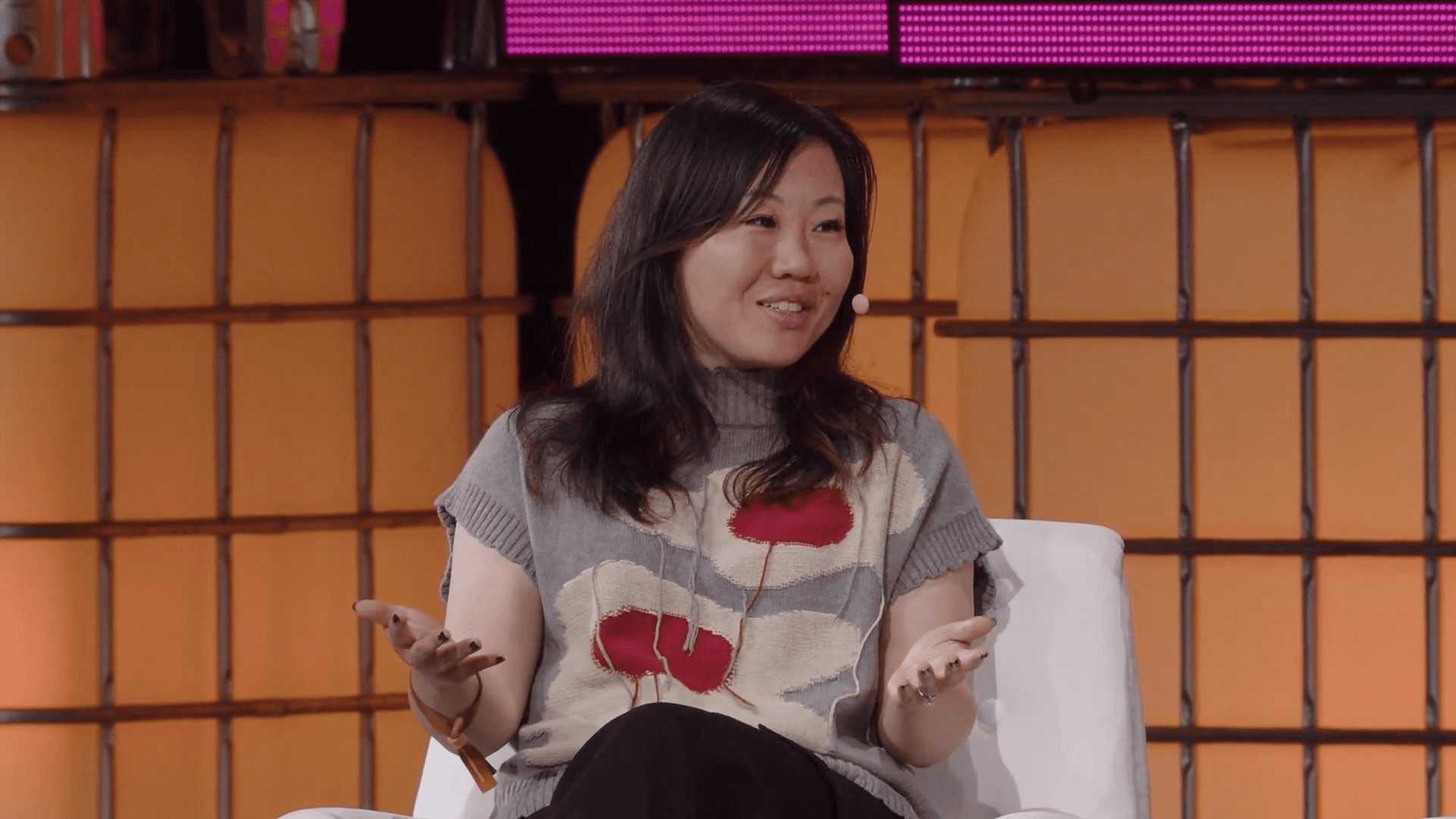
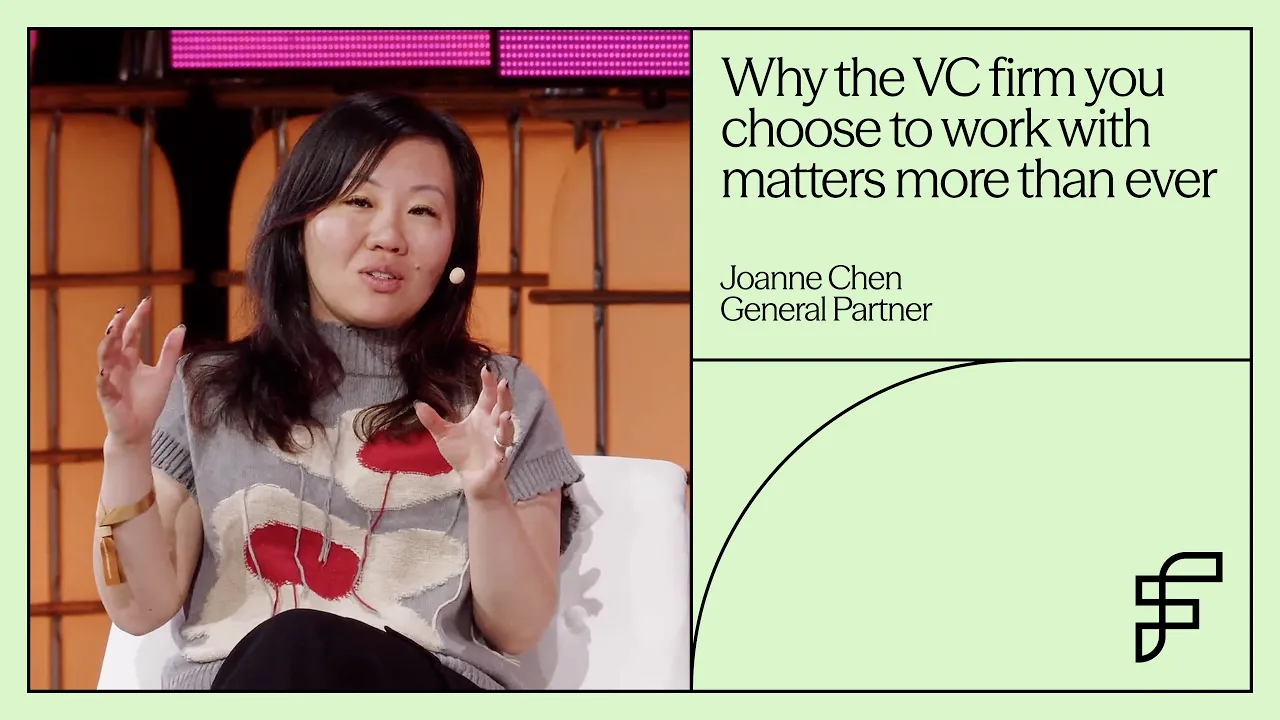
In a panel at the Centre Stage at Web Summit Vancouver, Joanne Chen sat down with Everett Randle (Benchmark) and Tengbo Li (ICONIQ), moderated by Axios reporter Lucinda Shen, to discuss the state of VC today and what this means for founders.

You can watch the full video and explore our key takeaways below. To learn more, check out Joanne’s other Web Summit panel on how AI is changing venture capital.
Time stamps:

0:00 — Cold open about Joanne’s investor mindset
2:00 — The downstream effects of AI platform shifts
4:00 — Why Foundation doubled down on pre-product market fit seed investing
7:00 — What it’s like working with firms of different fund sizes
13:00 — Differentiation in the market
16:00 — Taking a contrarian approach
18:00 — The Cerebras IPO and what it signals
24:00 — AI SaaS IPOs
28:00 — Why is a time where founders can be more ambitious than ever before

Our highlights from the conversation

From zero to one

The core question for any fund, regardless of size, is what value does it deliver to founders? As Joanne explains, “With more competition, you have to have specialization. You can’t do everything well…especially when the market is inundated with options.”

Joanne shares how Foundation Capital made the decision to narrow its focus to very early-stage companies in AI and crypto. “We took a step back and thought, what do we really, really excel at? We decided to focus the firm on super early-stage companies that are technical, but have pre-product market fit.”

“Our value proposition to founders is very clear: we help you go from zero to one,” she continues.

Conviction from the earliest stage

Using Cerebras as an example, Joanne describes how early-stage investors need to have conviction in futures that others may not believe in.

“I think it takes a special kind of investor to say, I don’t believe what the market is saying. I’m going to believe something that no one else believes and to make investments based on that. That’s a very different mindset than, say, a growth-stage investor who’s more investing in momentum and in the macro,” she says.

Find a partner who’s as passionate as you are

Now is a time where founders can be more ambitious than ever before. Joanne sums up the sentiment: “The sky is your limit. I wish I was 21, graduating from college today.”

Read the full talk:

Lucinda Shen: Good morning, folks. This is a fun setup for a panel: the death of the middle, and how the generalist investor is no longer as in vogue as it once was. We have the spectrum well represented here. Benchmark, you've famously stuck with a $450 million—now $425 million—fund as of your last raise. ICONIQ is the standout at the other end: a $5.75 billion fund as of 2024.

Let me set the state of play. The top 10 funds alone raised a combined $22 billion last year—32.9% of all venture capital, up two and a half times from 13% in 2021, according to NVCA. So battle it out: is the middle dead? Is the generalist investor on its way out? I'll start with you, Tengbo.

Tengbo Li: Thanks for having us. Lucinda's right—we have a lot of representation across the venture ecosystem on this panel. Personally, I'm encouraged by the amount of innovation we're seeing in venture right now. The stats you cited are indisputable: post-pandemic, and through the correction of 2022 and 2023, fund sizes bifurcated. The larger funds raised even larger funds, while the number of $25–100 million funds compressed between the pandemic and 2024.

What those numbers don't reflect is the last couple of years, when there's been enormous excitement and investment behind AI. It's when these platform shifts happen that newer players can emerge. Larger funds bring real resources and differentiated value to the companies they back; many smaller specialist funds do the same. And in that messy middle, there's always opportunity for innovation.

ICONIQ began as a family office supporting some of the best entrepreneurs in technology, and we built a tech investment firm on top of that to support founders from the earliest stages—seed and Series A. From the start, we asked ourselves: what is our differentiated value proposition to founders? That question is incumbent on any VC, whether you have a $200 million fund, a $1 billion fund, or a $10 billion fund. In an age when companies are growing in genuinely different ways than they did in the mobile and cloud era, all of us have to figure out what that differentiation is and how to be the best possible partner to founders. Funds of any scale can do that.

Lucinda: So tell me—what is the differentiation?

Joanne Chen: We actually wrestled with this exact question. I joined Foundation about 12 years ago, and venture was changing then too—maybe not as rapidly as today, but we were investing across many sectors and stages: Series A, Series B, and a little seed. We took a step back and asked: what do we truly excel at, and what do we want to do as individuals? We decided to focus the firm on the super early stage—predominantly seed—backing technical companies that are pre-product-market fit, with few or no customers or revenues, and to build a team and fund size that match that value proposition.

Today, about 90% of our companies have no revenue when we invest. No customers. Often no product. We write seed-stage checks, usually as the first institutional investor—85% of the time. Our value proposition to founders is clear: we help you go from zero to one. We help you land your first customers and make your first hires—your first heads of marketing, sales, and so on. That has played out well. The first fund where we really focused on this strategy was Fund 8, the fund in which we incubated Cerebras alongside Benchmark. Cerebras went public this morning, which is awesome. And we've repeated that playbook over and over since.

Everett Randle: I think the era of AI and LLMs has pushed the two bookends of the spectrum even further apart. It's harder today than it was five or six years ago to do both well—by "both" I mean being a platform focused primarily on growth investing and being a specialist focused on a particular sector or stage, typically early.

Here's why. Take Anthropic's $380 billion valuation round—their last announced round of funding—and assume Anthropic IPOs at a $1.5 trillion valuation sometime in the next four years. They're not there yet, but there are rumors they'll raise near that valuation now, so it's a fair line to draw. The investors in that $380 billion round would collectively make 35x more than the investors in the Snowflake pre-IPO round—and Snowflake's pre-IPO round was the gold-standard large growth round that everyone was proud to be in and every LP was happy about. A single Anthropic round will produce an order of magnitude more returns, and then some.

When you look at the capital-intensive rounds the LLM providers are raising—that was a $30 billion round, a mega-IPO's worth of capital in a single round, and OpenAI raised an even larger one before it—you can only do that if you're a large platform with a ton of capital to deploy. And if you're a large platform putting a billion dollars into an Anthropic, it is really, really hard to get up in the morning and convince yourself you care about a $10 million seed check. Firms like to lie to themselves or their LPs and insist they still care about seed and Series A.

Beyond Benchmark's brand and history, our differentiator today is as strong as ever: we can go to an entrepreneur and say we genuinely care about you and your company, and we will be deeply involved, even if we're only investing $5–10 million. I don't think you can say that with a straight face at a large platform, because if 90% of your P&L is coming from Anthropic, you're just not going to care about the small company.

Lucinda: I've heard the counterargument from the large funds: they create sub-categories within those funds, the organization gets much bigger, and they say, "We do have time for you, seed-stage founder—the growth investors, the Anthropic investors, are over there, and we have five seed-stage investors right here." Is that a fair argument for that kind of structure?

Everett: The best entrepreneurs and founders want to work with the principals of the firm—the people who matter most to it. It's very hard when you have a seed room and a growth room: the CEO of that firm goes to the growth room and talks about making billions of dollars in a very short amount of time, and then in the seed room it's, "Well, if this goes really, really well, maybe we make a billion dollars in 15 years." It's very hard to keep both in your mind at the same time. And that's not a bad thing—it's natural human instinct to focus on what you're best at and where the greatest dollar returns will come from, given your setup.

Joanne: I'm a little biased, but I agree. At Foundation, every single general partner is incentivized to make sure each company—with no revenue, no customers—succeeds. Our jobs are on the line for it. At multistage firms, that may not be the case, because you can generate returns in other ways.

Tengbo: I agree with the principle in concept. Venture is hard to scale, and both Benchmark and Foundation are artisans of the craft—individual GPs who genuinely want to be the best possible partners to founders. It does get hard when a multi-stage fund reaches four, five, six billion dollars and ends up investing in a huge number of companies, treating them more as call options than true partnerships.

I can't speak to other funds' philosophies, but having been at ICONIQ for over a decade, I can say we treat each partnership equally—whether it's Anthropic, where we've invested several billion dollars and are one of the largest financial investors, or companies we've recently incubated or seeded. Building a business is an incredibly hard journey, and some of our best investments have been ones where we've been alongside founders from close to day one. We were one of the earliest investors in Figma, where we invested less than $2 million and have been on that journey with Dylan and his team ever since. Over the last five years, roughly 50% of our checks have gone to companies with under $10 million in revenue.

Our approach is concentration. Despite the fact that we can write multi-billion-dollar checks, we're not trying to make 100 bets per fund—we partner with a select group of a few dozen companies, which lets each partner allocate the time and resources each situation warrants. On top of that, we've built a team that's larger than the investment team itself: 50 professionals solely dedicated to supporting portfolio companies across data science, leadership and talent introductions, and commercial introductions to the Global 2000 buyers we're closely connected to. Founders we work with often have 10 or 12 relationships across our team, not just with the partner who led the deal. That's how we try to solve the structural issue that exists in principle.

Get insights directly to your inbox.

Set your newsletter preferences:

Set your newsletter preferences:

Lucinda: At seed and early stage, you're writing more checks per fund than at later stages, which raises conflict-of-interest issues that typically aren't as severe at growth stage. Is that part of the thinking too?

Tengbo: We've written about as many seed, Series A, and early Series B investments as later-round ones—Series D, E, F. In general, we try to be conscious about time management and how many board seats each partner holds. Once you're at nine, ten, eleven boards, things start to get stretched, so we actively try to stay out of that situation.

Lucinda: Maybe a controversial question: do you think there are not enough investors in venture capital right now?

Everett: I think there are anywhere from five to ten times too many investors in venture at any given point. The best ideas are generally found quickly, they find great partners, and they're funded well throughout their lifecycle. That said, there's a ton of white space, as Tengbo said, where investors could be innovating and aren't.

If I were a growth-stage founder, I have no idea why I wouldn't go with a firm like ICONIQ, which has built an incredible platform and resources for that stage. As an early-stage founder, I don't know why I wouldn't go with a firm like Benchmark with all its history, or Foundation, or a Rivet if I were a fintech founder. Those firms have built resources and assets that act as genuine differentiators and let them continuously win great investments. But if you threw up on screen every venture and growth firm that exists and asked which have actually built true differentiation in the eyes of founders looking for capital, it would be hard to point to more than 20% of them.

Joanne: With more competition, you have to specialize. That's why we doubled down on this stage, and on the technology trends of AI and crypto. You can't do everything well—you have to do a few things really well—and that's especially true when the market is inundated with options.

Tengbo: There was a chart posted this morning—I've seen iterations of it before—showing the top theme in venture each year alongside the most valuable company founded that year. They're disjointed every single time. In a given year the top theme might have been Web3, and the most valuable company created that year had nothing to do with Web3.

That's indicative of what often happens in venture: capital flows to areas that are hyped in the moment, and there's arguably a misallocation away from areas that end up being enduring and genuinely valuable—societally and economically. We're seeing this in areas like next-gen manufacturing, which until recently saw little investment, and where companies are now using automation and software to revitalize the industrial base. I hope that over the arc of history, capital gets allocated in the right directions, but in the moment there are distortions—and those distortions create opportunities for venture investors to find pockets of underinvestment. We mentioned Cerebras earlier: chips were not hot in 2015 and 2016, and Benchmark and Foundation made that investment anyway. Often the job of venture is to be contrarian and see a little way into the future.

Lucinda: You beat me to Cerebras, because I want to talk about that. The underlying theme here is bigger and bigger funds chasing bigger and bigger outcomes—but those outcomes don't yet have full exits. We don't have liquidity from the Anthropics and SpaceXs of the world. We just got one in Cerebras, and it's been a huge outcome: a $23 billion last private-round valuation, an IPO slated around $54 billion a few months later, and now over $100 billion in first trading. For Foundation and Benchmark, early investments of tens to a couple hundred million dollars are now worth $6–7 billion in returns. Does the Cerebras IPO mean we're about to see far more AI companies going public on an accelerated basis?

Tengbo: The bar for going public has risen by maybe an order of magnitude in the last four or five years. We saw a flood of traditional software and mobile companies go public in the pandemic era, and some have performed extraordinarily well since—I'd argue the public markets haven't fully recognized the value those companies created. But the bar is much higher now. If it used to be a couple hundred million in revenue growing 40–50%, today you probably need closer to $500–600 million in revenue as a software or AI company to have a strong shot at performing well in the public markets. There's a lot of capital out there, but also a lot of places to park it—including newly public neo-cloud companies—so if you're a long-only asset manager, you have plenty of alternatives to traditional SaaS or subscale companies.

That's the sobering fact. At the same time, across our portfolios we're seeing companies grow faster than ever before. We're investors in Anthropic, ElevenLabs, Legora—companies outpacing every traditional software benchmark and reaching thresholds where they could conceivably succeed in the public markets in a reasonable timeframe. That gives me encouragement that over the next 24–36 months, we'll see true AI-native companies start to enter the public markets with strong showings. But notice the flavor of companies going out in this AI era: it's not traditional software. It's the Cerebrases and the CoreWeaves—infrastructure companies rather than applications, at least at this stage of the AI build-out. That will probably change over time.

Joanne: I don't opine on the public markets much, but from our experience, the market is open for special companies—as Tengbo said, ones with the kind of demand and growth we haven't seen before, driven by new technology. I hope we see more of that, so dollars flow back to LPs and get reinvested into venture funds. That's good for everybody.

One thing I want to underscore: in early-stage investing, the trends and problems are often not obvious. They have to be non-obvious—if they were obvious, more founders would be working on them, more capital would be flowing in, and the competitive dynamics would be completely different. It takes a special kind of investor to say, "I don't believe what the market is saying; I'm going to believe something no one else believes and invest based on that." That's a very different mindset from a growth-stage investor, who invests more in momentum and the macro. We try to hire people like that—more entrepreneurial founder types. Cerebras was a great example. When Andrew pitched, I had been at Foundation for just 18 months, and he was painting a picture of the future that most people didn't believe in. The future arrived later than expected, and maybe in a different way, but it arrived—and the direction was a point of high conviction for him and for our team.

Everett: Very practically, I think this will be the year of the true mega special-company IPO. There are reports of SpaceX going out, and one or both of the main foundation model companies could go out. That would make it very hard for anyone else to.

Lucinda: Because it takes the capital out of the market?

Everett: Capital, or just attention. The bar to IPO is higher than it's ever been because you need analysts to follow your stock and investors to care about your story—and it would be very hard for anyone to care about much else beyond the four potential companies we've discussed that have IPO'd or could IPO this year.

Next year, though, could be—and people want it to be—the year of the AI SaaS IPO. I've talked to equity analysts and asked, is SaaS dead? Why is everything in SaaS trading so cheaply? Their answer: it's not that we don't care about SaaS—we want AI SaaS, the companies growing from $100 to $400 million in a year and delivering an entirely new vector of value through AI-native products. None of the companies representing this new wave of AI-native SaaS are mature enough to go out this year. So there's a bit of a race: it would be pretty amazing to be the first vertical AI SaaS company to go public, or the first horizontal one. Some companies are definitely aiming for a 2027 listing—by which point, theoretically, the labs and SpaceX would already be trading, the distraction would be over, and there would be actual capital available for new IPOs rather than concentrated in this year's.

Lucinda: So there's a pre-AI cohort and a post-AI cohort of companies. Are these the post-ChatGPT companies—the ones you started hearing about after that first Cambrian explosion?

Everett: Exactly. I've been somewhat surprised by the market's reception of companies you could argue are AI winners. There's a pretty cogent argument that Figma is an AI winner, and the narrative of it as a potential AI loser was surprising, at least to me. The line a lot of people are drawing isn't even whether the company was founded pre- or post-ChatGPT—it's whether the core product was developed in a post-ChatGPT era, where the first product to hit customers' hands was built around LLMs, versus having LLMs bolted on as a secondary product later.

Joanne: Some of the growth we're seeing comes from companies targeting labor spend. Instead of going after existing software budgets, they're saying: we can almost fully automate what a person does.

Lucinda: Not terribly politically popular, unfortunately.

Joanne: Not the most politically popular opinion, but it's what's happening. Labor spend is much, much bigger than software spend, and the ROI is very clear—hence some of the growth we're seeing. I'm excited to see these companies graduate to the public markets in the coming years.

Lucinda: What does all this mean for founders? We've talked about what the barbell means for venture. What does it mean for the founder trying to raise a Series A or B who might be looking for a more generalist investor?

Tengbo: I tend to be a little traditional here. Building a company is an incredibly hard journey at any stage—whether you're an AI-native founder starting this year, or a traditional SaaS founder navigating this new era with technical debt and a team that may want to work at an AI-native company instead. We have a lot of empathy for that. But my traditional view is: don't build a business for us on stage. Build it on the basic business-building principles that actually create value. What drives value for your customers? What's the best way to win and out-compete in your market? If you nail those building blocks, there's venture capital out there for you—from a specialist fund, a larger fund, whatever the flavor. It has to start with the fundamentals of building a durable, valuable company and a product customers love.

Everett: It's hard to argue this isn't the best time to be a founder in the last quarter century. I'll butcher the quote, but there's an F1 line: you can't pass ten cars in the sun, but you can pass ten cars in the rain. The paradigm shift we're seeing with LLMs, and how uncertain everything is—no one knows what the models will be able to do in six months, let alone two years—is inherently great for entrepreneurs. Scrappy, small teams that can move at the pace of an entrepreneur, unburdened by a large organization or bureaucracy, are going to overtake incumbents and create enormous value. Because it's raining out.

Joanne: And that's true for individuals too. There's a lot of anxiety right now—"am I going to keep my job?"—and I see it especially in Silicon Valley, maybe a little less in other geographies. But on the flip side, it's an opportunity. For every young person, there's now an assistant that can teach you whatever you want and create all sorts of things for you in a very short period of time. In some ways, the sky's the limit. I wish I were 21 and graduating from college today.

Lucinda: Awesome. Thank you so much for joining us today—we're out of time. Thank you all for coming.

Posted

0 MIN READ

Show Outline

In a panel at the Centre Stage at Web Summit Vancouver, Joanne Chen sat down with Everett Randle (Benchmark) and Tengbo Li (ICONIQ), moderated by Axios reporter Lucinda Shen, to discuss the state of VC today and what this means for founders.

You can watch the full video and explore our key takeaways below. To learn more, check out Joanne’s other Web Summit panel on how AI is changing venture capital.

Time stamps:

0:00 — Cold open about Joanne’s investor mindset
2:00 — The downstream effects of AI platform shifts
4:00 — Why Foundation doubled down on pre-product market fit seed investing
7:00 — What it’s like working with firms of different fund sizes
13:00 — Differentiation in the market
16:00 — Taking a contrarian approach
18:00 — The Cerebras IPO and what it signals
24:00 — AI SaaS IPOs
28:00 — Why is a time where founders can be more ambitious than ever before

Our highlights from the conversation

From zero to one

The core question for any fund, regardless of size, is what value does it deliver to founders? As Joanne explains, “With more competition, you have to have specialization. You can’t do everything well…especially when the market is inundated with options.”

Joanne shares how Foundation Capital made the decision to narrow its focus to very early-stage companies in AI and crypto. “We took a step back and thought, what do we really, really excel at? We decided to focus the firm on super early-stage companies that are technical, but have pre-product market fit.”

“Our value proposition to founders is very clear: we help you go from zero to one,” she continues.

Conviction from the earliest stage

Using Cerebras as an example, Joanne describes how early-stage investors need to have conviction in futures that others may not believe in.

“I think it takes a special kind of investor to say, I don’t believe what the market is saying. I’m going to believe something that no one else believes and to make investments based on that. That’s a very different mindset than, say, a growth-stage investor who’s more investing in momentum and in the macro,” she says.

Find a partner who’s as passionate as you are

Now is a time where founders can be more ambitious than ever before. Joanne sums up the sentiment: “The sky is your limit. I wish I was 21, graduating from college today.”

Read the full talk:

Lucinda Shen: Good morning, folks. This is a fun setup for a panel: the death of the middle, and how the generalist investor is no longer as in vogue as it once was. We have the spectrum well represented here. Benchmark, you've famously stuck with a $450 million—now $425 million—fund as of your last raise. ICONIQ is the standout at the other end: a $5.75 billion fund as of 2024.

Let me set the state of play. The top 10 funds alone raised a combined $22 billion last year—32.9% of all venture capital, up two and a half times from 13% in 2021, according to NVCA. So battle it out: is the middle dead? Is the generalist investor on its way out? I'll start with you, Tengbo.

Tengbo Li: Thanks for having us. Lucinda's right—we have a lot of representation across the venture ecosystem on this panel. Personally, I'm encouraged by the amount of innovation we're seeing in venture right now. The stats you cited are indisputable: post-pandemic, and through the correction of 2022 and 2023, fund sizes bifurcated. The larger funds raised even larger funds, while the number of $25–100 million funds compressed between the pandemic and 2024.

What those numbers don't reflect is the last couple of years, when there's been enormous excitement and investment behind AI. It's when these platform shifts happen that newer players can emerge. Larger funds bring real resources and differentiated value to the companies they back; many smaller specialist funds do the same. And in that messy middle, there's always opportunity for innovation.

ICONIQ began as a family office supporting some of the best entrepreneurs in technology, and we built a tech investment firm on top of that to support founders from the earliest stages—seed and Series A. From the start, we asked ourselves: what is our differentiated value proposition to founders? That question is incumbent on any VC, whether you have a $200 million fund, a $1 billion fund, or a $10 billion fund. In an age when companies are growing in genuinely different ways than they did in the mobile and cloud era, all of us have to figure out what that differentiation is and how to be the best possible partner to founders. Funds of any scale can do that.

Lucinda: So tell me—what is the differentiation?

Joanne Chen: We actually wrestled with this exact question. I joined Foundation about 12 years ago, and venture was changing then too—maybe not as rapidly as today, but we were investing across many sectors and stages: Series A, Series B, and a little seed. We took a step back and asked: what do we truly excel at, and what do we want to do as individuals? We decided to focus the firm on the super early stage—predominantly seed—backing technical companies that are pre-product-market fit, with few or no customers or revenues, and to build a team and fund size that match that value proposition.

Today, about 90% of our companies have no revenue when we invest. No customers. Often no product. We write seed-stage checks, usually as the first institutional investor—85% of the time. Our value proposition to founders is clear: we help you go from zero to one. We help you land your first customers and make your first hires—your first heads of marketing, sales, and so on. That has played out well. The first fund where we really focused on this strategy was Fund 8, the fund in which we incubated Cerebras alongside Benchmark. Cerebras went public this morning, which is awesome. And we've repeated that playbook over and over since.

Everett Randle: I think the era of AI and LLMs has pushed the two bookends of the spectrum even further apart. It's harder today than it was five or six years ago to do both well—by "both" I mean being a platform focused primarily on growth investing and being a specialist focused on a particular sector or stage, typically early.

Here's why. Take Anthropic's $380 billion valuation round—their last announced round of funding—and assume Anthropic IPOs at a $1.5 trillion valuation sometime in the next four years. They're not there yet, but there are rumors they'll raise near that valuation now, so it's a fair line to draw. The investors in that $380 billion round would collectively make 35x more than the investors in the Snowflake pre-IPO round—and Snowflake's pre-IPO round was the gold-standard large growth round that everyone was proud to be in and every LP was happy about. A single Anthropic round will produce an order of magnitude more returns, and then some.

When you look at the capital-intensive rounds the LLM providers are raising—that was a $30 billion round, a mega-IPO's worth of capital in a single round, and OpenAI raised an even larger one before it—you can only do that if you're a large platform with a ton of capital to deploy. And if you're a large platform putting a billion dollars into an Anthropic, it is really, really hard to get up in the morning and convince yourself you care about a $10 million seed check. Firms like to lie to themselves or their LPs and insist they still care about seed and Series A.

Beyond Benchmark's brand and history, our differentiator today is as strong as ever: we can go to an entrepreneur and say we genuinely care about you and your company, and we will be deeply involved, even if we're only investing $5–10 million. I don't think you can say that with a straight face at a large platform, because if 90% of your P&L is coming from Anthropic, you're just not going to care about the small company.

Lucinda: I've heard the counterargument from the large funds: they create sub-categories within those funds, the organization gets much bigger, and they say, "We do have time for you, seed-stage founder—the growth investors, the Anthropic investors, are over there, and we have five seed-stage investors right here." Is that a fair argument for that kind of structure?

Everett: The best entrepreneurs and founders want to work with the principals of the firm—the people who matter most to it. It's very hard when you have a seed room and a growth room: the CEO of that firm goes to the growth room and talks about making billions of dollars in a very short amount of time, and then in the seed room it's, "Well, if this goes really, really well, maybe we make a billion dollars in 15 years." It's very hard to keep both in your mind at the same time. And that's not a bad thing—it's natural human instinct to focus on what you're best at and where the greatest dollar returns will come from, given your setup.

Joanne: I'm a little biased, but I agree. At Foundation, every single general partner is incentivized to make sure each company—with no revenue, no customers—succeeds. Our jobs are on the line for it. At multistage firms, that may not be the case, because you can generate returns in other ways.

Tengbo: I agree with the principle in concept. Venture is hard to scale, and both Benchmark and Foundation are artisans of the craft—individual GPs who genuinely want to be the best possible partners to founders. It does get hard when a multi-stage fund reaches four, five, six billion dollars and ends up investing in a huge number of companies, treating them more as call options than true partnerships.

I can't speak to other funds' philosophies, but having been at ICONIQ for over a decade, I can say we treat each partnership equally—whether it's Anthropic, where we've invested several billion dollars and are one of the largest financial investors, or companies we've recently incubated or seeded. Building a business is an incredibly hard journey, and some of our best investments have been ones where we've been alongside founders from close to day one. We were one of the earliest investors in Figma, where we invested less than $2 million and have been on that journey with Dylan and his team ever since. Over the last five years, roughly 50% of our checks have gone to companies with under $10 million in revenue.

Our approach is concentration. Despite the fact that we can write multi-billion-dollar checks, we're not trying to make 100 bets per fund—we partner with a select group of a few dozen companies, which lets each partner allocate the time and resources each situation warrants. On top of that, we've built a team that's larger than the investment team itself: 50 professionals solely dedicated to supporting portfolio companies across data science, leadership and talent introductions, and commercial introductions to the Global 2000 buyers we're closely connected to. Founders we work with often have 10 or 12 relationships across our team, not just with the partner who led the deal. That's how we try to solve the structural issue that exists in principle.

Get insights directly to your inbox.

Set your newsletter preferences:

Lucinda: At seed and early stage, you're writing more checks per fund than at later stages, which raises conflict-of-interest issues that typically aren't as severe at growth stage. Is that part of the thinking too?

Tengbo: We've written about as many seed, Series A, and early Series B investments as later-round ones—Series D, E, F. In general, we try to be conscious about time management and how many board seats each partner holds. Once you're at nine, ten, eleven boards, things start to get stretched, so we actively try to stay out of that situation.

Lucinda: Maybe a controversial question: do you think there are not enough investors in venture capital right now?

Everett: I think there are anywhere from five to ten times too many investors in venture at any given point. The best ideas are generally found quickly, they find great partners, and they're funded well throughout their lifecycle. That said, there's a ton of white space, as Tengbo said, where investors could be innovating and aren't.

If I were a growth-stage founder, I have no idea why I wouldn't go with a firm like ICONIQ, which has built an incredible platform and resources for that stage. As an early-stage founder, I don't know why I wouldn't go with a firm like Benchmark with all its history, or Foundation, or a Rivet if I were a fintech founder. Those firms have built resources and assets that act as genuine differentiators and let them continuously win great investments. But if you threw up on screen every venture and growth firm that exists and asked which have actually built true differentiation in the eyes of founders looking for capital, it would be hard to point to more than 20% of them.

Joanne: With more competition, you have to specialize. That's why we doubled down on this stage, and on the technology trends of AI and crypto. You can't do everything well—you have to do a few things really well—and that's especially true when the market is inundated with options.

Tengbo: There was a chart posted this morning—I've seen iterations of it before—showing the top theme in venture each year alongside the most valuable company founded that year. They're disjointed every single time. In a given year the top theme might have been Web3, and the most valuable company created that year had nothing to do with Web3.

That's indicative of what often happens in venture: capital flows to areas that are hyped in the moment, and there's arguably a misallocation away from areas that end up being enduring and genuinely valuable—societally and economically. We're seeing this in areas like next-gen manufacturing, which until recently saw little investment, and where companies are now using automation and software to revitalize the industrial base. I hope that over the arc of history, capital gets allocated in the right directions, but in the moment there are distortions—and those distortions create opportunities for venture investors to find pockets of underinvestment. We mentioned Cerebras earlier: chips were not hot in 2015 and 2016, and Benchmark and Foundation made that investment anyway. Often the job of venture is to be contrarian and see a little way into the future.

Lucinda: You beat me to Cerebras, because I want to talk about that. The underlying theme here is bigger and bigger funds chasing bigger and bigger outcomes—but those outcomes don't yet have full exits. We don't have liquidity from the Anthropics and SpaceXs of the world. We just got one in Cerebras, and it's been a huge outcome: a $23 billion last private-round valuation, an IPO slated around $54 billion a few months later, and now over $100 billion in first trading. For Foundation and Benchmark, early investments of tens to a couple hundred million dollars are now worth $6–7 billion in returns. Does the Cerebras IPO mean we're about to see far more AI companies going public on an accelerated basis?

Tengbo: The bar for going public has risen by maybe an order of magnitude in the last four or five years. We saw a flood of traditional software and mobile companies go public in the pandemic era, and some have performed extraordinarily well since—I'd argue the public markets haven't fully recognized the value those companies created. But the bar is much higher now. If it used to be a couple hundred million in revenue growing 40–50%, today you probably need closer to $500–600 million in revenue as a software or AI company to have a strong shot at performing well in the public markets. There's a lot of capital out there, but also a lot of places to park it—including newly public neo-cloud companies—so if you're a long-only asset manager, you have plenty of alternatives to traditional SaaS or subscale companies.

That's the sobering fact. At the same time, across our portfolios we're seeing companies grow faster than ever before. We're investors in Anthropic, ElevenLabs, Legora—companies outpacing every traditional software benchmark and reaching thresholds where they could conceivably succeed in the public markets in a reasonable timeframe. That gives me encouragement that over the next 24–36 months, we'll see true AI-native companies start to enter the public markets with strong showings. But notice the flavor of companies going out in this AI era: it's not traditional software. It's the Cerebrases and the CoreWeaves—infrastructure companies rather than applications, at least at this stage of the AI build-out. That will probably change over time.

Joanne: I don't opine on the public markets much, but from our experience, the market is open for special companies—as Tengbo said, ones with the kind of demand and growth we haven't seen before, driven by new technology. I hope we see more of that, so dollars flow back to LPs and get reinvested into venture funds. That's good for everybody.

One thing I want to underscore: in early-stage investing, the trends and problems are often not obvious. They have to be non-obvious—if they were obvious, more founders would be working on them, more capital would be flowing in, and the competitive dynamics would be completely different. It takes a special kind of investor to say, "I don't believe what the market is saying; I'm going to believe something no one else believes and invest based on that." That's a very different mindset from a growth-stage investor, who invests more in momentum and the macro. We try to hire people like that—more entrepreneurial founder types. Cerebras was a great example. When Andrew pitched, I had been at Foundation for just 18 months, and he was painting a picture of the future that most people didn't believe in. The future arrived later than expected, and maybe in a different way, but it arrived—and the direction was a point of high conviction for him and for our team.

Everett: Very practically, I think this will be the year of the true mega special-company IPO. There are reports of SpaceX going out, and one or both of the main foundation model companies could go out. That would make it very hard for anyone else to.

Lucinda: Because it takes the capital out of the market?

Everett: Capital, or just attention. The bar to IPO is higher than it's ever been because you need analysts to follow your stock and investors to care about your story—and it would be very hard for anyone to care about much else beyond the four potential companies we've discussed that have IPO'd or could IPO this year.

Next year, though, could be—and people want it to be—the year of the AI SaaS IPO. I've talked to equity analysts and asked, is SaaS dead? Why is everything in SaaS trading so cheaply? Their answer: it's not that we don't care about SaaS—we want AI SaaS, the companies growing from $100 to $400 million in a year and delivering an entirely new vector of value through AI-native products. None of the companies representing this new wave of AI-native SaaS are mature enough to go out this year. So there's a bit of a race: it would be pretty amazing to be the first vertical AI SaaS company to go public, or the first horizontal one. Some companies are definitely aiming for a 2027 listing—by which point, theoretically, the labs and SpaceX would already be trading, the distraction would be over, and there would be actual capital available for new IPOs rather than concentrated in this year's.

Lucinda: So there's a pre-AI cohort and a post-AI cohort of companies. Are these the post-ChatGPT companies—the ones you started hearing about after that first Cambrian explosion?

Everett: Exactly. I've been somewhat surprised by the market's reception of companies you could argue are AI winners. There's a pretty cogent argument that Figma is an AI winner, and the narrative of it as a potential AI loser was surprising, at least to me. The line a lot of people are drawing isn't even whether the company was founded pre- or post-ChatGPT—it's whether the core product was developed in a post-ChatGPT era, where the first product to hit customers' hands was built around LLMs, versus having LLMs bolted on as a secondary product later.

Joanne: Some of the growth we're seeing comes from companies targeting labor spend. Instead of going after existing software budgets, they're saying: we can almost fully automate what a person does.

Lucinda: Not terribly politically popular, unfortunately.

Joanne: Not the most politically popular opinion, but it's what's happening. Labor spend is much, much bigger than software spend, and the ROI is very clear—hence some of the growth we're seeing. I'm excited to see these companies graduate to the public markets in the coming years.

Lucinda: What does all this mean for founders? We've talked about what the barbell means for venture. What does it mean for the founder trying to raise a Series A or B who might be looking for a more generalist investor?

Tengbo: I tend to be a little traditional here. Building a company is an incredibly hard journey at any stage—whether you're an AI-native founder starting this year, or a traditional SaaS founder navigating this new era with technical debt and a team that may want to work at an AI-native company instead. We have a lot of empathy for that. But my traditional view is: don't build a business for us on stage. Build it on the basic business-building principles that actually create value. What drives value for your customers? What's the best way to win and out-compete in your market? If you nail those building blocks, there's venture capital out there for you—from a specialist fund, a larger fund, whatever the flavor. It has to start with the fundamentals of building a durable, valuable company and a product customers love.

Everett: It's hard to argue this isn't the best time to be a founder in the last quarter century. I'll butcher the quote, but there's an F1 line: you can't pass ten cars in the sun, but you can pass ten cars in the rain. The paradigm shift we're seeing with LLMs, and how uncertain everything is—no one knows what the models will be able to do in six months, let alone two years—is inherently great for entrepreneurs. Scrappy, small teams that can move at the pace of an entrepreneur, unburdened by a large organization or bureaucracy, are going to overtake incumbents and create enormous value. Because it's raining out.

Joanne: And that's true for individuals too. There's a lot of anxiety right now—"am I going to keep my job?"—and I see it especially in Silicon Valley, maybe a little less in other geographies. But on the flip side, it's an opportunity. For every young person, there's now an assistant that can teach you whatever you want and create all sorts of things for you in a very short period of time. In some ways, the sky's the limit. I wish I were 21 and graduating from college today.

Lucinda: Awesome. Thank you so much for joining us today—we're out of time. Thank you all for coming.

Get insights directly to your inbox.

Set your newsletter preferences:

Set your newsletter preferences: