


Last Friday, Jensen Huang used his first post on X to share an open letter: Open Weights and American AI Leadership. It launched with 25 logos and has since grown past 200, spanning every layer of the AI stack.
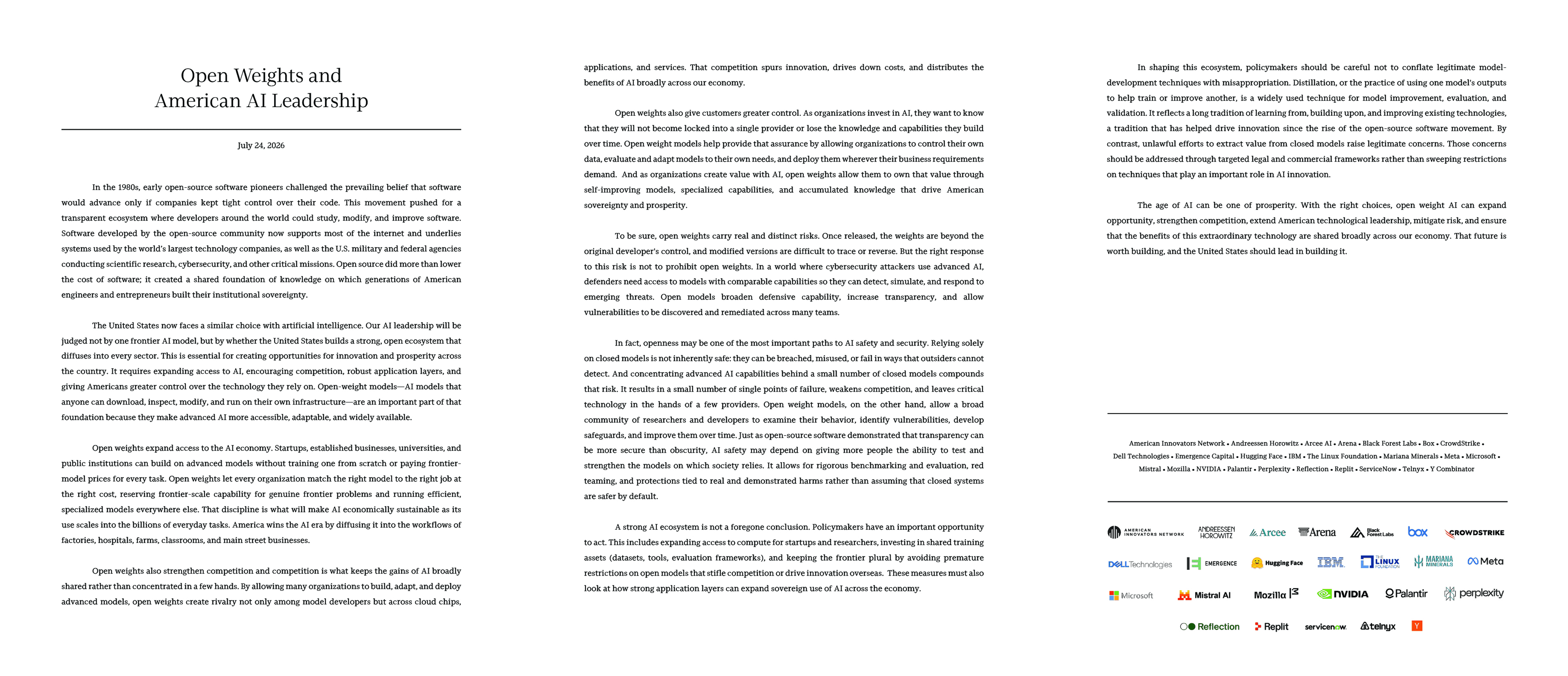
The letter arrived a few days after reports that the Trump administration was reviving a push to ban Chinese models, though it doesn’t name China directly. Instead, it makes a broader case for openness: more competition across the AI ecosystem, less control for a handful of closed labs, and more freedom for customers to own what they build.
On Saturday, OpenAI and Google added their names.
Anthropic remains the only major AI company that hasn’t signed. On Monday, it published its own statement: no ban on open weights, but chip export controls, a crackdown on industrial-scale distillation, and mandatory pre-release safety testing for every sufficiently capable model. These asks don’t explicitly say “ban,” but they amount to something close.
While OpenAI signed the letter, almost everything it has done since its pivot from being “open” points in the opposite direction. For all their animosity, OpenAI has reportedly been lobbying alongside Anthropic against Chinese open models. Endorsing Jensen’s letter in public while pursuing the opposite aim in private costs OpenAI very little.
Everyone in this fight is self-interested. The question is whose self-interest runs parallel to yours.
OpenAI aside, the companies on Jensen’s letter are trying to prevent one layer of the stack from capturing the economics of the entire industry. They want what their customers want: more competition, lower switching costs, and more control over where and how models run.
For a small number of frontier labs, the model is the product. For everyone else, it is a cost, a complement, or a building block. It is something they buy, tune, or use to make the product they sell more valuable. Either way, they want more intelligence, in more places, at lower cost.
Why this is different from the DeepSeek moment
Chinese open-weight models are no longer just cheaper alternatives. They are becoming real competitors to the U.S. frontier.
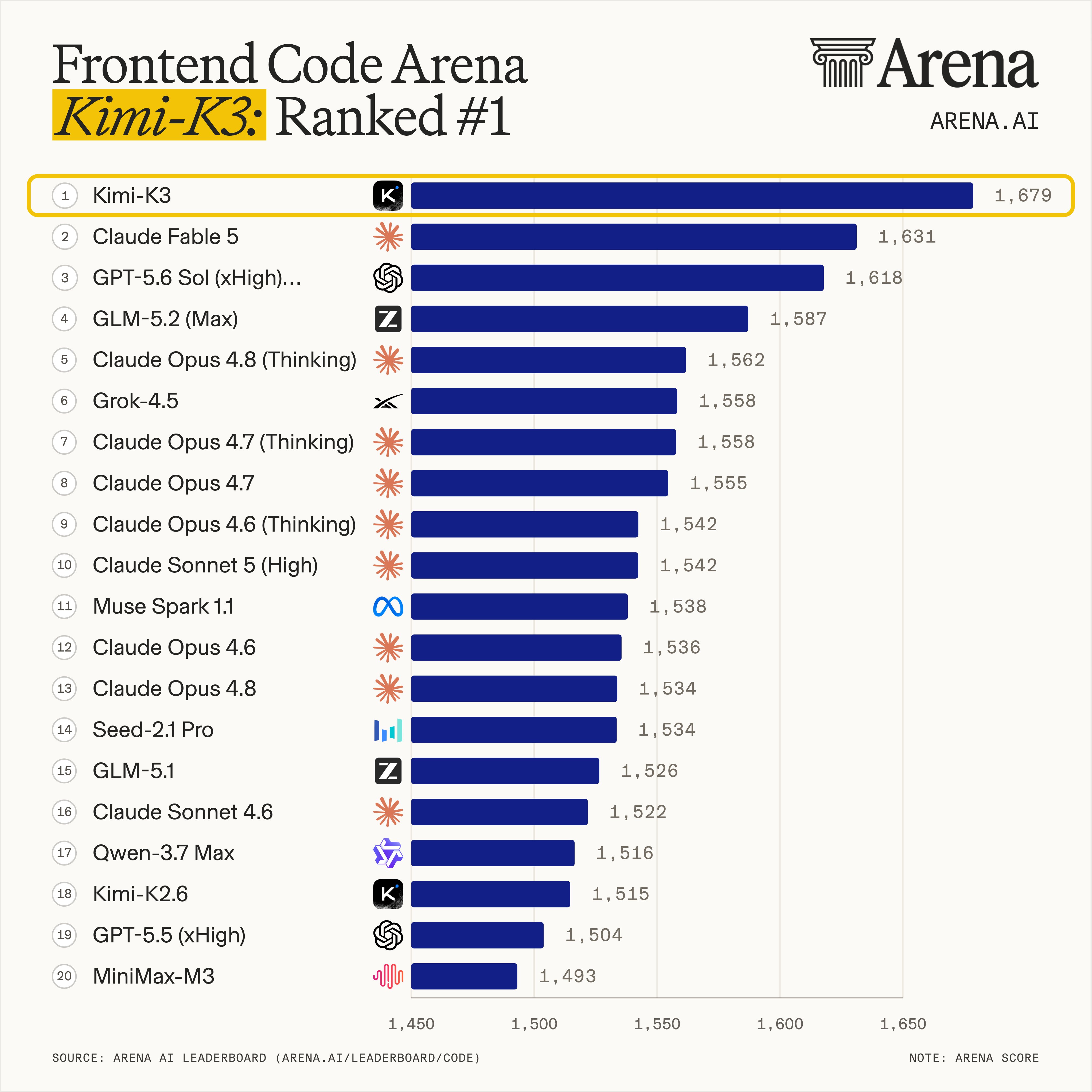
Moonshot unveiled Kimi K3 in mid-July and published the weights earlier this week. It is one of the largest open-weight model ever released. Benchmarks are gameable and should be held loosely. Still, K3 took first place on Arena’s Frontend Code leaderboard, ahead of Claude Fable 5 and GPT-5.6 Sol, and landed in the top four on broader evals, far ahead of every other open model.
Benchmarks are interesting; usage is even more so. On OpenRouter, Chinese open-weight models now hold 9 of the top 10 spots on the current leaderboard. NVIDIA is the only U.S. company represented. Their share of tokens from U.S. firms crossed 60% this month, up from under 10% at the start of 2025.
DeepSeek’s R1 was a price shock. Moonshot’s K3 is a capability shock.
DeepSeek forced the market to reconsider how much compute and capital a strong model really requires. It showed that smarter design and training choices could produce more capability with far less spend.
By contrast, K3 is big and expensive to run. The headline is not cost, but that a Chinese lab is now competing near the frontier with far less capital, tighter chip access, and a different path to market than the American labs.
Some of that is the advantage of going second. Once a leading lab ships, the rest of the field can study what worked, which tradeoffs mattered, and where performance can be reproduced more cheaply. Distillation is the most direct version of this second-place advantage, which is why it has become a flashpoint.
But distillation is not the whole story. Chinese labs are not merely copying. They are competing for the frontier under different constraints, with a playbook built around efficiency and open distribution. Whatever the distillation investigations ultimately establish, “fast follower” no longer captures what is happening.
The market has changed since DeepSeek.
Two shifts matter most: the rise of reasoning and agents, and the growing value of being just behind the frontier.
In the chatbot era, you chose a model. In the agentic era, you assemble a system, where the choice of model can be made step by step. Open weights let you match the model to the job: the frontier where success depends on it, something cheaper and specialized everywhere else.
As the next-best models improve, more work stops needing the frontier. The frontier keeps the hardest jobs and the premium that comes with them. It loses the volume, which is arguably where most of the revenue will live long-term.
China is playing for a much bigger prize than benchmarks.
Today, much of the global technology stack runs through the U.S. China’s counter-proposition, especially to emerging markets: run our models on your own hardware, adapt them to your own language and data, and own them. This is an AI layer on China’s Digital Silk Road, built around local control and freedom from U.S. leverage.
Insights for technical founders on the path to CEO.
Learn how to build and scale an enduring company from Ashu and leading founder-CEOs.
Why open models matter
Too dangerous to distribute, or too dangerous to concentrate?
I fall firmly in the second camp: pro-open-weight, against blanket bans, and in favor of a wider field of model providers.
Closed models are not safer by default.
Once released, open models can’t be recalled. Their safeguards can be removed, their use is harder to monitor, and their weights do not tell us about the data and methods used to produce them.
Closed models do not make those risks disappear: they just move more of the control inside the provider. They can also be breached, manipulated, and misused. Outsiders also have less ability to test, inspect, adapt, and challenge how they behave.
The cat is out of the bag.
Export controls work best on physical goods and concentrated supply chains. A model file, once published, is nearly impossible to contain. The U.S. can determine which models its own companies distribute, buy, or support, but it can’t stop Chinese labs from shipping.
Open frontier models will exist. The choice we can make is whether U.S. companies, researchers, and institutions help shape that ecosystem, or cede it to others.
Concentration brings its own risks.
Two or three labs running most of the world’s inference would become dominant buyers of chips, power, data-center capacity, and talent. They’d also have every incentive to move up the stack and capture more and more of the value created above their models.
Along with profits, a world served by a handful of models also concentrates judgment: over what gets built, what gets refused, and who gets access. Credible open-weight competition is one of the few checks on this power.
Open models make the pie bigger for everyone.
Exponential View estimates that token volume has grown roughly 17,000x over 4 years as prices have fallen. OpenRouter’s data shows the same direction of travel: usage is rising sharply as developers move from one-shot chat to reasoning, coding, and agentic workflows.
That’s why competition is a net good. Frontier labs still remain powerful in an open ecosystem. They just have to keep earning their premium through capability, product, and distribution rather than through scarcity, which is both a harder business and a healthier one.
For the startups we back, a vibrant open-model ecosystem is crucial.
Startups are the backbone of the American economy. Venture-backed companies account for over 40% of U.S. public market cap and over 60% of public-company R&D. 7 of the 10 most valuable companies in the country were venture-backed.
For product builders, models are COGS. At 80% margins, a dollar of revenue funds 80 cents of engineering and sales; at 45%, where inference costs have pushed many AI startups, it funds 45. Thin margins also cap what you can spend to win a customer, which is how a better-capitalized competitor takes a market from a better product.
Otherwise put: open models are not a philosophical preference for many startups. They’re the reason their unit economics work.
Open models also expand what’s possible to build. Expensive intelligence pushes startups toward the largest markets and use cases. Cheaper intelligence opens up the long tail: niche workflows, overlooked customers, and seemingly strange ideas that incumbents ignore. Many look too small or marginal to matter until a startup makes them work and turns them into a market.
Where are the American open-weight models?
If open models matter so much, why doesn’t America have a stronger open-model ecosystem?
Follow the incentives.
The U.S. does have its own open models. Llama, GPT-OSS, DBRX, and several smaller American model families all exist. What it lacks is a durable system for producing them at the frontier and building the developer ecosystem around them.
The economics of openness look very different in the U.S. and China.
For an American lab, the model is the primary source of revenue. Publish the weights and anyone can serve it, so you spend billions building an asset and then give up the ability to monetize it. The serving margin goes to whoever hosts it, the product margin goes to whoever builds on it, and you keep the goodwill.
This is why U.S. open source has almost always come from somewhere other than the company whose product it is: from academia, where public funding removes the need to monetize; from a company releasing something peripheral to what it sells; or from a challenger commoditizing an incumbent’s moat.
For Chinese labs, the tradeoffs are different. Domestic API revenue is a fraction of American levels, so there is less to forgo. They’re also effectively shut out of Western enterprise sales by procurement, trust, and regulation. Open weights are one of the few paths they have to global distribution.
Beyond economics, the barriers are data, compute efficiency, and talent.
China has a much bigger digital footprint and fewer restrictions on using it, which yields a larger stock of high-quality training data. The U.S. has more capital and better chips, but China has become very good at extracting most of the performance from a fraction of the compute.
Talent is the biggest gap and gets the least attention. U.S. academia is being hollowed out, with the leading labs bidding away the researchers who would otherwise train the next generation. More of the researchers who once came here are choosing to stay in China or move to Europe.
Our own rules make the problem worse.
U.S. labs forbid customers from using their model outputs to train a competitor. Chinese licenses are generally more permissive. A U.S. startup often has a clearer legal path to learn from a model built in Beijing than from one built in San Francisco.
Guardrails further complicate the issue. When Hugging Face investigated a recent breach, the U.S. frontier models it tried to use blocked parts of the analysis because the logs included real attack commands. Hugging Face ended up using an open Chinese model on its own infrastructure instead.
The U.S. should compete by building, not banning
Restricting Chinese open models would remove technologies U.S. companies depend on without creating the U.S. alternatives we lack. The cost would fall on the U.S. businesses (startups dominant among them) that would have to pull these models out of production and build on more expensive alternatives.
If the U.S. wants a thriving open-model ecosystem, it has to do more than sign letters. It needs the institutions, incentives, and rules that make competitive open releases possible.
To that end, a few recommendations:
Fix the talent pipeline.
America has a major STEM shortage. The leading labs are also pulling top AI researchers out of universities. That may help their next product release, but it doesn’t help train the next generation.
An open-model strategy has to start with people: more researchers, more students, more university labs with access to meaningful compute, and more paths for technical talent to work on open systems.
Fund open models at moonshot scale.
If open models are strategic infrastructure, the funding needs to match the stakes. The scale should be measured in $Bs and sustained over years.
For example, $10B/year for 5 years could fund 10 open-source model-training initiatives across a set of university consortiums. That’s $50B in total, roughly what Congress committed to semiconductors in the CHIPS and Science Act.
$1B/year per initiative won’t finance a race to the absolute frontier, but it doesn’t need to. The vast majority of builders and businesses need something much less ambitious than AGI: models performant enough to build on, cheap enough to run at scale, and open enough to improve.
Compute and talent also have to be funded together. Students without compute produce papers rather than models. Compute without students produces expensive hardware without the institutional knowledge to use it.
Make the rules clear.
Regulatory clarity and stability are among the most valuable things the government can provide. As long as policymakers openly entertain bans, every American open-model project carries the risk that its market disappears before the model ships. The more we treat models as technologies that can be switched off without warning, the easier it becomes for China to argue that its stack is the safer long-term bet.
Summing up
America is not short of open models. It’s short of frontier open models and institutions with the incentive to build them.
Every leading AI lab was built on open data, research, code, and infrastructure. Without that openness, there would be no frontier to protect.
Nvidia, Google, Meta, Databricks, and the rest of the open-weight coalition all have economics that improve when models get cheaper, more capable, and more widely available. They signed the letter. Their next move is to ship the thing it asks for.
In my view, the choice is not between openness or safety. It’s whether the U.S. wants an economy defined by gatekeeping and scarcity, or by builders and competition. In the long run, the second choice always wins.