
The great unbundling (of consumer fintech)

 (Trey Holterman, Co-founder & CEO, Tennr)

Posted

0 MIN READ
0 MIN READ

Show Outline

Imagine never needing to manage your financial accounts manually. An agent acts as a 24/7 personal treasury manager, moving your money and growing your portfolio on your behalf. Another agent shops around for the best products and rates, serving recommendations for lower-cost insurance, better mortgage refinancing opportunities, and new tax strategies that shift dynamically based on life changes like a raise, a move, or having a kid. Meanwhile, a separate agent acts as your financial bookkeeper, requesting missing tax documents, updating mailing addresses across accounts, and interacting with other AI-powered customer service agents. 

The agentic era is poised to transform the way we curate and interact with our financial stack. While software and services move into a world of bundling and efficiency, consumer financial services in the US continue to mushroom and fragment. Looking ahead, we remain optimistic that the next great consumer financial app will not be a walled garden of single-branded products, but a neutral ecosystem delivering both visibility and execution across our increasingly diverse financial stack.
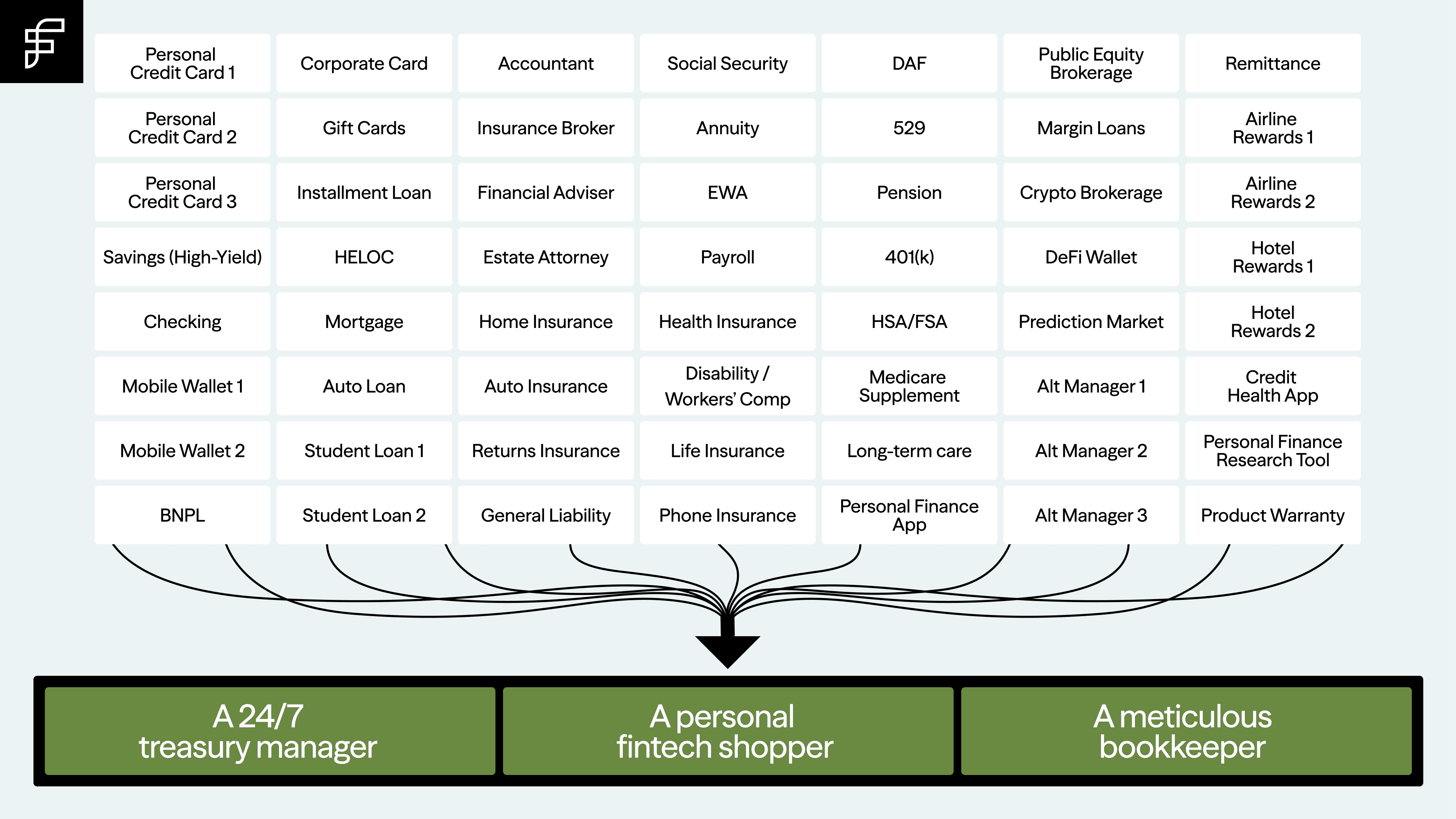
Read on to learn why consumer fintech won’t be a winner-takes-all story, and explore the three product paths we can see gaining traction in this new era.

Why isn’t consumer fintech a winner-takes-all story?

To start, let’s take a look at one of the current winners, Robinhood, and the challenges the company will face in the agentic era.

Robinhood is an exceptional company. Over the past decade, they’ve built and bought functionality across core brokerage, active trading, crypto, banking, lending, retirement, and wealth, as well as knowledge and social. As of year-end 2025, the platform supported 27M funded accounts and $324B assets under custody, generating $4.4B revs (50%+ YoY growth) and $1.9B net income (35%+ YoY).

Source: ARK Invest

From an ARPU and LTV perspective, Robinhood’s closed architecture is killer. To be the “top of wallet” choice for just a single financial product is lucrative, let alone five to ten of them. The bundling approach works when stickiness and brand love is your primary moat: every time an existing user thinks about adopting a new financial product, their default choice is Robinhood. In the pre-AI era, where consumers were the main customers and inertia won the day, this makes a ton of sense. Now, the all-in-one provider approach is under threat. There are a couple of reasons why.

First, finding the “right” product becomes easier and cheaper than ever with AI. There are too many financial offerings, and therefore too many specialists, across the market for Robinhood to be the best at everything. Brand consolidation is an arduous strategy given the abundance of choice; it becomes even harder when AI demonstrably lowers the barrier to product discovery. 

Next, switching costs will go to zero. It’s no longer on the user to open and close accounts, fill forms and fight with customer service. Now, the onus of product picking and switching is transferred to an always-working, very patient agent.

Do bundling and brand will really matter in an AI world? Not nearly as much as they did before.

While Robinhood is adept at shipping AI-native functionality like their agentic trading and credit card products, these remain closed ecosystems in what AI should make an increasingly open playing field. Because of that, we believe there is a broader opportunity to build a net new consumer platform that meets users where they are and makes our increasingly unbundled stack far more manageable.

What the next great consumer fintech looks like: always-on dynamic analysis, truly neutral, and able to execute

To truly transform the consumer experience, an AI-native platform must aggregate, analyze, recommend, and execute. The first three items are table stakes: functionality already exists across platforms like Wealthfront, Monarch, Betterment, and others. 

If a platform is going to help users understand their full financial picture, it needs to start by accessing and understanding the underlying data in deeper and more flexible ways. Pairing a robust personal dataset with purpose-built LLMs means analysis and recommendation can be dynamic based on ongoing requests, and continually improve as the agent learns. The key here is to not optimize for point solutions, but rather construct a full stack playbook that fits a user’s current financial situation and future goals. 
Execution is the real unlock in the era of agents. Being able to open and close accounts, actively manage subscriptions, execute trades, and move money on behalf of a user closes the loop. This was relatively impossible before breakthroughs in agentic credentialing and security, payment tokenization, and MCP technology. Crucially, users are also becoming more comfortable with this paradigm shift.

Now that we have all of the pieces in play, there are three product paths through which we can potentially see this playing out.

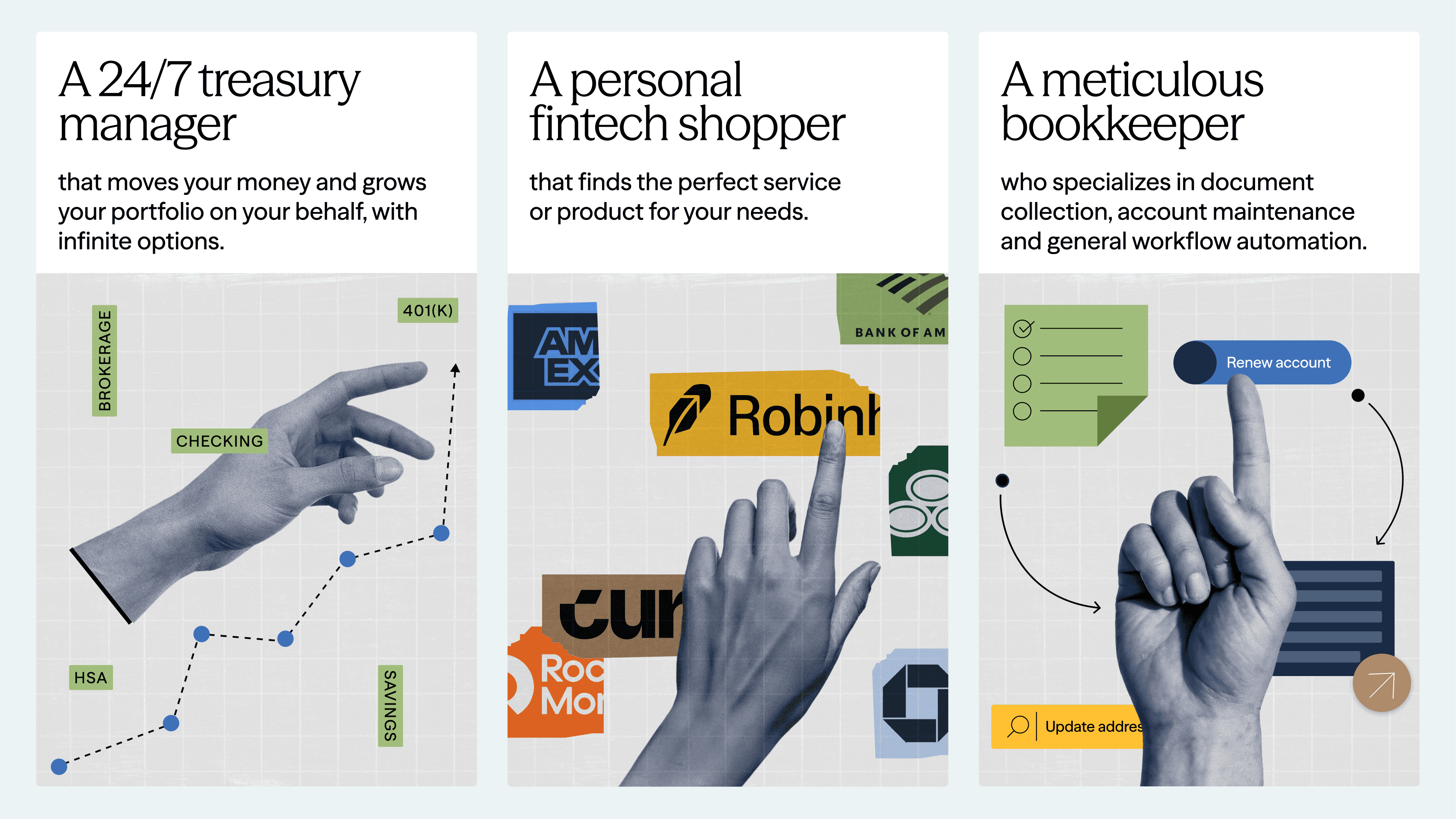
A 24/7 personal treasury manager that moves your money and grows your portfolio on your behalf, with infinite options
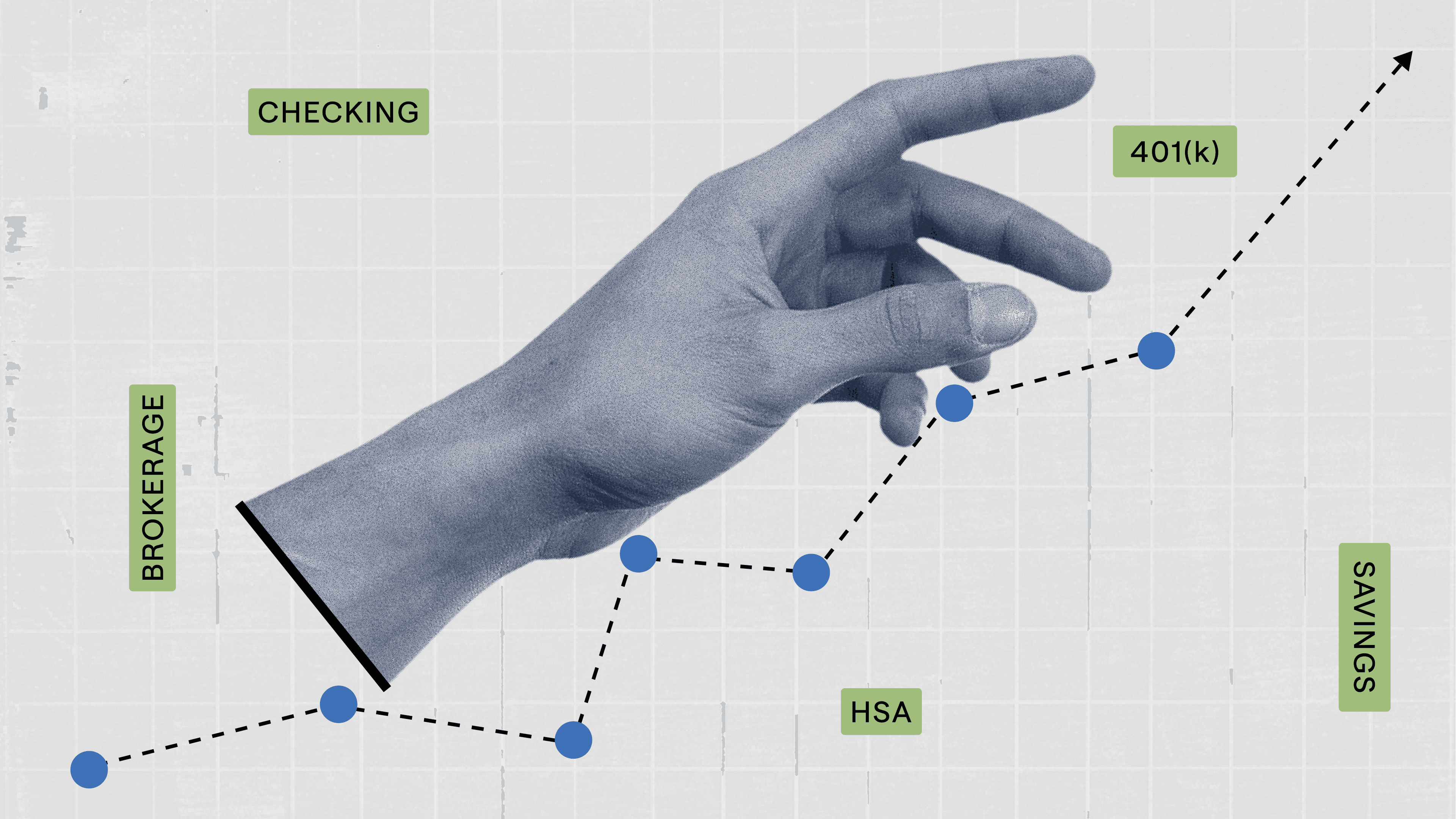
Most consumers don’t have a treasury strategy, rather they accumulate accounts over time. Each product is managed independently, but every financial decision affects the others. Rather than periodically logging in to rebalance a portfolio or move excess cash into savings, an always-on AI-native treasury agent would constantly evaluate where every dollar should live based on the user’s goals, tax situation, spending habits, market conditions, and available financial products.

Execution is what separates this from today’s personal finance tools. The 24/7 personal treasury manager doesn’t just recommend opening an HSA or moving idle cash into a money market fund, it actually does it. It pays down high-interest debt when appropriate, harvests tax losses, reallocates investments, moves excess cash into the highest-yield vehicle available, refinances loans when economics improve, and continuously optimizes liquidity. Now, every consumer gets something that previously only existed for family offices and large corporations.

A personal fintech shopper that finds the perfect service or product for your needs
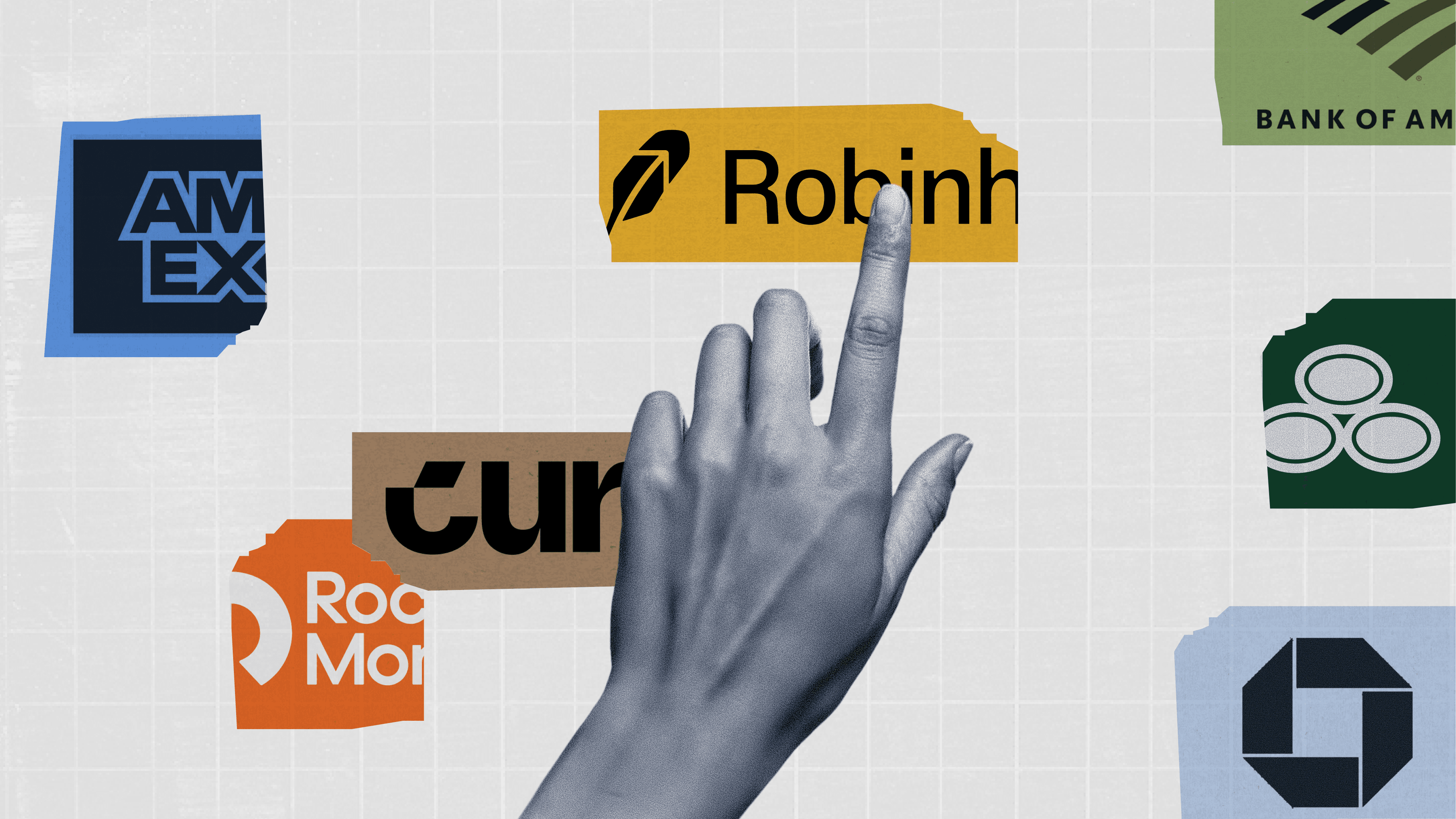
With thousands of choices across checking accounts, mortgages, insurance policies, credit cards, investment products, and more, it’s impossible to “do all the necessary research.” How do you make sure you’re using the best services for your financial situation, and that nothing is falling through the cracks? If managing your financial tools isn’t something you’re passionate about, it’s easy to get overwhelmed. This superabundance of choice is what makes branding and bundling so attractive today.

But these attributes are meaningless to an agent. A personal fintech shopper that understands a user’s financial profile can proactively search for better alternatives that offer more utility. For example, a user moving states might automatically receive recommendations for lower-cost insurance, better mortgage refinancing opportunities, and local banking options. A salary increase could trigger recommendations for new tax strategies, retirement accounts or wealth management products. Of course, the personal shopper doesn’t just recommend products—it also executes, handling the account opening, policy purchasing, form filling, and more. Consumers can trust that the financial services they subscribe to are continually optimized, with very little oversight.

A meticulous bookkeeper who specializes in document collection, account maintenance, and general workflow automation

Much of personal finance has little to do with investing or budgeting and everything to do with admin. Consumers spend countless hours organizing and updating, opening and closing, fighting a customer rep (who are less and less likely to be human these days). Overseeing everything—especially the act of coordinating between different organizations and platforms—can quickly approach the scope of a part-time job (or at least the mental headspace of one).

An AI-native bookkeeper removes the bulk of this administrative burden. The agent knows when insurance policies are renewing and can request missing tax documents before filing deadlines, update mailing addresses across institutions after a move, and more. The agent becomes the knowledge worker; as it develops a longer relationship with its user, it will become the true financial memory layer—maintaining records, surfacing important deadlines, and ensuring nothing falls through the cracks. Peace of mind is within reach.

The intelligent layer on top of everything—and a new location where brand resides

All three product paths require neutrality Robinhood can’t and won’t want to offer. Robinhood’s main goal is to increase wallet share, whereas an AI-native financial operating system should be indifferent to where assets reside. Furthermore, Robinhood only has visibility into activity on Robinhood, while a true financial bookkeeper needs a unified view across the entire financial stack.

The new fintech platform is default neutral: a Swiss bank employed with superpower agents. Rather than requiring ownership of every account type, it acts as the intelligent layer on top of everything. In a world where branding and bundling no longer create moats, seamless UX and autonomous execution are everything.

In this new world, brand is still important to consumers, but it becomes unbundled from a specific financial platform. Instead, a brand becomes associated with the agent or agents an organization offers. Which means that the utility of that agent is paramount to a company’s success.

How we get there: reliable data connections and creative distribution

Structurally, the biggest hurdle to building a fully integrated platform is the integrations themselves. Plaid remains the dominant data aggregation player and has seen a renewed growth trajectory over the past 12-24 months: it grew annual recurring revenue 40%+ in 2025 to over $500M (vs 24% growth in 2024) and raised at $8B earlier this year. However, a platform built on Plaid today will not drive meaningfully improved or delightful consumer experiences. Links are frequently broken and increasingly contested by the banks themselves.

If a platform’s core value proposition is to unify financial intelligence and then act on subsequent analysis, the outcome is only as good as the data coming in. If balances are stale, transactions are miscategorized, or connections drop, the product fails and trust is lost. To bridge the gap until we solve the data connectivity problem, we need to see Plaid-like players built for the AI era, or teams that leverage agentic credentialing and direct integrations.

Of course, there is also the distribution question. A net new platform that does not immediately require users to rip and replace existing financial products faces an interesting conundrum: there isn’t necessarily a switching cost to adopt, but there also isn’t an immediate “why now.” The winning companies will likely enter through a single, high-value workflow that immediately demonstrates ROI. Consumers rarely care about the underlying technology powering a product; they care about outcomes. Perhaps the agent finds thousands of dollars in tax savings, or automatically lowers insurance premiums, putting hundreds of dollars back into users’ pockets each month. The winning AI-native platform won’t market itself as a financial operating system or autonomous treasury manager, it will promise concrete results. 

Finally, third-party neutrality creates real opportunity for channel partnerships. As agents upend financial services and traditional acquisition strategy, institutions with existing distribution will be forced to play nice or risk getting passed over by the agents evaluating them. Rather than competing head-on amongst each other, the AI layer and the underlying service providers are well positioned to join forces, or at least find complementary ways to work with each other.

A call for founders building the future of fintech apps and data layers

Are you already building for this new fintech agent–powered future? Or someone who sees a new product path we haven’t identified yet? We’d love to meet with you!

At Foundation, we’re interested in those providing the picks and shovels—namely the data and execution layers—that will enable and power these apps. We’re also excited to back founders building at the app layer, those going against the Robinhoods of the world to build the next great consumer fintech app. 

We have a history of backing exciting B2B and consumer companies across this stack: One Finance, Current, Spinwheel, PayOS, and Stripe, to name a few, and we have no plans of stopping there. If you’re building in this space, please reach out!

Get insights directly to your inbox.

Set your newsletter preferences:

Set your newsletter preferences:

Posted

0 MIN READ

Show Outline

Imagine never needing to manage your financial accounts manually. An agent acts as a 24/7 personal treasury manager, moving your money and growing your portfolio on your behalf. Another agent shops around for the best products and rates, serving recommendations for lower-cost insurance, better mortgage refinancing opportunities, and new tax strategies that shift dynamically based on life changes like a raise, a move, or having a kid. Meanwhile, a separate agent acts as your financial bookkeeper, requesting missing tax documents, updating mailing addresses across accounts, and interacting with other AI-powered customer service agents. 

The agentic era is poised to transform the way we curate and interact with our financial stack. While software and services move into a world of bundling and efficiency, consumer financial services in the US continue to mushroom and fragment. Looking ahead, we remain optimistic that the next great consumer financial app will not be a walled garden of single-branded products, but a neutral ecosystem delivering both visibility and execution across our increasingly diverse financial stack.

Read on to learn why consumer fintech won’t be a winner-takes-all story, and explore the three product paths we can see gaining traction in this new era.

Why isn’t consumer fintech a winner-takes-all story?

To start, let’s take a look at one of the current winners, Robinhood, and the challenges the company will face in the agentic era.

Robinhood is an exceptional company. Over the past decade, they’ve built and bought functionality across core brokerage, active trading, crypto, banking, lending, retirement, and wealth, as well as knowledge and social. As of year-end 2025, the platform supported 27M funded accounts and $324B assets under custody, generating $4.4B revs (50%+ YoY growth) and $1.9B net income (35%+ YoY).

Source: ARK Invest

From an ARPU and LTV perspective, Robinhood’s closed architecture is killer. To be the “top of wallet” choice for just a single financial product is lucrative, let alone five to ten of them. The bundling approach works when stickiness and brand love is your primary moat: every time an existing user thinks about adopting a new financial product, their default choice is Robinhood. In the pre-AI era, where consumers were the main customers and inertia won the day, this makes a ton of sense. Now, the all-in-one provider approach is under threat. There are a couple of reasons why.

First, finding the “right” product becomes easier and cheaper than ever with AI. There are too many financial offerings, and therefore too many specialists, across the market for Robinhood to be the best at everything. Brand consolidation is an arduous strategy given the abundance of choice; it becomes even harder when AI demonstrably lowers the barrier to product discovery. 

Next, switching costs will go to zero. It’s no longer on the user to open and close accounts, fill forms and fight with customer service. Now, the onus of product picking and switching is transferred to an always-working, very patient agent.

Do bundling and brand will really matter in an AI world? Not nearly as much as they did before.

While Robinhood is adept at shipping AI-native functionality like their agentic trading and credit card products, these remain closed ecosystems in what AI should make an increasingly open playing field. Because of that, we believe there is a broader opportunity to build a net new consumer platform that meets users where they are and makes our increasingly unbundled stack far more manageable.

What the next great consumer fintech looks like: always-on dynamic analysis, truly neutral, and able to execute

To truly transform the consumer experience, an AI-native platform must aggregate, analyze, recommend, and execute. The first three items are table stakes: functionality already exists across platforms like Wealthfront, Monarch, Betterment, and others. 

If a platform is going to help users understand their full financial picture, it needs to start by accessing and understanding the underlying data in deeper and more flexible ways. Pairing a robust personal dataset with purpose-built LLMs means analysis and recommendation can be dynamic based on ongoing requests, and continually improve as the agent learns. The key here is to not optimize for point solutions, but rather construct a full stack playbook that fits a user’s current financial situation and future goals. 

Execution is the real unlock in the era of agents. Being able to open and close accounts, actively manage subscriptions, execute trades, and move money on behalf of a user closes the loop. This was relatively impossible before breakthroughs in agentic credentialing and security, payment tokenization, and MCP technology. Crucially, users are also becoming more comfortable with this paradigm shift.

Now that we have all of the pieces in play, there are three product paths through which we can potentially see this playing out.

A 24/7 personal treasury manager that moves your money and grows your portfolio on your behalf, with infinite options

Most consumers don’t have a treasury strategy, rather they accumulate accounts over time. Each product is managed independently, but every financial decision affects the others. Rather than periodically logging in to rebalance a portfolio or move excess cash into savings, an always-on AI-native treasury agent would constantly evaluate where every dollar should live based on the user’s goals, tax situation, spending habits, market conditions, and available financial products.

Execution is what separates this from today’s personal finance tools. The 24/7 personal treasury manager doesn’t just recommend opening an HSA or moving idle cash into a money market fund, it actually does it. It pays down high-interest debt when appropriate, harvests tax losses, reallocates investments, moves excess cash into the highest-yield vehicle available, refinances loans when economics improve, and continuously optimizes liquidity. Now, every consumer gets something that previously only existed for family offices and large corporations.

A personal fintech shopper that finds the perfect service or product for your needs

With thousands of choices across checking accounts, mortgages, insurance policies, credit cards, investment products, and more, it’s impossible to “do all the necessary research.” How do you make sure you’re using the best services for your financial situation, and that nothing is falling through the cracks? If managing your financial tools isn’t something you’re passionate about, it’s easy to get overwhelmed. This superabundance of choice is what makes branding and bundling so attractive today.

But these attributes are meaningless to an agent. A personal fintech shopper that understands a user’s financial profile can proactively search for better alternatives that offer more utility. For example, a user moving states might automatically receive recommendations for lower-cost insurance, better mortgage refinancing opportunities, and local banking options. A salary increase could trigger recommendations for new tax strategies, retirement accounts or wealth management products. Of course, the personal shopper doesn’t just recommend products—it also executes, handling the account opening, policy purchasing, form filling, and more. Consumers can trust that the financial services they subscribe to are continually optimized, with very little oversight.

A meticulous bookkeeper who specializes in document collection, account maintenance, and general workflow automation

Much of personal finance has little to do with investing or budgeting and everything to do with admin. Consumers spend countless hours organizing and updating, opening and closing, fighting a customer rep (who are less and less likely to be human these days). Overseeing everything—especially the act of coordinating between different organizations and platforms—can quickly approach the scope of a part-time job (or at least the mental headspace of one).

An AI-native bookkeeper removes the bulk of this administrative burden. The agent knows when insurance policies are renewing and can request missing tax documents before filing deadlines, update mailing addresses across institutions after a move, and more. The agent becomes the knowledge worker; as it develops a longer relationship with its user, it will become the true financial memory layer—maintaining records, surfacing important deadlines, and ensuring nothing falls through the cracks. Peace of mind is within reach.

The intelligent layer on top of everything—and a new location where brand resides

All three product paths require neutrality Robinhood can’t and won’t want to offer. Robinhood’s main goal is to increase wallet share, whereas an AI-native financial operating system should be indifferent to where assets reside. Furthermore, Robinhood only has visibility into activity on Robinhood, while a true financial bookkeeper needs a unified view across the entire financial stack.

The new fintech platform is default neutral: a Swiss bank employed with superpower agents. Rather than requiring ownership of every account type, it acts as the intelligent layer on top of everything. In a world where branding and bundling no longer create moats, seamless UX and autonomous execution are everything.

In this new world, brand is still important to consumers, but it becomes unbundled from a specific financial platform. Instead, a brand becomes associated with the agent or agents an organization offers. Which means that the utility of that agent is paramount to a company’s success.

How we get there: reliable data connections and creative distribution

Structurally, the biggest hurdle to building a fully integrated platform is the integrations themselves. Plaid remains the dominant data aggregation player and has seen a renewed growth trajectory over the past 12-24 months: it grew annual recurring revenue 40%+ in 2025 to over $500M (vs 24% growth in 2024) and raised at $8B earlier this year. However, a platform built on Plaid today will not drive meaningfully improved or delightful consumer experiences. Links are frequently broken and increasingly contested by the banks themselves.

If a platform’s core value proposition is to unify financial intelligence and then act on subsequent analysis, the outcome is only as good as the data coming in. If balances are stale, transactions are miscategorized, or connections drop, the product fails and trust is lost. To bridge the gap until we solve the data connectivity problem, we need to see Plaid-like players built for the AI era, or teams that leverage agentic credentialing and direct integrations.

Of course, there is also the distribution question. A net new platform that does not immediately require users to rip and replace existing financial products faces an interesting conundrum: there isn’t necessarily a switching cost to adopt, but there also isn’t an immediate “why now.” The winning companies will likely enter through a single, high-value workflow that immediately demonstrates ROI. Consumers rarely care about the underlying technology powering a product; they care about outcomes. Perhaps the agent finds thousands of dollars in tax savings, or automatically lowers insurance premiums, putting hundreds of dollars back into users’ pockets each month. The winning AI-native platform won’t market itself as a financial operating system or autonomous treasury manager, it will promise concrete results. 

Finally, third-party neutrality creates real opportunity for channel partnerships. As agents upend financial services and traditional acquisition strategy, institutions with existing distribution will be forced to play nice or risk getting passed over by the agents evaluating them. Rather than competing head-on amongst each other, the AI layer and the underlying service providers are well positioned to join forces, or at least find complementary ways to work with each other.

A call for founders building the future of fintech apps and data layers

Are you already building for this new fintech agent–powered future? Or someone who sees a new product path we haven’t identified yet? We’d love to meet with you!

At Foundation, we’re interested in those providing the picks and shovels—namely the data and execution layers—that will enable and power these apps. We’re also excited to back founders building at the app layer, those going against the Robinhoods of the world to build the next great consumer fintech app. 

We have a history of backing exciting B2B and consumer companies across this stack: One Finance, Current, Spinwheel, PayOS, and Stripe, to name a few, and we have no plans of stopping there. If you’re building in this space, please reach out!

Get insights directly to your inbox.

Set your newsletter preferences:

Get insights directly to your inbox.

Set your newsletter preferences:

Set your newsletter preferences: