


Today, Pulse Security AI emerged from stealth to announce its agentic platform for security leaders and an $8M seed round led by Foundation Capital, with participation from Zetta Venture Partners and a group of prominent cyber operators and angels.
Pulse gives the security leader something every other C-suite executive takes for granted: a system to run their function. The CRO has Salesforce. The CHRO has Workday. The CFO has SAP. The CISO? A stale spreadsheet, a tangle of siloed tools, and a prayer.
This is a company we helped build rather than found through the traditional VC search. In September 2024, the founders and I sat down to brainstorm what AI agents could actually do for the person running security. Each session, we cut away vagueness and refined the solution into something more real, and by December we could see it: a system of record and system of intelligence for the person accountable for security. We incubated the company from that first conversation, stayed in the room as the founders shaped it, and invested at inception when it launched in January 2025.
I've been on the board since the beginning. Here's how the journey began, why we invested, and what's ahead.

With Dan Lamorena, Mike Armistead and Robert Hipps (left to right) at Foundation Capital’s Palo Alto office
A twenty-year relationship, three companies deep
We’ve known Mike Armistead for almost twenty years, and in that time he's been consistently early and consistently right.
Mike started as the first product manager for Reed Hastings at Pure Software. This was Reed’s first company before he founded what would become one of our most famous portfolio companies - Netflix. Mike later joined Foundation as an EIR for about a year and a half. Then came Fortify, where he co-founded the first SAST company ever built and helped create the application security category; HP acquired it in 2010. His next act, Respond Software, built the AI SOC before “AI SOC” was a category. Foundation backed Respond at inception and did every round, seed through B, and I got a firsthand look at what makes him such an exceptional leader. FireEye Mandiant acquired Respond in 2020, Mandiant went to Google, and the whole team landed there together.

Catching up with Mike in Palo Alto, CA in May 2022 to celebrate Google’s acquisition of Mandiant and reminisce about the Respond Software days
But Pulse isn't just Mike. It's a team of seasoned veterans who have built and operated together before.
Robert Hipps (President & CPO) is the kind of engineering leader who attracts high-density talent. He was early and key at Oracle and Informatica, worked alongside Mike at HP, and at Google co-ran SecLM, Google's security-focused LLM. Nick Gilligan (VP Engineering) was a founding engineer at Respond and co-ran SecLM development with Robert. He studied CS at Princeton, spent time as an IB analyst, and had founded a company before. Robert and Nick run engineering and product together, as one, a fusion most companies spend years trying to achieve, and exactly how the best software gets built today.
Dan Lamorena rounds out the group as the first go-to-market hire. Dan was CMO at Respond, was with the team at Google, and ran the CISO programs there. Distribution matters more than ever, and telling the Pulse story right needs someone with deep trust from the buyer network.
This team isn’t new to startups. They're deep builders and operators, and that experience is what lets them understand this problem in the first place.
About Sid
Sid is a partner at Foundation Capital, where he leads the firm’s cybersecurity practice and invests across the enterprise stack, from apps to infrastructure. He was an early investor in Prime Security, AirMDR, Stacklet, AegisAI, Pulse Security, and DevZero. Previously, he worked in private equity investor and advised tech companies at Barclays Capital.

Are you protected, or are you just lucky?
Over the last decade, the CISO role has climbed the corporate ladder, evolving from a manager under the CIO, to the CIO's peer, to an executive who reports to the board and briefs the audit committee quarterly. Boards care about two liabilities above almost everything else: financial and security.
But unlike a CFO answering questions grounded in accounting and real numbers, the CISO fields questions that are broad and uniquely hard to answer: “I read about a cyberattack in the WSJ this morning, does it affect us?” “How should I think about our cyber risk?” The data needed to answer isn't just siloed, it's difficult to even locate in today's tools.
Meanwhile, security teams at mid-market and public companies have grown from 5 to 10 people to anywhere from 200 to 1,500 and beyond. The market keeps building platforms to help those teams operate across cloud, endpoint, identity, network, and application, but the tooling for the CISO just hasn't shown up. And the stakes are now personal: in the wake of Joe Sullivan's case, security leaders face personal and legal liability.
Underneath all of it is an uncomfortable truth: this is really about security program effectiveness, and there has never been a tool to measure it. Are you protected, or are you just lucky?
Today most of this work is human middleware: for example Accenture, Deloitte, and PwC consultants running NIST CSF frameworks and risk assessments by hand. The opportunity is to replace that effort, or dramatically shrink it, with AI agents. The signals are everywhere: NIST CVE submissions are up 263% from 2020 to 2025, VulnCheck found 884 newly exploited vulnerabilities in 2025 with roughly 29% exploited on or before the day the CVE was published, and across more than 80 CISO interviews we heard the same pattern again and again.

Mike and Robert speaking with Hans Gustavson (CISO at Workato) at Foundation Capital’s annual RSA Happy Hour in April 2025
An intelligent system of record for cybersecurity strategy
Pulse is both a system of record and a system of intelligence for the security leader. It's where they formulate strategy, automate program-level workflows, communicate with clarity, and, for the first time, measure whether their program is actually working instead of flying blind.
That combination is the whole point. Capturing the program requires a database; automating the work has always required an army of consultants. Doing both inside one system wasn't possible until the technology caught up. With today's LLMs, it has.
The engine underneath is a context graph. It sits above the technical silos teams already run (EDR, cloud, identity) and pulls in the unstructured data where a program's institutional knowledge lives. Risks, environment, regulatory obligations, people, and business priorities, integrated into one consolidated picture instead of a dozen disconnected ones.
Pulse doesn't replace the tooling a security team already runs; it sits upstream and makes everything already in place more valuable. That also makes it a net-new solution, which is both its biggest opportunity and its most interesting challenge. There's no pre-defined budget line waiting for a product like this, but across those 80 CISO conversations we kept hearing that leaders are rethinking their programs for the agentic era from the ground up. Net-new is an advantage today, not a liability. We see it displacing spend on expensive consultants and on siloed, feature-level tooling like vendor management.
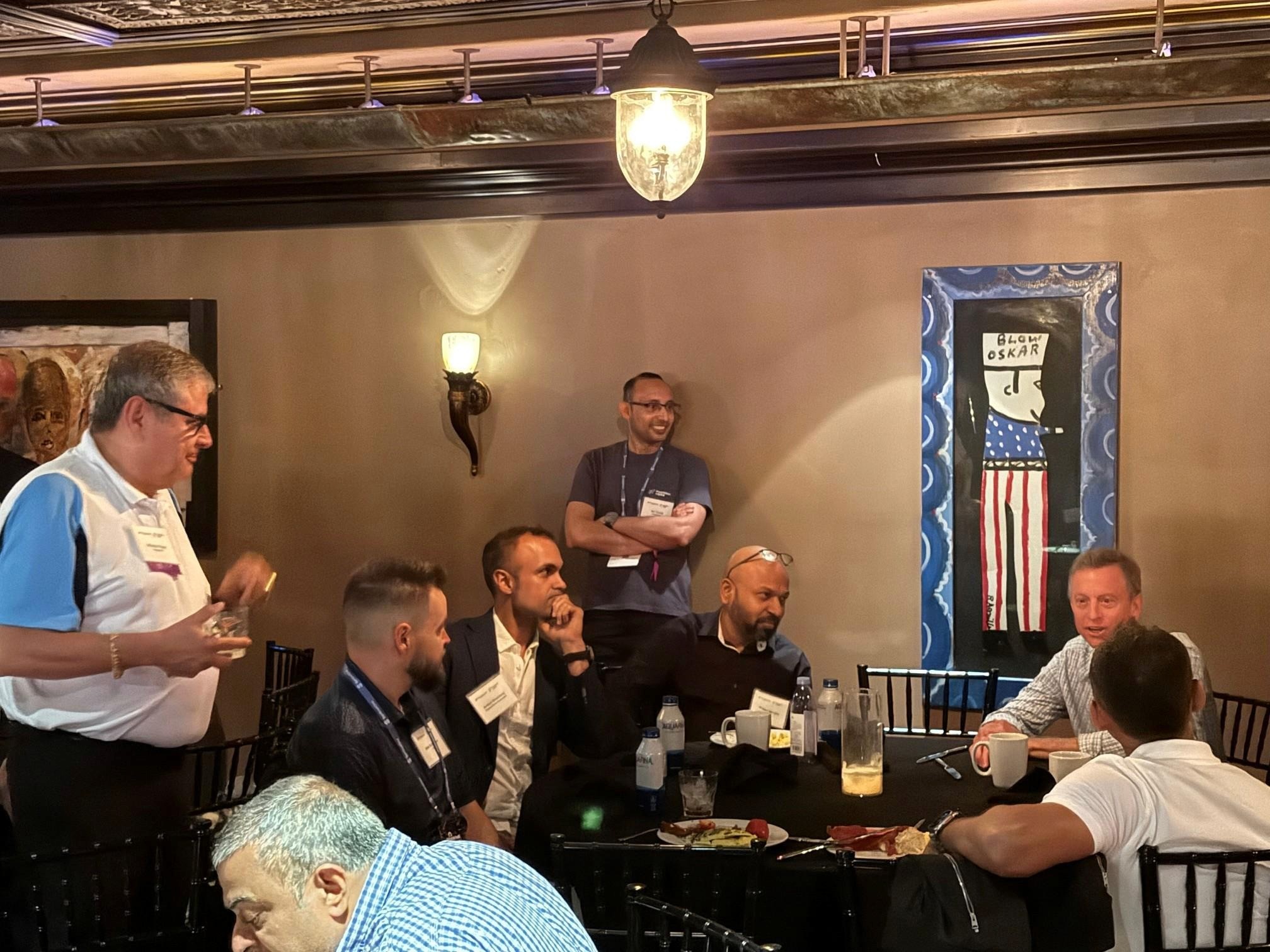
Mike explaining the Pulse Security vision to a group of CISOs at Foundation Capital’s annual Black Hat CISO Brunch in August 2025
What brought us the most conviction was watching engagements that historically took months of human time now run on Pulse:
Program maturity assessment against NIST CSF: Pulse produces the artifacts a board asks for: a maturity spider diagram, gap reports, and a top-threats readout.
Program status mapping: Pulse ingests the spreadsheets, audit reports, and JIRA tickets a program already lives in, organizes them into a structured catalog of risks, initiatives, and workstreams, and helps define outcome-based metrics to track against them.
Vendor health and status review: Pulse pulls the details that matter across top vendors (SLAs, cost, contract terms) to show where the real exposure sits.
Mythos assessment: When a CISO needs to understand exposure to Mythos-related vulnerabilities, Pulse has already pulled the CSA Mythos framework, correlated signals across existing tools, translated it into business risk, and surfaced what's newly relevant.
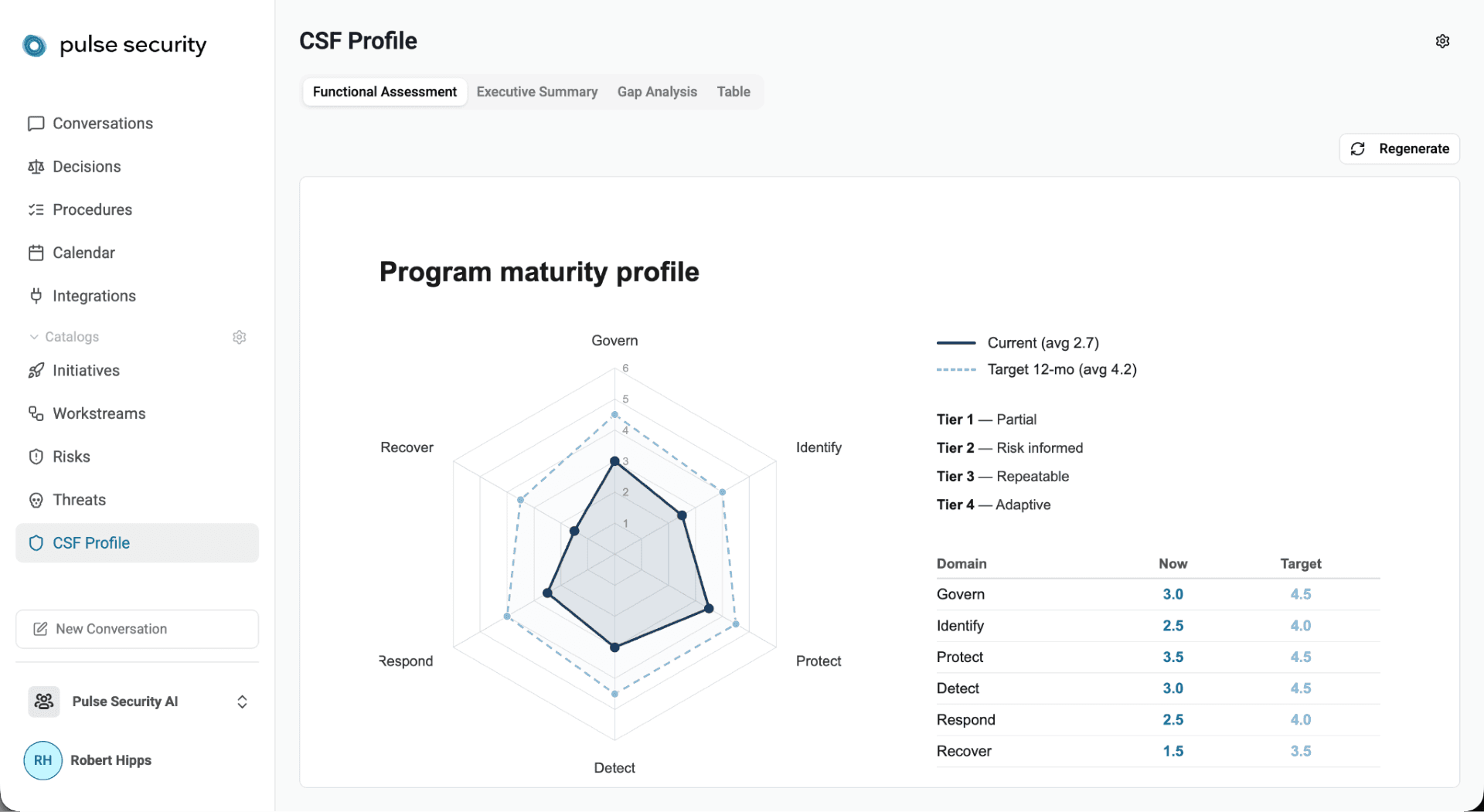
Pulse Security’s autonomous NIST CSF assessment in action
Each of these once meant a multi-month engagement with Accenture, Deloitte, or PwC. On Pulse they take days.
Caroline Tsay, Pulse advisor and public-company director at Coca-Cola, Morningstar, and NiCE, put it from the board's side of the table: “CISOs really need a technology platform to support them in security leadership, and now's the right time for it.” With Pulse as the operational foundation, security leaders can walk into the boardroom and confidently answer the questions on risk, disclosures, budget, and program maturity that a director like Caroline would ask.
Building for the security leader
For years, the security industry built better and better tools for every practitioner, then sold their merits to security leaders. Pulse flips that. A decade ago the industry fought to get the CISO into the boardroom. We won. Now the CISO sits there fielding questions their spreadsheets can't answer. That's the problem Pulse was built to solve.
For twenty years we've watched Mike call where security was going before the market did, then build a great company from it. Fortify pioneered AppSec. Respond pioneered AI SOC. Pulse is his next move, this time with the strongest team he's ever assembled.
All of us at Foundation Capital are proud to support Pulse Security's mission. Congratulations to Mike, Robert, Nick, Dan, and the entire Pulse team.
Pulse Security AI is headquartered in Los Altos, CA, and is actively hiring across engineering, product, AI, and go-to-market roles.
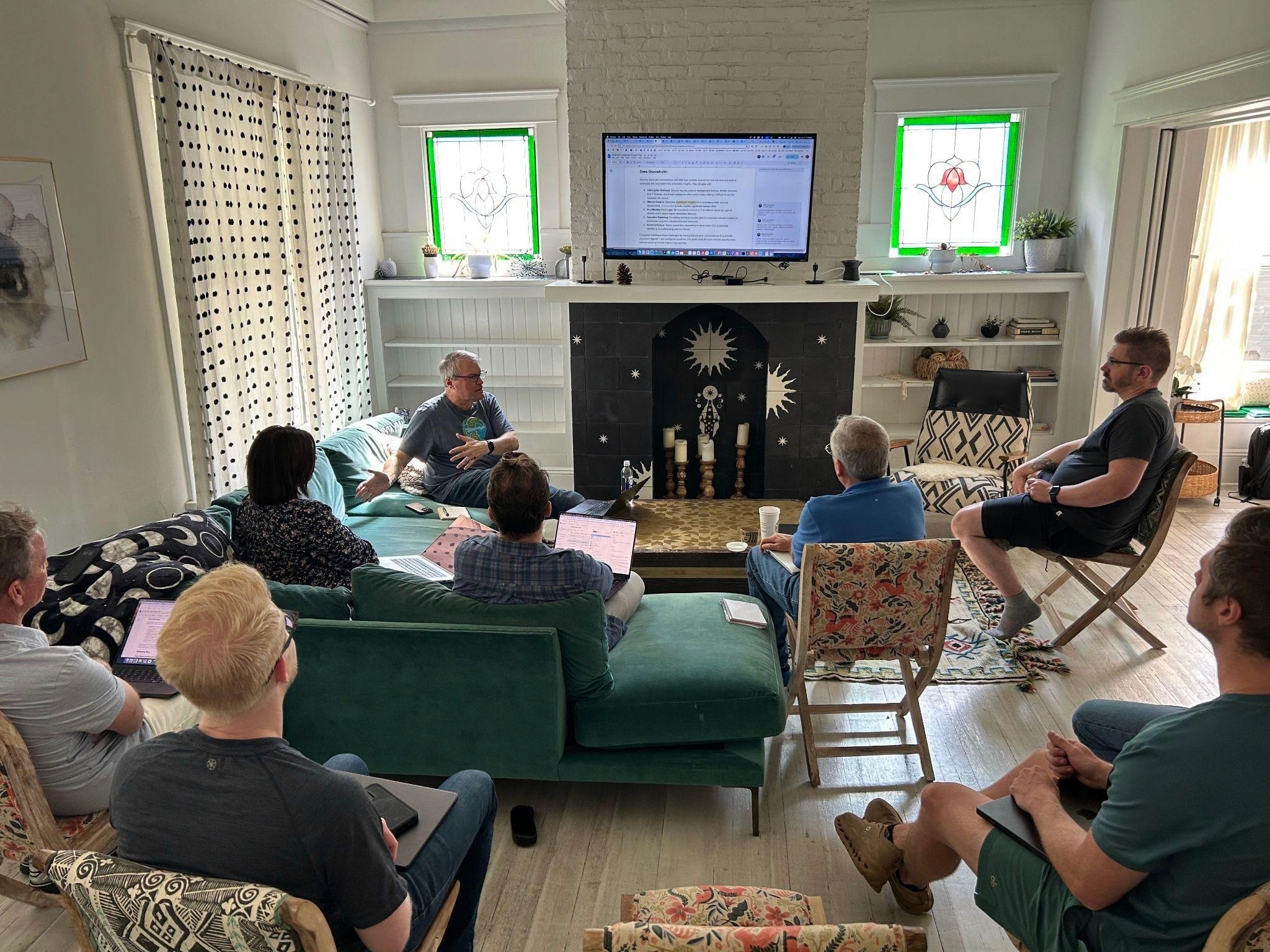
The Pulse Security team at their September 2025 offsite in Atlanta, GA