Follow Along
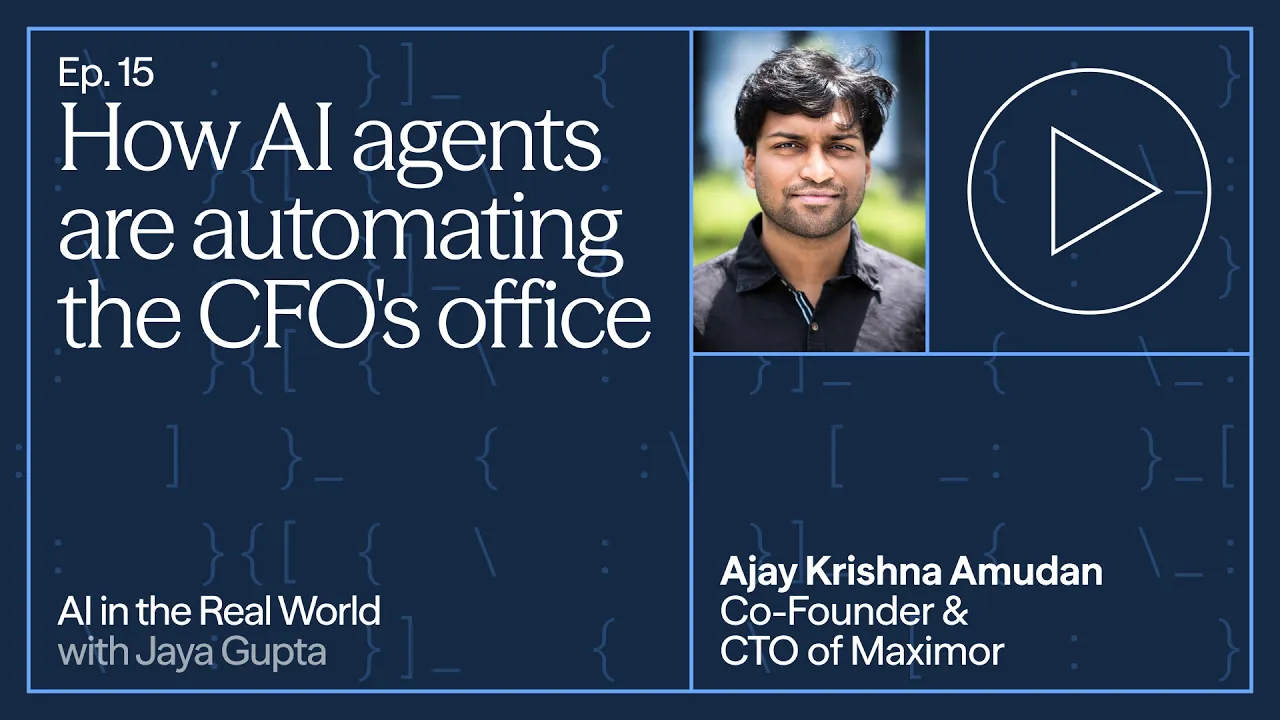
What does it take to make AI agents you can actually trust with your books?
Ajay Krishna Amudan, co-founder and CTO of Maximor, joins Foundation Capital partner Jaya to talk about building an autonomous finance platform for the office of the CFO. Maximor’s agents handle revenue recognition, month-end close, reconciliations, AR, AP, and billing ops in ways that finance teams can actually audit. Instead of fighting to become the next system of record, Maximor chose to become ERP-agnostic, working across whatever ERPs a customer already has, even if they have different data models.
Ajay and Jaya dig into the technical decisions behind creating trustworthy AI for finance: an "adversarial agent architecture" where agents audit each other like a human auditor would, with built-in verifiability. They talk about when post-training actually improves quality (versus just cost), along with how roles are shifting: finance teams are becoming custodians of policies and judgments as agents take on more of the day-to-day work.
The discussion closes Ajay's hardest founder lesson and his vision for the future, where Maximor becomes every company's central decision-making brain.
What we covered:
00:00 - Cold open, Ajay on what a fully re-architected finance function looks like
00:40 - Intro to Maximor
01:18 - Maximor’s design decision to stay ERP-agnostic
03:13 - Treating finance as a decomposable problem and building for verifiability by design
04:05 - Adversarial agents explained
06:24 - Why "doing the work" is the easy part in finance
06:56 - How work patterns are changing with AI-powered finance ops
08:13 - Lessons from watching OpenAI/Sam Altman up close at Microsoft
11:07 - Founder lessons, including the shift to full-stack ownership
13:05 - The promise of continual learning
15:15 - Maximor's 5-10 year vision as a "company brain"
Read the transcript:
Jaya: You've written that finance is one of the last major enterprise functions not fundamentally re-architected for the AI era. What does the fully re-architected version actually look like?
Ajay: You're going to have the ability to trace why you have this much revenue all the way down to how a particular prospect moved through the sales cycle. That's going to fundamentally change the depth of information you have to make decisions. Folks who spend a lot of time doing operational work — that's going to get delegated to agents. The 5-to-10-year version of Maximor is going to become closer to this company brain enabling strategic finance.
Jaya: Thanks for coming on AI in the Real World, Ajay. We really appreciate having you on. Tell us a little about what Maximor is.
Ajay: Thank you for having me, Jaya. Maximor is the autonomous finance platform for the office of the CFO. Our agents do the actual work of finance — that means revenue recognition, month-end close, reconciliations, AR, AP, and billing ops. And we do all of this work in an audit-ready way. At a high level, that means our users can verify the work of our agents, inspect the evidence, and when the agent gets it wrong, they can override it. That loop, where the user gives feedback, is how our system learns over time and gets better.
Jaya: One thing that's interesting about Maximor is you made the architectural and design decision to be ERP-agnostic. Tell us about why you made that decision.
Ajay: If you look at the market broadly, there's a huge chunk that is neither enterprise nor mid-market. We decided pretty early on that most of these companies aren't committed to their ERP, and that's proven to be true over the last year.
Jaya: People, when they talk about large enterprise companies — the F500 — say they have one ERP. But in fact, usually they have something like 62 ERPs. What's actually the hardest part of unifying data across so many different ERPs? And what does AI make easier, and what does it maybe make harder?
Ajay: You're right — some of our customers have multiple ERPs. In some cases, multiple instances of the same ERP; in others, completely different ERPs. Many of our customers are quite acquisitive, so you might have bought a business in the last six or twelve months, and that business comes with its own ERP. There are a number of problems that make this painful — three ERPs might call the same thing a "transaction," but it can look very different. Unifying data models is definitely one of the fundamental problems.
What we've realized is that you shouldn't be optimizing for full unification, which is what used to happen in the past. Our choices have tended toward allowing customer-specific variance to happen more naturally. Everything from our database choice to our data models and schema is predicated on the fact that two different customers may have the same ERP but very different data models, and a single customer can have three different ERPs with different data models. We allow for all of it — mapping the ontology quite deeply and allowing AI to do a lot of the heavy lifting in handling that variance is our architectural paradigm.
Jaya: Tell us more about those core architectural decisions — I think there's a lot to unpack here.
Ajay: From the very beginning, we looked at finance as a set of decomposable problems. That helped us go to market faster and get feedback faster. For example, we believe that although the work agents do gets better as models improve and harness engineering improves, at the end of the day, that work needs to be verified. We can't just delegate verification to the end user. So we made two key architectural choices. One was an agent architecture choice we call the adversarial agent architecture.. The other was building verifiability as a first-class citizen. Happy to speak more about both.
Jaya: I'd love to learn more. Let's start with adversarial agents. That sounds cool.
Ajay: The fundamental belief here is that there needs to be a verifiable spine to the way our agents do the work — you can have agents that verify the work of other agents, constantly critiquing it and checking that it makes sense. This works very naturally in our space, because that's what an auditor does. The auditor is this adversarial figure who comes in and critiques the work — in some sense, their number one job is actually to find holes in the work that's been done. That's how we've modeled our adversarial agents: the way an auditor would behave when inspecting the data.
Jaya: How do you think about which models to use, and when to use them?
Ajay: There's definitely a spectrum of complexity — you should use models that are appropriate for the type of task. That's been true for a while. When I looked at "token maxing" earlier this year, I didn't believe in it at all. Routing to the right model, and being thoughtful about when you use which one, is absolutely fundamental. We rate the complexity of the task we're trying to achieve and route to different models based on the level of sophistication we believe the task needs. We've built architecture on top of harnesses — if you can achieve the same task with fewer tokens or lower dollar cost, it's better to do that. We're also increasingly seeing that post-training models with enterprise-specific and process-specific data improves the model in certain ways — not in all cases, but in particular ones.
Jaya: Most people, when they talk about post-training open-weight models, talk about cost. Are you also seeing improvements in quality?
Ajay: Not in all tasks — in fact, I'd say not in most tasks. In certain tasks, yes. In tasks with a lot of deep enterprise context, that's where we see the most improvement, and that's really speaking to quality, not just cost. Revenue is one workflow where we see that working. In treasury and cash, we don't see that need as much.
Jaya: What do you think most people get wrong about building at the intersection of AI and finance — not from a go-to-market sense, but a technical one?
Ajay: I'd say that doing the work is the most important part. It's not. Proving that your work is correct is a very big part of doing the work in finance. If you make decisions where you don't treat that as a first-class citizen, you can run into serious issues six months or a year down the line as you start working with more complex customers.
Jaya: One of the interesting things to double-click into here is that AI is changing the way work actually gets done. What new patterns have you seen, whether among accountants or finance folks, that have changed how they work by using Maximor?
Ajay: The way a lot of our customers have adapted is: they spend some time doing very basic verification and approval. A bit more time looking into cases where the agent isn't confident in its work — that might mean missing context, or it might just need a bit more verification before approving it. And a lot of time goes to these truly corner cases — subjective, interpretable in many different ways — which becomes a loop of creating new judgments and new policies. After enough iterations of this, humans start to see themselves as custodians of policies and judgments, rather than doers of the actual work. They're happy to delegate that work to agents, intervene only when necessary, and work at the level of judgments, policies, and key decisions that, once made, can be repeatedly applied.
Jaya: Who do you admire in this space?
Ajay: Because I was working at Microsoft, I had an interesting vantage point on how OpenAI started. In 2019, OpenAI began working with Microsoft, and I was working with the Azure CTO office quite closely at the time — so I had a unique lens on how far ahead of their time OpenAI was. They were willing to make certain bets — almost narrative bets — where you want to believe a certain world is possible, and years later, some of that comes true. Sam Altman is someone I admire, at least with respect to company building. He was far ahead of his time — ChatGPT was, in some sense, almost inevitable, years in the making. OpenAI started working with massive superclusters in Azure toward early 2019, and it took many iterations of GPT for all of that to finally come together. Having a vision you can work toward, even without knowing the exact sequence of steps, is something I admire, having seen that happen.
Elon is someone I'd say is very similar. Most recently, among many things he's done, is the narrative around space data centers. I was following that closely — when it first started, people said it wasn't possible, everybody wrote it off. Increasingly, it seems like it is possible. I was trying to figure out what changed — it was really just one person talking about the narrative, incrementally making it more palatable every few months and weeks, and eventually it became real. That's something I admire, and I think both of them have that. Another example is Vercel's CEO, Guillermo — when he speaks about vision, he's a lot more creative and adventurous. I try to see how I can use that in my day-to-day life. You have a lot of decisions that could break the company in the next month, but at the same time, you need to leave room for the creativity that can pay off over many quarters and years.
If you look at Maximor's vision today, we believe this isn't just an opportunity to take finance function spend and convert it into automation. It's going to end up in a state where finance starts broadly influencing the other functions of a business — the business models, the pricing decisions. We're already starting to see that happen organically with some of our customers. One customer with a pretty complex pricing model — because they can now do this deep instrumentation through our agents — can make pricing decisions on a per-prospect basis: "Can you come up with the best pricing model for this prospect?" That was something that was completely frowned upon before.
Jaya: What have been some of your lessons as a founder?
Ajay: One of the more painful lessons I learned, because I had certain beliefs, was that enterprise software is best built by a team of semi-specialists: your frontend engineer, backend engineer, AI and data engineer. I've come to learn that's just not true anymore. The most effective path to building right now is having individual people take a lot of ownership. That means you have to serve the end customer, even if your expertise is in UI, you still have to build the product, which means understanding what the customer wants, converting that into a UX and UI, and making the right choices with respect to models, API agents, and the database. The culture today at Maximor is that everybody's a full-stack engineer — that wasn't the case eight or nine months ago. Another way that manifested: we used to have separate frontend and backend repos, and we moved to a monorepo earlier this year. That was the culmination of a lot of lessons learned in the six months prior.
Jaya: Anything you wish you had known when you started?
Ajay: One thing I learned, and am still learning, is how sales, product, and engineering have to be in this tandem dance. For example, if a new prospect uses an ERP we haven't deeply integrated with, the question becomes: should we have already invested time in the past to figure out how to integrate with it? If you can squint hard and think about what choices now make your life easier six months later, you can enable sales to happen better. The idea that there needs to be this dance between sales, product, and engineering is intuitive but very hard to implement.
Jaya: What excites you most about where AI is heading?
Ajay: I'm very excited about continual learning. I think of it as the way humans learn. The most extreme example I can come up with is identical twins born at the same time. The information they receive is quite similar initially, but then starts to diverge over time, and they end up becoming very different people. If models can get to a point where there's a certain starting point, a certain origin — just like humans have an origin — you could then create millions or billions of models that have different experiences. Tying that to Maximor, it could mean that some of our more complex enterprise customers could have models more custom to them, and the work we do becomes better, easier, cheaper. I'm just excited about the idea that some of this could be possible soon. If we believe AI has some sentient properties of humans, this could be a direction where that becomes possible.
Jaya: That's interesting. I can imagine a world where every enterprise, and every person, that uses Maximor has a personalized version of it.
Ajay: Yeah, and to some extent it's already the case. Models don't really have any concept of short-term or long-term memory. They have a version of in-context learning, which you can think of as short-term memory, but no memory otherwise. That's the fundamental problem: if it's solved, it would be a very interesting world to live in.
Jaya: I was listening to a podcast with one of your friends, Arvind Srinivas from Perplexity, and he said the single metric that will matter in AI is token value per watt per user. Do you agree with him?
Ajay: I'd say it's not necessarily tokens, because one token from a model might not be the same as another token from a different model. But it's essentially intelligence per unit of energy: that's a very key metric we should be tracking.
Jaya: Yeah, I agree. You've written that finance is one of the last major enterprise functions not fundamentally re-architected for the AI era. What does the fully re-architected version actually look like?
Ajay: I think the observability layer is going to get very deep. You're going to have the ability to trace why you have this much revenue all the way down to how a particular prospect moved through the sales cycle, and what may have even brought them in in the first place. That's going to fundamentally change the depth of information you have to make decisions. What happens then is that a lot of operational finance folks — people who spend a lot of time doing operational work — will get delegated to agents. Agents still aren't going to do all of the work; there's still a need for humans to sit at the level of judgments, creating policies, and approving high-value operations. Then there's going to be this abundance of finance's influence on strategic decision-making. The 5-to-10-year version of Maximor is going to become closer to this company brain, as opposed to just automating operational work or even enabling strategic finance.
Jaya: Ajay, thank you so much for doing this, and for being on the pod. We're super excited, and I can't wait until December when we have 100 customers.
Ajay: Thank you so much for having me, Jaya.