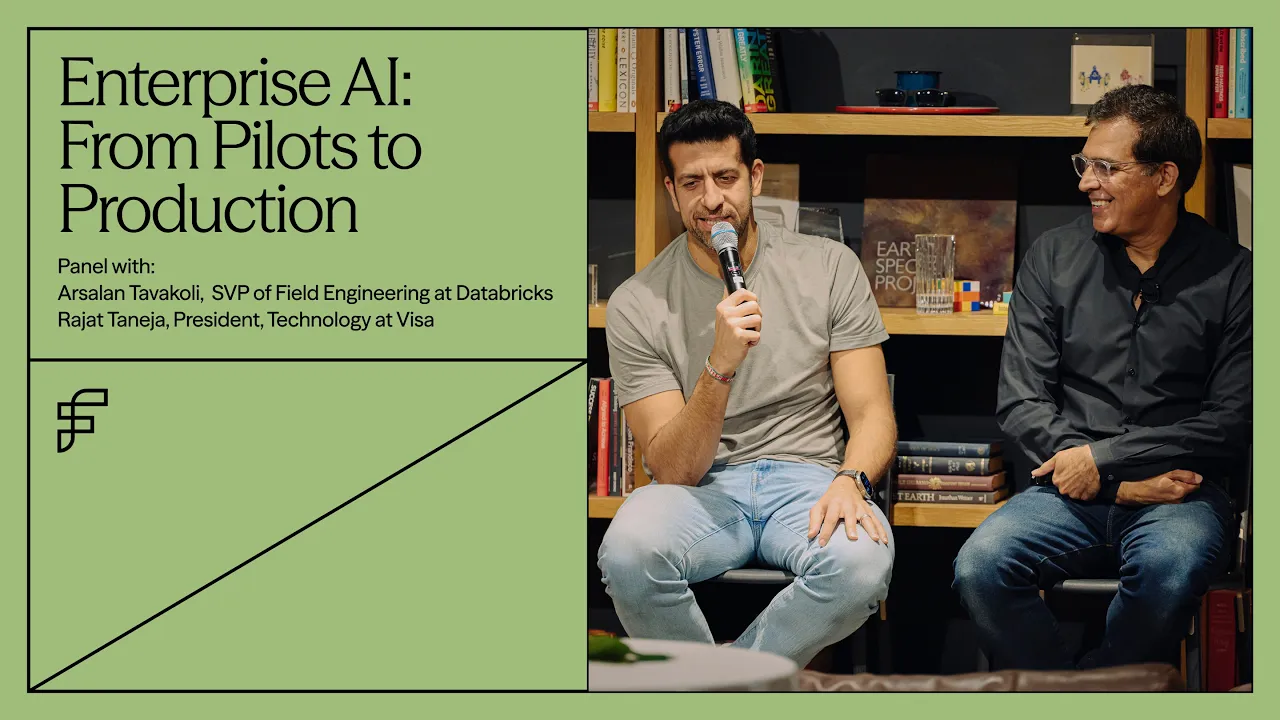
Enterprise AI: From pilots to production

Posted

0 MIN READ
0 MIN READ

Show Outline

As AI continues to mature, what’s holding enterprises back from going all in?

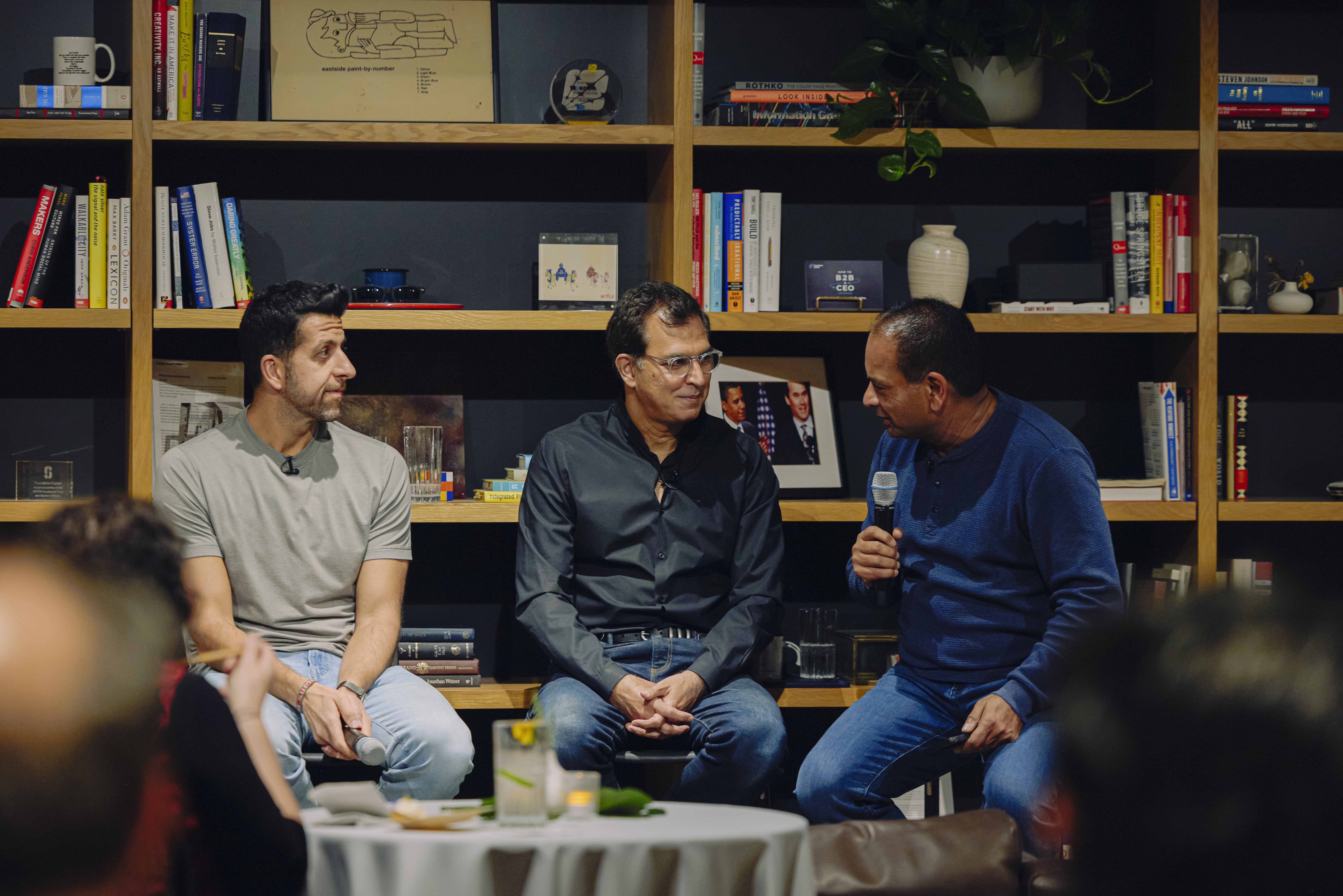
To get closer to the answer, we sat down with Arsalan Tavakoli, co-founder and SVP Field Engineering at Databricks, and Rajat Taneja, President of Technology at Visa for a frank discussion. Moderated by Ashu, the discussion covered what actually works when pitching AI products to enterprise teams, from getting the first meeting to closing the sale.

The panel was just one of the items on the schedule at our CEO Dinner, which brought together our founders to discuss what really moves the needle on the path from enterprise AI pilots to production. We first invited our founders to share stories and trade learnings in intimate group sessions. Then we opened up the room to the panel with Arsalan and Rajat, giving founders the opportunity to glean rare insights from leaders in the industry.

Watch the video here, or jump below to recap the key insights that emerged from the talk with Arsalan and Rajat.
0:00 – Intros
0:57 – The importance of governance, auditability, and policy management
3:11 – The biggest mistake? Treating AI as a checkbox.
4:48 – Where AI is actually working today
8:42 – Why “boring” use cases win
11:27 – Agentic commerce will reinvent shopping
14:07 – Don’t give agents human-level permissions
16:25 – Why SaaS is facing a tsunami
18:30 – Systems of creation will be disrupted first
24:28 – Process redesign is the real unlock
37:35 – Final advice for founders

Our takeaways from the conversation

Don’t use AI for AI’s sake

Both Arsalan and Rajat emphasized that the biggest mistake companies make is chasing AI hype without tying it to real business problems. The goal is to embed intelligence into processes, not check a box.

Governance, trust, and control are critical

Enterprise leaders aren’t worried about choosing between Claude or GPT, they’re worried about safety. The hard part is securely connecting AI to data, managing permissions, ensuring auditability, and building the oversight infrastructure around it. Both Arsalan and Rajat repeatedly returned to trust as a compounding strategic moat.

Pilots are insufficient

Real value emerges when AI is tested in production. Process redesign—not just tool adoption—is what unlocks true productivity gains, similar to how factories reorganized their entire floor layouts when switching from steam to electric engines.

User permissions and governance are shifting with agents

The traditional software stack (database → business logic → human interface) gets disrupted when agents replace human interfaces. This has massive implications for commerce, SaaS incumbents, and enterprise workflows. Permissions and governance designed for humans don't translate directly to agents. Furthermore, interfaces will become redundant before the underlying data structures do.

Lead with real business outcomes

Arsalan and Rajat shared several tips for pitching enterprise AI. Be novel, not incremental. Lead with business outcomes rather than features. And finally, ditch the PowerPoint. Demonstrate the value your product offers, don’t just pitch.

Read the full talk:

Rajat: I think everybody makes these mistakes. It's getting into the hype of AI and using AI for the sake of using AI and checking a box, right? It's not about using AI. AI and software are the tools. You have to think about it as an intelligence layer that you're embedding everywhere and you have to rethink your business process. 

Ashu: Well, two of you are in this unique situation where you're trying to sell people a lot of AI and you're buying a lot of AI from what I hear. So you're at the intersection of this at a huge scale at a few billion dollars each. What is the one thing you both think founders get wrong in the world of AI? 

Rajat: When you look at the way AI is going to impact enterprises or people, there are several other pieces that are as or more important than the pure model. It is a layer of control that you need to have on top of the model. How do you manage the model? How do you ensure the model is trustworthy? How do you implement your policies in your company? What is the audit trail that you have? And I think value is moving into this control plane that over time will differentiate companies that are using similar products. 

Ashu: Arsalan, you've been both an attacker for many years and now you've become the incumbent. That's the price of success. So what advice do you have to farmers who are here who are in the same seat you were a decade ago? 

Arsalan: Yeah, I don't know if we consider ourselves an incumbent yet. I think the second you start thinking about yourself as an incumbent, you get complacent.

You know, one of the things that happens, especially in this day and age, I feel like we're early on is like, so much news is changing and you read the news. Somebody did this, somebody did X and you're like, shit, I don't know, maybe we're not supposed to curse, but I'll be in trouble the whole night probably then. But you're like, crap, I like, I've got to basically emulate that. Why did they do that? I have to ship that first and like, I think that's a big mistake that people make, right? I think that there's certain things, if somebody did something right and it's going to be commoditized, you should basically leverage it. But what I find is like founders will spend a lot of time thinking somebody did something cool, how do I emulate that?

And if all you're doing is emulating what other people do, you won't survive as a company, right? Like the best founders I know have conviction in a vision. They kind of absorb all the information, but they basically stay focused on how do they basically execute on that vision, live and die by it, and then basically know when it's time to pivot. So I think that's a really important thing. Otherwise, especially in this day and age, anything that you're building, you can go on X and read, here's all the other things that people are releasing and you're like, crap, how do I emulate this and this? And then you'll just end up churning. 

Ashu: Given the scale of your customer base, what are some of the things you're seeing work really well, customers who are leveraging AI well, and what are some of the examples without naming customers where you're seeing people completely misfire? 

Arsalan: Yeah, so the second one is kind of the easier one to do. I think there are a lot of people whose approach to AI is driven by FOMO, which is like people are missing out on it. And so I'll walk into a customer and they're beating their chest to like, I've got 400 AI rag POCs going on right now. I'm like, who cares? And as a result, then they start seeing how much you're spending, how many people are using it, what are the benefits you're getting? And they kind of look at you during the headlines, right? I think that the other big thing, like those who are doing it really well are realizing one, how do I basically pick business problems that I can solve? And for many folks actually, the first set of business problems is a lot about internal productivity. It's the most common one that we see. It's like, how do you help sales reps figure out the next best action? How do you help people talk to the data? How do you help people leverage this to go more because you're basically getting comfortable with the technology.

And I think around that people realize one of the hard parts about getting AI. I think Rajat just talked about it, it’s not what model do I pick? Do I pick Claude? Do I pick GPT? It's around like, how do I connect it to data? How do I think about governance? How do I make sure that, what are the permissions I give agents to do things because how do we control them? So those are some of the hard parts that the people who know what they're doing picked a strong business problem. And then they're spending a lot of time on that infrastructure and governance to be able to deploy these safely and accurately and measure what's the productivity output they're getting from it as well. 

Ashu: Makes a lot of sense. If we go from the macro to the micro, Rajat, I'd love to get some examples of things that have gone well for you. What are examples of AI projects that are working well? 

Rajat: Look, Ashu, if you look at the arc, the initial arc was places where you have bounded scope, where the data quality that you're connecting the model to was very clear and easy to connect to, where the outcome was very measurable and very precise, so you could understand what the benefits were, and where the human judgment was in the loop, and where the workforce and the work process had a lot of cognitive repetition. So if you look at those characteristics, then the first wave that has happened over the last couple of years has been around coding, developer productivity.

It has been around customer service and support, which is very predictable. It's been, in our case, around risk, which again has those characteristics. If you form a grid and you say, which one you check box, that's from central casting, dispute management, right? So these are the compliance. So these are the places where you start with the data, you see, can the model connect to it? You say, can I manage it? Can I govern it? And will the humans still be in the loop to provide the judgment? So it's still assistive. I think the shift that's going to take place, and we all have to form a view of where the puck will be two years from now. Will it still be assistive, or will it be autonomous? If it is autonomous, then the whole game changes again, and where it goes in and how it will impact companies is going to shift again. 

Ashu: I want to come back to this autonomous question, but before we go there, I'm curious, and I'll start again with you, Rajat, what are some examples of mistakes that your peers are making? Not mistakes that Visa is making, but mistakes that other people are making about using AI and applying AI to their businesses. 

Rajat: Look, I think everybody makes these mistakes. It's getting into the hype of AI and using AI for the sake of using AI and checking a box, right? It's not about using AI, AI and software are the tools. You have to think about it as an intelligence layer that you're embedding everywhere and you have to rethink your business process. You have to rethink the culture of the company and how the leadership is going to evolve to incorporate it into everything we are doing.

You have to look at it from a security point of view. I talked about the control layers and the governance, the auditability, and getting too enamored by pilots, I think it's a mistake people make. Pilots are very pristine. They're beautiful. They're in a lab. They always work well, but production is where you get a cross-section of real life and real life is messy. So trying to do more A/B testing or champion challenger or multivariate and saying, I'm going to actually simulate this with a lot of control in production is, I think, the answer to not making those mistakes. 

I'll give you an example. When we used to buy cars, we would go do a test drive for an hour, half an hour on the freeway. Really nice. The person sitting next to you, the sales guy, telling you all the great features and the conversion rate was what it was. Tesla came along and said, you know what, we're going to let you do this in production. You can take the car home and drive it for three days like you would normally drive and you can check this out in a, quote unquote, production environment in real life. See all the messiness of taking your dog to the vet and going to Costco and parking and all of that. And now the conversion rate is completely different. 

Ashu: I'm curious, you know, you're dealing with thousands of customers and to your credit, you've been at the bleeding edge of, you know, deploying AI across these companies and you personally seem to be involved in that. So what are some of your lessons? What has worked well for you? What have you seen customers do? Well, and what are examples of mistakes you see customers making? 

Arsalan: Look, I think that there's a couple of pieces of what happens. Like, one, many of the use cases that people come on are ones that people would talk about as being very, very boring, right? Like, I think we, with AI, we got really excited about self-driving cars, and it's a robot arm that serves you coffee, and all of that sounds great, but like, the actual things that drive value are very, very different.

I'll give you a simple example. We just had, like, NBC Universal, right? They just hosted the Olympics, and you come out, and normally, there's a whole bunch of what you wanna do by reaching out to suppliers and advertisers. What are the new ads? What do you wanna do? What worked well? What didn't? What do you do on the next one? Normally, that report takes weeks, right, for them to do it. Now, the short answer was, as soon as the Olympics were done, or the Super Bowl was done, or basically any of those events were done, shortly thereafter, within kind of like, I would say, hours, they have all the data. Basically, all the reports have been written. They're basically already talking about what their next game plan is, and where they're gonna make their next set of investments. It was huge for the company, right? If you looked at that speed up of being able to move something forward two weeks earlier that they could do, bought them kind of like a huge rise in their conversion rates for being able to, that's valuable to them, right? 

Or on the alternative, we had ones where, previously, you look at airlines, where they want to make revenue optimization decisions. We've all been there, like, what happens? It used to be, you make one decision, the data comes slowly, you make that decision, let's say, weekly. Now, they have data in real time that can kind of think through this airline, this is delayed, we rerouted it, this plane, this pilot can get there. If we make these changes, here's the benefits that it drives. 

So, I think you're starting to see it transform, and many of those are what he described. Use case data is super valuable. If we can basically drive insights faster from that data, it has a huge productivity. It's either always increase revenue, productivity means lower costs, or basically protecting risk. Like, those are the three categories that you do it. So, seeing people do that is great.

Where the mistakes were was, I think that there's a lot of people who got really excited, wedded to a very specific technique and a model, and pilot, and then they got in trouble, because almost anybody today you ask, if they built an agent, say, are you happy with your agent? Yes, three months ago. Would you build it the same way today? Absolutely not, I would do it differently. So, that notion of how they can kind of evolve and not be wedded to a specific technique or model has been one of the big mistakes that people are learning from as well. 

Ashu: One of the big changes in AI has really been, you know, two years ago, no one talked about agents, and now agents are the rage. And Rajat, you in particular have been involved with shopping and commerce for longer than either of us want to admit to this group. Rajat and I have noticed it for a couple of decades at this point. You know, shopping is involved in many ways, but agent commerce is now going to reinvent shopping all over again. Would love to get your thoughts on that. 

Rajat: First of all, I would just change the aperture and say everything is going to get rewired in society, whether it is health care, it is education, it is agriculture. And certainly commerce, which you and I love, is going to have a huge benefit. So today, you know, two parties are trying to figure out what one is selling, what the other one is buying, and then how do you pay for this. And there is a guarantee that takes place implicitly and explicitly by a platform like Visa, MasterCard and others. The shift with autonomy is going to take place sooner rather than later, where we will empower an agent to know us really well and to be able to conduct commerce on our behalf.

Now, when you're doing that, there are a lot of risks that come with it. Is it the right agent? Is it authorized to do what it is doing? Can it buy from a reputable merchant, or is it a scam merchant? So the whole system has to be reinvented for it. Now, there is work that's happened over decades by a platform like Visa. We do a billion, almost a billion transactions every day in real time. In a few milliseconds, we authorize a yes or no, $16 trillion goes to the platform. So an underlying trust system has been built. How do you do that when an agent is doing the shopping for you? You do that by having protocols that allow you to cryptographically verify the agent, to know who the agent is representing, and what the agent can do.

And so you need, again, layers in this stack, right? If there's a problem, how do you manage the dispute? Is there compliance? Have you done AML checks? Have you done OFAC checks? Those layers that I was talking about earlier for all applications are as equally and more important for commerce. What will happen if we do this correctly is that all the mundane aspects of shopping and commerce will be done by something, a software that knows us really well. And the joys and the pleasure and the happiness that shopping brings from discovering things you like, whether it's artwork or movies or travel and getting all the work done to book that or to buy it or to arrange something, will happen in a much more seamless and friction-free way. 

Ashu: Arsalan, I'm curious, you work with a lot of, you know, customers that also I'm sure are thinking about agentic commerce and how it's going to influence sort of, you know, the trillions of dollars that are spent on platforms like Visa. What has been your experience? 

Arsalan: Yeah, so look, I think you related to that both. It's true of agentic commerce and otherwise. One of the things that we've realized is we've spent a lot of time, I think, designing interfaces and software for being used by humans. And I think now many more of those are going to be used by basically agents. And I think people are being like, oh, it's not a big deal. We'll just add an API to it. I don't think it's that simple, right? So I think we underestimate the level of the speed at which people work, the judgment that they use as humans.

So that when we basically hand them off to agents, how do we transform that is a big deal. Like, I'll give you a very simple example of like, we've talked about governance a lot. It's an example internally, right? That just applies to commerce and everything else where you see that it's different. You naturally assume if you have an agent that you are going to give the agent, and Arsalan has permission to do something. So I would give the agent the same permissions as Arsalan. We've realized this is a terrible idea, right? Because in general, Arsalan hopefully applies a little bit of intuition and basically common sense and judgment, whereas agents are much more black and white.

So we have this case internally that we had basically a system, fortunately, a development system that we all have internally like in a personal agentic loop, think like Claude Code or something else like that. You ask it to go do something on your behalf. It went and hit the system. The system responds and says, we are at capacity, delete something. Now, they don't know that the context of the reason we say that is because we want people to go through security for that. So the system says, oh, I don't have access to it. You said, delete an app. So I just deleted a random app on the system. I found something that had permissions to do, deleted and went, well, that brought the whole system down. Similar things, right? There's times in place of agentic commerce where new information comes, new facts come, where we have other contexts and we use it. 

So we are learning to say, one, what is the right set of information to expose to agents? Two, what is the set of permissions you want? How do you govern it? What are your checks and balances? Especially because right now, most people's agentic loops are pretty narrow. We went from like one shot asking a question to now having this, okay, maybe two or three steps. When it gets registered, so much longer things that they're handling end to end. How do you put checks in place? I think it is the main thing everybody's wrestling with. 

Rajat: And can I build on that? So what you said is very key. I don't know if everybody sort of got it. That applications today, all applications, have been built with an interface. So you have your database, you have your business logic, and then you have an interface. And then you have APIs that you connect to bring upstream and move data downstream. But that interface is used by a human being. And the humans in companies are entering data. They are posting records. They are moving the workflow to the next person and so on. And that's been the conventional architecture for decades.

So why is there such turmoil right now? And people are saying, oh, that, all the SaaS companies are going to be disrupted. It's what Arsalan just said. Because that interface becomes redundant. The question is of time. Is it redundant in one year? Is it redundant in two years? Because if the work is going to be done by an autonomous agent that has been built, trained, and runs in your enterprise, then they don't come into an interface like a human being and are typing keys, right? They are working inside the system, the interface goes away, and they are running the entire application. And if you think of applications in three categories, systems of record, systems of work, and systems of creation, you can make your own judgment which ones will be most disrupted fastest when that interface and all the applications built over decades disappear.

There is a tsunami of change coming. And I think this area is ripe for disruption, especially if you do it correctly, the way you describe the architecture with intelligence being governed properly. 

Ashu: No, I can't resist. I'm going to put Arsalan on the spot. So three systems, systems of record, systems of work, and systems of creation. Which one of those three do you think, Arsalan, is most at risk? What is the dinosaur of the software system?

Arsalan: So it feels like a trick question, right? For me, I actually think if I were going to order, it's probably, it's not the system of record for me.

I think the main one is basically the system of creation or potentially the system of work. Probably creation, right? It's just that, look, the simplest example we look into, and hopefully there's no like Salesforce lovers in here, right? It's like, it's where do I go to create, where do I go to build? Just the interface which I'm doing it has fundamentally changed because you're also now saying for many of those places, the expertise that you needed to do it beforehand is very, very different with AI. So I think that that's where it starts, where it flows through all of them on the guillotine, frankly, but it's like the system of creation is going to change the first like, so it's like where you can create, that's the interface for then where you can do work. And I think systems of record, some of those things, those are data that have existed for a while, systems are built on it, it's much harder to basically disrupt them in the early days. 

Ashu: Although if every system of record just becomes a database, you know, the markup Salesforce has with the Oracle database is, you know, 100X. 

Arsalan: Yeah, but it depends on what you mean by system of record, because I think it's also funny that everybody just describes, and I'm not a Salesforce fan, just to be clear, but I think everybody describes it as a 90s interface with a database, and I think that that's kind of unfair, right? There's a whole bunch of things also around, for many of these systems, like the HR systems, right? Think of the compliance that they have, what are some of the other pieces? There's a lot of those that have been built up over time, and I think AI, everybody thinks, look, they can kind of learn it, understand it, move it to centralized systems. It's not saying that they won't be disrupted, but I think it's the interfaces, first, which I think about the systems of creation. 

Ashu: Rajat, what is your experience? 

Rajat: I think of creating images, creating documents, creating content, creating a campaign, right? So the workflows which are the systems of work like you're doing approvals or you know you're running code through the process etc. I think the first one is most at risk because you're not really messing with the underlying data structures. But if you think of applications as crowd functions on a database with business logic on top of that and the interface to execute the business logic and humans kind of managing it and they are the judgment, they are the control in many ways, they implement the policy in many ways and you form a conviction or an opinion on where things are going. And if our conviction is that a couple of years from now these models are going to have context, they're going to have memory, large windows and chain of debate, ability to spawn, baby agents and so on then you can imagine a world in 2028 or 2029 where that layer becomes fully automated and the control of that and the layers in the company that control that become the most important IP, right?

And what you need are some layers there then, you need a layer, an action layer, you need a semantic layer, right? You need a cross-system orchestration layer so these artificial boundaries over decades of CRM and HR and marketing systems and service systems I think are going to be blown up. Now who blows it up? It's an open question. Will the incumbents do it? Will you guys in the room do it? Will some combination do it? But it's ripe for innovation but it'll only occur if you have these planes that will be the safety net and so companies will become policy-driven and the policy is configured in these planes and managed and audited and observed and governed and overseen over there and I think the next one will be systems of creation and then systems of record will sort of become enterprise-wide.

So it's going to be a very exciting time to see how this changes but the value it'll unleash in companies is going to be unlike anything in the history of humankind and running businesses. Those artificial boundaries are gone. Now imagine how a company can work with a 360 degree view of a customer, ability to self-serve before they even know they have a problem, right? Doing things at a speed that was previously unforeseen, things like that. 

Ashu: This is probably a good time to get a couple of questions from the group.

Rajat: Look, I think you're hitting the nail on the head. I think this is a multifaceted issue, right? Because your process has to be part of the change. And before the process, the leadership mindset and the culture has to be part of the change. So you have to sort of win the hearts and minds of companies trying this to say, hey, look, we are doing this because we have some safety nets built in.

You can revert to the last known good very fast. And I have these capabilities I've built in that allows you to trust my platform. Look, trust is a compounder, right? If you are able to provide a confidence on the trust, then the process and the test can be simulated in production with a small portion of the traffic. And that's why I was saying multivariate testing or A/B testing. But you only really can see if there is a business benefit and an outcome that you want, if you are running it in a full simulation of production, which you cannot do. And pilots are good at kicking the tires, to validate some assumptions, but then the real value and the unlock happens in a proper test. Make sense? 

Arsalan: Yeah, so I'll take a slightly contrary view to that, not just for fun, right? Just for debate. Yeah, just for debate, which is, look, here's one of the things that we are at least realizing. I agree with him that pilots aren't great, but if you kind of take a look at what are the stages of, I would say, AI adoption, number one is that they're not using it. I don't count using chat GPT as using AI. Number two is what I call the AI sprawl, where everybody's just using some form of AI. Number three is you're getting some forms of basically productivity improvement, but the real unlock is when you do process redesign. That's the hard part, and the really, really hard part is it's very, very hard to do that in existing groups.

Basically one of the best examples I've seen is somebody described like steam engines, and sorry to date myself, but like steam engines existed, and they had specific layouts on the factory floor, and then the electric engine came out, and they just replaced all the steam engines with electric engines, but nothing changed in productivity because it was laid out for the steam engine. What you found is that a lot of people, if you just release AI tools, they kind of look at it and say, oh, this is a nice to have, I'll look at it, I may optimize something I'm doing, but I'm going to go back to doing everything the way that I did. If you really want to change it, you have to say, if you have AI, how do you do things from the ground up?

We found in some organizations, and at Databricks itself, when we looked at transforming the field organization, you kind of have to have a group where you shock the system enough that they have no choice but to redesign it, and if you have a large existing org, at least for us, it's hard to start as, that's the first place that you do it, so you still need to think about production, but finding a place where they're thinking about process redesign is really, really important, I think, to truly get all the unlocks. 

Rajat: Yeah, there is no debate with you on this, right? I mean, the steam engine and the electric motor are a classic example. Steam engines are central. And then they say, I'm going to centralize my motors. And then they say, well, that doesn't work. You have to put the motors in smaller form factors all through the assembly line, right? So you have to redo the process, right? And so you have to prove that you can do it, that there is business value, and that there is an ability to revert back to last for good if you fail.

And so that governance layer or that control plane or that ability to sort of do that champion challenge becomes important. And what companies look at is, have you done it yourself? Do you have a proof point? Are you client zero? Is it like, show me something that I can see in production. I'm going to kick the tires myself heavily in my pilot to validate a bunch of stuff. But to see it in action and to deploy it at scale, I think you really need something that simulates how you will be doing it in the future. And there are different ways to do it, right, in a new group, a place you're already re-engineering. But I think the leadership mindset, you have data quality. I think leadership quality is equally important.

Ashu: Thank you. Before we go to the next question, the one thing I did and I'm going to call on Arjun, the one thing that both of you said, and I read that you in particular that resonated from the sessions we had before, there were two different sessions and moats and the key takeaway from both was trust is a moat. Like you build trust, trust compounds, and trust is a moat. 

Rajat: I think it's in flux right now. I think it's all messy. Before the sun shines in a few years it's going to be pretty messy, it'll be turbulent. I don't think I go in every day and say my goal is to buy fewer pieces of software. In fact, I have a different view. My goal is to build a string of pearls. I want to build the best of breed and I want to tie it together and I want to unlock value for my company that others are not being able to unlock or faster than them or with better quality than them, right? So how do you do that? And so you look at fit for purpose technologies. There may be something that comes in the foundation. There'll be some, because it's going to be a stack, right? And that stack, the person who builds it, that stack that makes it easier to connect your data to bring all the things I talked about earlier to bear in a usable, practical way will, I think, have a special place in an enterprise. And that's my view.

How things will evolve, we don't know. So I think companies and people form convictions based on certain assumptions. And you should know what those assumptions are. And when you're coming to sell to them, you should say, I think these are your assumptions. These assumptions I agree with. I have a different point of view. Let me prove it to them, prove it to you. The sister of conviction is opinion. So I have some convictions, but I also have certain opinions. And trying to decipher and separate that and then have a logical discussion becomes a key way to win the hearts and minds of companies that you are taking your product to. 

Ashu: Arsalan, I'd love to get your perspective on this whole notion of opinions, convictions, and you know, where is the world of enterprise software headed? I mean, the public markets clearly don't seem to like software that much these days. 

Arsalan: What is the word now? SaaSpocalypse? Is that what we always get asked about? Look, I think, as you might imagine, we talk about this a bunch, right, from our side. And I agree with Rajat, which is like anybody who tells you that they know exactly what the world looks like in five years, either as a crystal ball or they're full of crap—one of the two. Usually it's the second one.

But I think that there's a couple of things that are true. One, with the era of, you know, kind of agents and AI and vibe coding, I think building software has become much easier, right? And like every time someone says, yeah, you can build software, but it's like AI slop. And I'm like, yeah, but that's getting better. Yeah, but you basically have pull requests, but then you need them to kind of review it. And I'm like, we now see AI's review, like everything that it does, they're kind of knocking it down. I think that means a couple of things. I think software is easier to build. Do I think that that means that every single enterprise is going to build their own? No, I don't think that that's, but I do think it means that barriers to entry have come down. So I think that this notion where you have in some spaces like SAP has been unchallenged realistically in that domain for decades at this point, I think that that's going to shift. I think the barriers to entry have, you know, kind of come down.

And so one of the things I do think is going to happen in the software space is there's going to be a lot of pressure on gross margins, because usually when you have less barriers of entries, people to enter, people cut their prices down to get in. So now everybody's going to look at what are the eras of innovation. So you're going to see, hey, look, a lot of people are going to basically have a broader set of software and everybody's going to look to figure out what is the moat, right? 

One thing, my hot take, which Dario and Sam won't love, is like, I don't think the best model right now, what we talk about in scaling laws is going to be the moat that everybody thinks it is. You're already starting to see them commoditized. You're already starting to see some of the distillation of the models, the Chinese models and the other ones get very good. And like, there's going to be a limit to how much you can get better. And it's why you see kind of whether it's OpenAI talking about frontier and Anthropic talking about building, they're all realizing they need to move into the application space. I tend to think trust is one, data and governance are kind of tied to trust. Those are some of the biggest moats.

I’m obviously a little bit biased, right? Because Databricks comes from that space. But I think then everybody's going to try to figure out what is the moat that you have? How quickly can you build around it? And what is the value of having, you know, one thing that drives many, you know, many more, like basically one place that you can get many more of your business needs there.  So it's early days, but I think we are seeing some of those trends play out. And I think many of the folks you see around today in like a year to 18 months, you won't see. But I think that there'll be such a large influx of new ones, especially as AI and token prices drop so people can kind of develop. So we watch it every day, but it's an interesting time for sure. 

Rajat: Look, I think if you look at the future with the lens of the past, you're going to repeat and rebuild it, right? So you have to think about what a future will look like when intelligence is abundant and you can get it as utility like faucet and water coming out or power from, you know, the electrical grid. So that rewires how you're going to think about running your enterprise.

Your customers are the center of your enterprise. Every company should be obsessed with your customer, which means building the right product, supporting them, marketing to them, all of that. So if you're building an enterprise in a new rubric, how do you distinguish yourself, compete with others, or build trust? I believe it comes by shifting the value of what you're doing to a new layer that doesn't exist today. And then saying, I've invested in this new layer. This layer allows you to configure and ensure that your agents are working with oversight. They're following the policies that are important to your company and the compliance and the regulations your company is subjected to compared to somebody else. You can have observability that is real time because a mistake a human being could make in the past was gated by the speed of what human beings did.

Now, mistakes by an agent can happen and scale really fast. So you are not getting longevity in your mode because of time, but you're providing a layer that allows companies to say, yeah, I think I can configure this. I have an observability window that allows me to look at privacy and consent and regulations and model performance and drift and bias and all of that. And I'm able to get tremendous value out of this from a company that didn't exist before. So I'm going to give it a shot. And then that begins the journey. The journey of a thousand miles begins with the first step, right? Because you don't earn decades of trust on the first day, but you earn a heart and mind buying into what you have built if you can prove it, but you have to prove it, right? At least that's my point of view. 

Arsalan: So I think, though, the only thing I would add to that is like, I think the way people define trust and the speed of getting it will change going forward. I think right now when you talk about trust taking a decade or two decades to get there, it's because that's how much time it takes you to get that many deployments and to show you what's happening.

But I do think that the speed that things happen are going to pick up. So one, just I'll give you a simple example. A lot of times, you know, trust is like governance and security of the product. Normally today, it's like, what do you do if I come into an organization? If I go into Visa, they're going to be like, I'm going to hand it to the CSO. The CSO has a set of things. They have a bunch of people. They have a pen testing team that's going to do the blue test. They're going to do the blue team, the red team. They're going to go through it. It takes a while. They got to check it. They have a questionnaire to go through.

One of the things that we're looking at, right, for those of you interested, like RSA, right, like the security conferences, I think it's next week and a couple of things that like data show the time from when basically like agents have operated on both sides, the time from when somebody publishes like code to when basically an exploit is basically found on it has been shrinking dramatically over time because there's all of these agents that are working. So I think that the other thing that's going to happen is like two interesting statistics. One, the time that agents are being used to find exploits has gotten far, far faster. So most people are using agents. And two, the speed like databases is an example.

Previously, historically, you're like somebody, a system has databases. Over 80 percent of databases today are actually created by agents and not created by humans. So you can just see the volume going up. So I think some of the other things that is going to happen, the speed of when you release something of basically being able to, I think Roger said it, prove it right, that you have like all of your agents and your judges on CSO that can kind of test software, see what happens under any of the like systems, like basically on any of the simulations. And then it's not the same as production. And two, when it gets deployed, agents will spin up and use the software. The amount of usage you'll get in a short period of time will be a lot. So I don't think the answer is like anybody new comes in, I'm always going to get disrupted. I won't get a decade to build trust. I don't think that that will be the case, right? I think that there'll be much faster ways of verifying and getting usage of it. So the whole world is going to change on both sides. 

Ashu: We're going to have to wrap on behalf of the group. I'm going to ask one last question for both of you, and then both Rajat and Arsalan will be here, and we can sort of continue over drinks. Pretty much everyone here is a founder who's trying to partner with a large company, sell to a large company. Arsalan, in your case, partner with you, use your massive distribution channel in some shape or form. Same thing for you, Rajat, at Visa. So what is the one piece of advice you have? If you had to pick one thing, I'm sure there's a hundred things you could pick, but if you had to pick one thing which is advice for the founders here that you think would apply for those of them that are trying to partner with you as an organization, so in your case, Arsalan, I'll let you go first with Databricks, and then Rajat, I'll come to you for Visa. Advice for people looking to partner with you. 

Arsalan: Um, so for us, like the biggest advice is, uh, I'd love to one oftentimes be more important than anything else, but it’s the caliber of the people, just to be honest. The second piece they have is an idea with conviction that they can kind of demonstrate that their approach or their bet is somewhat unique to the organization. We are less interested in the, Hey, I'm one of 10 people doing the same exact thing. But there's like, Here's a secular shift we're betting on. Here's why we think it's an important problem. And here's why we think we basically have a novel approach. Like that is the key thing. Those, those are the ones that all day long, we love to partner with.

Basically we have our own, obviously like we work with you guys, like we will like to invest in those folks. We like to bring them into deals and partners because that's kind of always been our mentality, our mindset. So, um, I always get worried when somebody says, Oh no, don't worry. I'm just the, you know, I'm the Uber for X or I'm the Airbnb for Y or like Hey, there's, uh, like there's 20 other people, but I'm like Apple. I come in 20th and it's like, they'll pick us. So those are the key. Those are the questions I always ask. And, um, yeah, I've honestly been impressed with a lot of folks, you know, that I've met, you know, some in this room and otherwise, which are like, we're not solving the problem today. Here's where we think that the world is going. Here's that secular drift that we'll bet on. And here's why we think we have a unique approach to it. That always resonates well with it on the Databricks front. 

Rajat: Yeah, I would say that companies should come in with a clear theory of their business. Every company has a theory, whether you have explicitly written it down or not, you do. So when you come in and say, this is the theory of my business, these are my assumptions, and I want to give you a 360 view of my shiny new widget. It's not just the shiny new widget and the one extra feature of my shiny AI model, because companies are not buying AI. They are buying a benefit to themselves or their customers.

So what is the business outcome that you are bringing as part of your theory, which distinguishes you from others? And if you have fleshed it out, you would say, not only is this a superior solution for you, it allows you to run it at high cybersecurity, high availability. It is compliant. This is how you manage risk. These are the safeguards I have built in. I've thought through all this, and I'm willing to walk the walk and show this to you. And I would say, throw out your PowerPoints. Just show the product. Don't come in with a shiny, splashy PowerPoint. Bring that mindset and say, let me just show it to you. I think that, at least for companies, or at least for me and folks at Visa, would resonate. 

Ashu: Thank you, sirs, very much. I took three things away. Be novel, not incremental. Sell the dream and sell the assumptions behind the dream. And show me, don't just tell me. With that Arsalan and Rajat, thank you so much. Thank you on behalf of all of the CEOs for Foundation.

Get insights directly to your inbox.

Set your newsletter preferences:

Set your newsletter preferences:

Posted

0 MIN READ

Show Outline

As AI continues to mature, what’s holding enterprises back from going all in?

To get closer to the answer, we sat down with Arsalan Tavakoli, co-founder and SVP Field Engineering at Databricks, and Rajat Taneja, President of Technology at Visa for a frank discussion. Moderated by Ashu, the discussion covered what actually works when pitching AI products to enterprise teams, from getting the first meeting to closing the sale.

The panel was just one of the items on the schedule at our CEO Dinner, which brought together our founders to discuss what really moves the needle on the path from enterprise AI pilots to production. We first invited our founders to share stories and trade learnings in intimate group sessions. Then we opened up the room to the panel with Arsalan and Rajat, giving founders the opportunity to glean rare insights from leaders in the industry.

Watch the video here, or jump below to recap the key insights that emerged from the talk with Arsalan and Rajat.

0:00 – Intros
0:57 – The importance of governance, auditability, and policy management
3:11 – The biggest mistake? Treating AI as a checkbox.
4:48 – Where AI is actually working today
8:42 – Why “boring” use cases win
11:27 – Agentic commerce will reinvent shopping
14:07 – Don’t give agents human-level permissions
16:25 – Why SaaS is facing a tsunami
18:30 – Systems of creation will be disrupted first
24:28 – Process redesign is the real unlock
37:35 – Final advice for founders

Our takeaways from the conversation

Don’t use AI for AI’s sake

Both Arsalan and Rajat emphasized that the biggest mistake companies make is chasing AI hype without tying it to real business problems. The goal is to embed intelligence into processes, not check a box.

Governance, trust, and control are critical

Enterprise leaders aren’t worried about choosing between Claude or GPT, they’re worried about safety. The hard part is securely connecting AI to data, managing permissions, ensuring auditability, and building the oversight infrastructure around it. Both Arsalan and Rajat repeatedly returned to trust as a compounding strategic moat.

Pilots are insufficient

Real value emerges when AI is tested in production. Process redesign—not just tool adoption—is what unlocks true productivity gains, similar to how factories reorganized their entire floor layouts when switching from steam to electric engines.

User permissions and governance are shifting with agents

The traditional software stack (database → business logic → human interface) gets disrupted when agents replace human interfaces. This has massive implications for commerce, SaaS incumbents, and enterprise workflows. Permissions and governance designed for humans don't translate directly to agents. Furthermore, interfaces will become redundant before the underlying data structures do.

Lead with real business outcomes

Arsalan and Rajat shared several tips for pitching enterprise AI. Be novel, not incremental. Lead with business outcomes rather than features. And finally, ditch the PowerPoint. Demonstrate the value your product offers, don’t just pitch.

Read the full talk:

Rajat: I think everybody makes these mistakes. It's getting into the hype of AI and using AI for the sake of using AI and checking a box, right? It's not about using AI. AI and software are the tools. You have to think about it as an intelligence layer that you're embedding everywhere and you have to rethink your business process. 

Ashu: Well, two of you are in this unique situation where you're trying to sell people a lot of AI and you're buying a lot of AI from what I hear. So you're at the intersection of this at a huge scale at a few billion dollars each. What is the one thing you both think founders get wrong in the world of AI? 

Rajat: When you look at the way AI is going to impact enterprises or people, there are several other pieces that are as or more important than the pure model. It is a layer of control that you need to have on top of the model. How do you manage the model? How do you ensure the model is trustworthy? How do you implement your policies in your company? What is the audit trail that you have? And I think value is moving into this control plane that over time will differentiate companies that are using similar products. 

Ashu: Arsalan, you've been both an attacker for many years and now you've become the incumbent. That's the price of success. So what advice do you have to farmers who are here who are in the same seat you were a decade ago? 

Arsalan: Yeah, I don't know if we consider ourselves an incumbent yet. I think the second you start thinking about yourself as an incumbent, you get complacent.

You know, one of the things that happens, especially in this day and age, I feel like we're early on is like, so much news is changing and you read the news. Somebody did this, somebody did X and you're like, shit, I don't know, maybe we're not supposed to curse, but I'll be in trouble the whole night probably then. But you're like, crap, I like, I've got to basically emulate that. Why did they do that? I have to ship that first and like, I think that's a big mistake that people make, right? I think that there's certain things, if somebody did something right and it's going to be commoditized, you should basically leverage it. But what I find is like founders will spend a lot of time thinking somebody did something cool, how do I emulate that?

And if all you're doing is emulating what other people do, you won't survive as a company, right? Like the best founders I know have conviction in a vision. They kind of absorb all the information, but they basically stay focused on how do they basically execute on that vision, live and die by it, and then basically know when it's time to pivot. So I think that's a really important thing. Otherwise, especially in this day and age, anything that you're building, you can go on X and read, here's all the other things that people are releasing and you're like, crap, how do I emulate this and this? And then you'll just end up churning. 

Ashu: Given the scale of your customer base, what are some of the things you're seeing work really well, customers who are leveraging AI well, and what are some of the examples without naming customers where you're seeing people completely misfire? 

Arsalan: Yeah, so the second one is kind of the easier one to do. I think there are a lot of people whose approach to AI is driven by FOMO, which is like people are missing out on it. And so I'll walk into a customer and they're beating their chest to like, I've got 400 AI rag POCs going on right now. I'm like, who cares? And as a result, then they start seeing how much you're spending, how many people are using it, what are the benefits you're getting? And they kind of look at you during the headlines, right? I think that the other big thing, like those who are doing it really well are realizing one, how do I basically pick business problems that I can solve? And for many folks actually, the first set of business problems is a lot about internal productivity. It's the most common one that we see. It's like, how do you help sales reps figure out the next best action? How do you help people talk to the data? How do you help people leverage this to go more because you're basically getting comfortable with the technology.

And I think around that people realize one of the hard parts about getting AI. I think Rajat just talked about it, it’s not what model do I pick? Do I pick Claude? Do I pick GPT? It's around like, how do I connect it to data? How do I think about governance? How do I make sure that, what are the permissions I give agents to do things because how do we control them? So those are some of the hard parts that the people who know what they're doing picked a strong business problem. And then they're spending a lot of time on that infrastructure and governance to be able to deploy these safely and accurately and measure what's the productivity output they're getting from it as well. 

Ashu: Makes a lot of sense. If we go from the macro to the micro, Rajat, I'd love to get some examples of things that have gone well for you. What are examples of AI projects that are working well? 

Rajat: Look, Ashu, if you look at the arc, the initial arc was places where you have bounded scope, where the data quality that you're connecting the model to was very clear and easy to connect to, where the outcome was very measurable and very precise, so you could understand what the benefits were, and where the human judgment was in the loop, and where the workforce and the work process had a lot of cognitive repetition. So if you look at those characteristics, then the first wave that has happened over the last couple of years has been around coding, developer productivity.

It has been around customer service and support, which is very predictable. It's been, in our case, around risk, which again has those characteristics. If you form a grid and you say, which one you check box, that's from central casting, dispute management, right? So these are the compliance. So these are the places where you start with the data, you see, can the model connect to it? You say, can I manage it? Can I govern it? And will the humans still be in the loop to provide the judgment? So it's still assistive. I think the shift that's going to take place, and we all have to form a view of where the puck will be two years from now. Will it still be assistive, or will it be autonomous? If it is autonomous, then the whole game changes again, and where it goes in and how it will impact companies is going to shift again. 

Ashu: I want to come back to this autonomous question, but before we go there, I'm curious, and I'll start again with you, Rajat, what are some examples of mistakes that your peers are making? Not mistakes that Visa is making, but mistakes that other people are making about using AI and applying AI to their businesses. 

Rajat: Look, I think everybody makes these mistakes. It's getting into the hype of AI and using AI for the sake of using AI and checking a box, right? It's not about using AI, AI and software are the tools. You have to think about it as an intelligence layer that you're embedding everywhere and you have to rethink your business process. You have to rethink the culture of the company and how the leadership is going to evolve to incorporate it into everything we are doing.

You have to look at it from a security point of view. I talked about the control layers and the governance, the auditability, and getting too enamored by pilots, I think it's a mistake people make. Pilots are very pristine. They're beautiful. They're in a lab. They always work well, but production is where you get a cross-section of real life and real life is messy. So trying to do more A/B testing or champion challenger or multivariate and saying, I'm going to actually simulate this with a lot of control in production is, I think, the answer to not making those mistakes. 

I'll give you an example. When we used to buy cars, we would go do a test drive for an hour, half an hour on the freeway. Really nice. The person sitting next to you, the sales guy, telling you all the great features and the conversion rate was what it was. Tesla came along and said, you know what, we're going to let you do this in production. You can take the car home and drive it for three days like you would normally drive and you can check this out in a, quote unquote, production environment in real life. See all the messiness of taking your dog to the vet and going to Costco and parking and all of that. And now the conversion rate is completely different. 

Ashu: I'm curious, you know, you're dealing with thousands of customers and to your credit, you've been at the bleeding edge of, you know, deploying AI across these companies and you personally seem to be involved in that. So what are some of your lessons? What has worked well for you? What have you seen customers do? Well, and what are examples of mistakes you see customers making? 

Arsalan: Look, I think that there's a couple of pieces of what happens. Like, one, many of the use cases that people come on are ones that people would talk about as being very, very boring, right? Like, I think we, with AI, we got really excited about self-driving cars, and it's a robot arm that serves you coffee, and all of that sounds great, but like, the actual things that drive value are very, very different.

I'll give you a simple example. We just had, like, NBC Universal, right? They just hosted the Olympics, and you come out, and normally, there's a whole bunch of what you wanna do by reaching out to suppliers and advertisers. What are the new ads? What do you wanna do? What worked well? What didn't? What do you do on the next one? Normally, that report takes weeks, right, for them to do it. Now, the short answer was, as soon as the Olympics were done, or the Super Bowl was done, or basically any of those events were done, shortly thereafter, within kind of like, I would say, hours, they have all the data. Basically, all the reports have been written. They're basically already talking about what their next game plan is, and where they're gonna make their next set of investments. It was huge for the company, right? If you looked at that speed up of being able to move something forward two weeks earlier that they could do, bought them kind of like a huge rise in their conversion rates for being able to, that's valuable to them, right? 

Or on the alternative, we had ones where, previously, you look at airlines, where they want to make revenue optimization decisions. We've all been there, like, what happens? It used to be, you make one decision, the data comes slowly, you make that decision, let's say, weekly. Now, they have data in real time that can kind of think through this airline, this is delayed, we rerouted it, this plane, this pilot can get there. If we make these changes, here's the benefits that it drives. 

So, I think you're starting to see it transform, and many of those are what he described. Use case data is super valuable. If we can basically drive insights faster from that data, it has a huge productivity. It's either always increase revenue, productivity means lower costs, or basically protecting risk. Like, those are the three categories that you do it. So, seeing people do that is great.

Where the mistakes were was, I think that there's a lot of people who got really excited, wedded to a very specific technique and a model, and pilot, and then they got in trouble, because almost anybody today you ask, if they built an agent, say, are you happy with your agent? Yes, three months ago. Would you build it the same way today? Absolutely not, I would do it differently. So, that notion of how they can kind of evolve and not be wedded to a specific technique or model has been one of the big mistakes that people are learning from as well. 

Ashu: One of the big changes in AI has really been, you know, two years ago, no one talked about agents, and now agents are the rage. And Rajat, you in particular have been involved with shopping and commerce for longer than either of us want to admit to this group. Rajat and I have noticed it for a couple of decades at this point. You know, shopping is involved in many ways, but agent commerce is now going to reinvent shopping all over again. Would love to get your thoughts on that. 

Rajat: First of all, I would just change the aperture and say everything is going to get rewired in society, whether it is health care, it is education, it is agriculture. And certainly commerce, which you and I love, is going to have a huge benefit. So today, you know, two parties are trying to figure out what one is selling, what the other one is buying, and then how do you pay for this. And there is a guarantee that takes place implicitly and explicitly by a platform like Visa, MasterCard and others. The shift with autonomy is going to take place sooner rather than later, where we will empower an agent to know us really well and to be able to conduct commerce on our behalf.

Now, when you're doing that, there are a lot of risks that come with it. Is it the right agent? Is it authorized to do what it is doing? Can it buy from a reputable merchant, or is it a scam merchant? So the whole system has to be reinvented for it. Now, there is work that's happened over decades by a platform like Visa. We do a billion, almost a billion transactions every day in real time. In a few milliseconds, we authorize a yes or no, $16 trillion goes to the platform. So an underlying trust system has been built. How do you do that when an agent is doing the shopping for you? You do that by having protocols that allow you to cryptographically verify the agent, to know who the agent is representing, and what the agent can do.

And so you need, again, layers in this stack, right? If there's a problem, how do you manage the dispute? Is there compliance? Have you done AML checks? Have you done OFAC checks? Those layers that I was talking about earlier for all applications are as equally and more important for commerce. What will happen if we do this correctly is that all the mundane aspects of shopping and commerce will be done by something, a software that knows us really well. And the joys and the pleasure and the happiness that shopping brings from discovering things you like, whether it's artwork or movies or travel and getting all the work done to book that or to buy it or to arrange something, will happen in a much more seamless and friction-free way. 

Ashu: Arsalan, I'm curious, you work with a lot of, you know, customers that also I'm sure are thinking about agentic commerce and how it's going to influence sort of, you know, the trillions of dollars that are spent on platforms like Visa. What has been your experience? 

Arsalan: Yeah, so look, I think you related to that both. It's true of agentic commerce and otherwise. One of the things that we've realized is we've spent a lot of time, I think, designing interfaces and software for being used by humans. And I think now many more of those are going to be used by basically agents. And I think people are being like, oh, it's not a big deal. We'll just add an API to it. I don't think it's that simple, right? So I think we underestimate the level of the speed at which people work, the judgment that they use as humans.

So that when we basically hand them off to agents, how do we transform that is a big deal. Like, I'll give you a very simple example of like, we've talked about governance a lot. It's an example internally, right? That just applies to commerce and everything else where you see that it's different. You naturally assume if you have an agent that you are going to give the agent, and Arsalan has permission to do something. So I would give the agent the same permissions as Arsalan. We've realized this is a terrible idea, right? Because in general, Arsalan hopefully applies a little bit of intuition and basically common sense and judgment, whereas agents are much more black and white.

So we have this case internally that we had basically a system, fortunately, a development system that we all have internally like in a personal agentic loop, think like Claude Code or something else like that. You ask it to go do something on your behalf. It went and hit the system. The system responds and says, we are at capacity, delete something. Now, they don't know that the context of the reason we say that is because we want people to go through security for that. So the system says, oh, I don't have access to it. You said, delete an app. So I just deleted a random app on the system. I found something that had permissions to do, deleted and went, well, that brought the whole system down. Similar things, right? There's times in place of agentic commerce where new information comes, new facts come, where we have other contexts and we use it. 

So we are learning to say, one, what is the right set of information to expose to agents? Two, what is the set of permissions you want? How do you govern it? What are your checks and balances? Especially because right now, most people's agentic loops are pretty narrow. We went from like one shot asking a question to now having this, okay, maybe two or three steps. When it gets registered, so much longer things that they're handling end to end. How do you put checks in place? I think it is the main thing everybody's wrestling with. 

Rajat: And can I build on that? So what you said is very key. I don't know if everybody sort of got it. That applications today, all applications, have been built with an interface. So you have your database, you have your business logic, and then you have an interface. And then you have APIs that you connect to bring upstream and move data downstream. But that interface is used by a human being. And the humans in companies are entering data. They are posting records. They are moving the workflow to the next person and so on. And that's been the conventional architecture for decades.

So why is there such turmoil right now? And people are saying, oh, that, all the SaaS companies are going to be disrupted. It's what Arsalan just said. Because that interface becomes redundant. The question is of time. Is it redundant in one year? Is it redundant in two years? Because if the work is going to be done by an autonomous agent that has been built, trained, and runs in your enterprise, then they don't come into an interface like a human being and are typing keys, right? They are working inside the system, the interface goes away, and they are running the entire application. And if you think of applications in three categories, systems of record, systems of work, and systems of creation, you can make your own judgment which ones will be most disrupted fastest when that interface and all the applications built over decades disappear.

There is a tsunami of change coming. And I think this area is ripe for disruption, especially if you do it correctly, the way you describe the architecture with intelligence being governed properly. 

Ashu: No, I can't resist. I'm going to put Arsalan on the spot. So three systems, systems of record, systems of work, and systems of creation. Which one of those three do you think, Arsalan, is most at risk? What is the dinosaur of the software system?

Arsalan: So it feels like a trick question, right? For me, I actually think if I were going to order, it's probably, it's not the system of record for me.

I think the main one is basically the system of creation or potentially the system of work. Probably creation, right? It's just that, look, the simplest example we look into, and hopefully there's no like Salesforce lovers in here, right? It's like, it's where do I go to create, where do I go to build? Just the interface which I'm doing it has fundamentally changed because you're also now saying for many of those places, the expertise that you needed to do it beforehand is very, very different with AI. So I think that that's where it starts, where it flows through all of them on the guillotine, frankly, but it's like the system of creation is going to change the first like, so it's like where you can create, that's the interface for then where you can do work. And I think systems of record, some of those things, those are data that have existed for a while, systems are built on it, it's much harder to basically disrupt them in the early days. 

Ashu: Although if every system of record just becomes a database, you know, the markup Salesforce has with the Oracle database is, you know, 100X. 

Arsalan: Yeah, but it depends on what you mean by system of record, because I think it's also funny that everybody just describes, and I'm not a Salesforce fan, just to be clear, but I think everybody describes it as a 90s interface with a database, and I think that that's kind of unfair, right? There's a whole bunch of things also around, for many of these systems, like the HR systems, right? Think of the compliance that they have, what are some of the other pieces? There's a lot of those that have been built up over time, and I think AI, everybody thinks, look, they can kind of learn it, understand it, move it to centralized systems. It's not saying that they won't be disrupted, but I think it's the interfaces, first, which I think about the systems of creation. 

Ashu: Rajat, what is your experience? 

Rajat: I think of creating images, creating documents, creating content, creating a campaign, right? So the workflows which are the systems of work like you're doing approvals or you know you're running code through the process etc. I think the first one is most at risk because you're not really messing with the underlying data structures. But if you think of applications as crowd functions on a database with business logic on top of that and the interface to execute the business logic and humans kind of managing it and they are the judgment, they are the control in many ways, they implement the policy in many ways and you form a conviction or an opinion on where things are going. And if our conviction is that a couple of years from now these models are going to have context, they're going to have memory, large windows and chain of debate, ability to spawn, baby agents and so on then you can imagine a world in 2028 or 2029 where that layer becomes fully automated and the control of that and the layers in the company that control that become the most important IP, right?

And what you need are some layers there then, you need a layer, an action layer, you need a semantic layer, right? You need a cross-system orchestration layer so these artificial boundaries over decades of CRM and HR and marketing systems and service systems I think are going to be blown up. Now who blows it up? It's an open question. Will the incumbents do it? Will you guys in the room do it? Will some combination do it? But it's ripe for innovation but it'll only occur if you have these planes that will be the safety net and so companies will become policy-driven and the policy is configured in these planes and managed and audited and observed and governed and overseen over there and I think the next one will be systems of creation and then systems of record will sort of become enterprise-wide.

So it's going to be a very exciting time to see how this changes but the value it'll unleash in companies is going to be unlike anything in the history of humankind and running businesses. Those artificial boundaries are gone. Now imagine how a company can work with a 360 degree view of a customer, ability to self-serve before they even know they have a problem, right? Doing things at a speed that was previously unforeseen, things like that. 

Ashu: This is probably a good time to get a couple of questions from the group.

Rajat: Look, I think you're hitting the nail on the head. I think this is a multifaceted issue, right? Because your process has to be part of the change. And before the process, the leadership mindset and the culture has to be part of the change. So you have to sort of win the hearts and minds of companies trying this to say, hey, look, we are doing this because we have some safety nets built in.

You can revert to the last known good very fast. And I have these capabilities I've built in that allows you to trust my platform. Look, trust is a compounder, right? If you are able to provide a confidence on the trust, then the process and the test can be simulated in production with a small portion of the traffic. And that's why I was saying multivariate testing or A/B testing. But you only really can see if there is a business benefit and an outcome that you want, if you are running it in a full simulation of production, which you cannot do. And pilots are good at kicking the tires, to validate some assumptions, but then the real value and the unlock happens in a proper test. Make sense? 

Arsalan: Yeah, so I'll take a slightly contrary view to that, not just for fun, right? Just for debate. Yeah, just for debate, which is, look, here's one of the things that we are at least realizing. I agree with him that pilots aren't great, but if you kind of take a look at what are the stages of, I would say, AI adoption, number one is that they're not using it. I don't count using chat GPT as using AI. Number two is what I call the AI sprawl, where everybody's just using some form of AI. Number three is you're getting some forms of basically productivity improvement, but the real unlock is when you do process redesign. That's the hard part, and the really, really hard part is it's very, very hard to do that in existing groups.

Basically one of the best examples I've seen is somebody described like steam engines, and sorry to date myself, but like steam engines existed, and they had specific layouts on the factory floor, and then the electric engine came out, and they just replaced all the steam engines with electric engines, but nothing changed in productivity because it was laid out for the steam engine. What you found is that a lot of people, if you just release AI tools, they kind of look at it and say, oh, this is a nice to have, I'll look at it, I may optimize something I'm doing, but I'm going to go back to doing everything the way that I did. If you really want to change it, you have to say, if you have AI, how do you do things from the ground up?

We found in some organizations, and at Databricks itself, when we looked at transforming the field organization, you kind of have to have a group where you shock the system enough that they have no choice but to redesign it, and if you have a large existing org, at least for us, it's hard to start as, that's the first place that you do it, so you still need to think about production, but finding a place where they're thinking about process redesign is really, really important, I think, to truly get all the unlocks. 

Rajat: Yeah, there is no debate with you on this, right? I mean, the steam engine and the electric motor are a classic example. Steam engines are central. And then they say, I'm going to centralize my motors. And then they say, well, that doesn't work. You have to put the motors in smaller form factors all through the assembly line, right? So you have to redo the process, right? And so you have to prove that you can do it, that there is business value, and that there is an ability to revert back to last for good if you fail.

And so that governance layer or that control plane or that ability to sort of do that champion challenge becomes important. And what companies look at is, have you done it yourself? Do you have a proof point? Are you client zero? Is it like, show me something that I can see in production. I'm going to kick the tires myself heavily in my pilot to validate a bunch of stuff. But to see it in action and to deploy it at scale, I think you really need something that simulates how you will be doing it in the future. And there are different ways to do it, right, in a new group, a place you're already re-engineering. But I think the leadership mindset, you have data quality. I think leadership quality is equally important.

Ashu: Thank you. Before we go to the next question, the one thing I did and I'm going to call on Arjun, the one thing that both of you said, and I read that you in particular that resonated from the sessions we had before, there were two different sessions and moats and the key takeaway from both was trust is a moat. Like you build trust, trust compounds, and trust is a moat. 

Rajat: I think it's in flux right now. I think it's all messy. Before the sun shines in a few years it's going to be pretty messy, it'll be turbulent. I don't think I go in every day and say my goal is to buy fewer pieces of software. In fact, I have a different view. My goal is to build a string of pearls. I want to build the best of breed and I want to tie it together and I want to unlock value for my company that others are not being able to unlock or faster than them or with better quality than them, right? So how do you do that? And so you look at fit for purpose technologies. There may be something that comes in the foundation. There'll be some, because it's going to be a stack, right? And that stack, the person who builds it, that stack that makes it easier to connect your data to bring all the things I talked about earlier to bear in a usable, practical way will, I think, have a special place in an enterprise. And that's my view.

How things will evolve, we don't know. So I think companies and people form convictions based on certain assumptions. And you should know what those assumptions are. And when you're coming to sell to them, you should say, I think these are your assumptions. These assumptions I agree with. I have a different point of view. Let me prove it to them, prove it to you. The sister of conviction is opinion. So I have some convictions, but I also have certain opinions. And trying to decipher and separate that and then have a logical discussion becomes a key way to win the hearts and minds of companies that you are taking your product to. 

Ashu: Arsalan, I'd love to get your perspective on this whole notion of opinions, convictions, and you know, where is the world of enterprise software headed? I mean, the public markets clearly don't seem to like software that much these days. 

Arsalan: What is the word now? SaaSpocalypse? Is that what we always get asked about? Look, I think, as you might imagine, we talk about this a bunch, right, from our side. And I agree with Rajat, which is like anybody who tells you that they know exactly what the world looks like in five years, either as a crystal ball or they're full of crap—one of the two. Usually it's the second one.

But I think that there's a couple of things that are true. One, with the era of, you know, kind of agents and AI and vibe coding, I think building software has become much easier, right? And like every time someone says, yeah, you can build software, but it's like AI slop. And I'm like, yeah, but that's getting better. Yeah, but you basically have pull requests, but then you need them to kind of review it. And I'm like, we now see AI's review, like everything that it does, they're kind of knocking it down. I think that means a couple of things. I think software is easier to build. Do I think that that means that every single enterprise is going to build their own? No, I don't think that that's, but I do think it means that barriers to entry have come down. So I think that this notion where you have in some spaces like SAP has been unchallenged realistically in that domain for decades at this point, I think that that's going to shift. I think the barriers to entry have, you know, kind of come down.

And so one of the things I do think is going to happen in the software space is there's going to be a lot of pressure on gross margins, because usually when you have less barriers of entries, people to enter, people cut their prices down to get in. So now everybody's going to look at what are the eras of innovation. So you're going to see, hey, look, a lot of people are going to basically have a broader set of software and everybody's going to look to figure out what is the moat, right? 

One thing, my hot take, which Dario and Sam won't love, is like, I don't think the best model right now, what we talk about in scaling laws is going to be the moat that everybody thinks it is. You're already starting to see them commoditized. You're already starting to see some of the distillation of the models, the Chinese models and the other ones get very good. And like, there's going to be a limit to how much you can get better. And it's why you see kind of whether it's OpenAI talking about frontier and Anthropic talking about building, they're all realizing they need to move into the application space. I tend to think trust is one, data and governance are kind of tied to trust. Those are some of the biggest moats.

I’m obviously a little bit biased, right? Because Databricks comes from that space. But I think then everybody's going to try to figure out what is the moat that you have? How quickly can you build around it? And what is the value of having, you know, one thing that drives many, you know, many more, like basically one place that you can get many more of your business needs there.  So it's early days, but I think we are seeing some of those trends play out. And I think many of the folks you see around today in like a year to 18 months, you won't see. But I think that there'll be such a large influx of new ones, especially as AI and token prices drop so people can kind of develop. So we watch it every day, but it's an interesting time for sure. 

Rajat: Look, I think if you look at the future with the lens of the past, you're going to repeat and rebuild it, right? So you have to think about what a future will look like when intelligence is abundant and you can get it as utility like faucet and water coming out or power from, you know, the electrical grid. So that rewires how you're going to think about running your enterprise.

Your customers are the center of your enterprise. Every company should be obsessed with your customer, which means building the right product, supporting them, marketing to them, all of that. So if you're building an enterprise in a new rubric, how do you distinguish yourself, compete with others, or build trust? I believe it comes by shifting the value of what you're doing to a new layer that doesn't exist today. And then saying, I've invested in this new layer. This layer allows you to configure and ensure that your agents are working with oversight. They're following the policies that are important to your company and the compliance and the regulations your company is subjected to compared to somebody else. You can have observability that is real time because a mistake a human being could make in the past was gated by the speed of what human beings did.

Now, mistakes by an agent can happen and scale really fast. So you are not getting longevity in your mode because of time, but you're providing a layer that allows companies to say, yeah, I think I can configure this. I have an observability window that allows me to look at privacy and consent and regulations and model performance and drift and bias and all of that. And I'm able to get tremendous value out of this from a company that didn't exist before. So I'm going to give it a shot. And then that begins the journey. The journey of a thousand miles begins with the first step, right? Because you don't earn decades of trust on the first day, but you earn a heart and mind buying into what you have built if you can prove it, but you have to prove it, right? At least that's my point of view. 

Arsalan: So I think, though, the only thing I would add to that is like, I think the way people define trust and the speed of getting it will change going forward. I think right now when you talk about trust taking a decade or two decades to get there, it's because that's how much time it takes you to get that many deployments and to show you what's happening.

But I do think that the speed that things happen are going to pick up. So one, just I'll give you a simple example. A lot of times, you know, trust is like governance and security of the product. Normally today, it's like, what do you do if I come into an organization? If I go into Visa, they're going to be like, I'm going to hand it to the CSO. The CSO has a set of things. They have a bunch of people. They have a pen testing team that's going to do the blue test. They're going to do the blue team, the red team. They're going to go through it. It takes a while. They got to check it. They have a questionnaire to go through.

One of the things that we're looking at, right, for those of you interested, like RSA, right, like the security conferences, I think it's next week and a couple of things that like data show the time from when basically like agents have operated on both sides, the time from when somebody publishes like code to when basically an exploit is basically found on it has been shrinking dramatically over time because there's all of these agents that are working. So I think that the other thing that's going to happen is like two interesting statistics. One, the time that agents are being used to find exploits has gotten far, far faster. So most people are using agents. And two, the speed like databases is an example.

Previously, historically, you're like somebody, a system has databases. Over 80 percent of databases today are actually created by agents and not created by humans. So you can just see the volume going up. So I think some of the other things that is going to happen, the speed of when you release something of basically being able to, I think Roger said it, prove it right, that you have like all of your agents and your judges on CSO that can kind of test software, see what happens under any of the like systems, like basically on any of the simulations. And then it's not the same as production. And two, when it gets deployed, agents will spin up and use the software. The amount of usage you'll get in a short period of time will be a lot. So I don't think the answer is like anybody new comes in, I'm always going to get disrupted. I won't get a decade to build trust. I don't think that that will be the case, right? I think that there'll be much faster ways of verifying and getting usage of it. So the whole world is going to change on both sides. 

Ashu: We're going to have to wrap on behalf of the group. I'm going to ask one last question for both of you, and then both Rajat and Arsalan will be here, and we can sort of continue over drinks. Pretty much everyone here is a founder who's trying to partner with a large company, sell to a large company. Arsalan, in your case, partner with you, use your massive distribution channel in some shape or form. Same thing for you, Rajat, at Visa. So what is the one piece of advice you have? If you had to pick one thing, I'm sure there's a hundred things you could pick, but if you had to pick one thing which is advice for the founders here that you think would apply for those of them that are trying to partner with you as an organization, so in your case, Arsalan, I'll let you go first with Databricks, and then Rajat, I'll come to you for Visa. Advice for people looking to partner with you. 

Arsalan: Um, so for us, like the biggest advice is, uh, I'd love to one oftentimes be more important than anything else, but it’s the caliber of the people, just to be honest. The second piece they have is an idea with conviction that they can kind of demonstrate that their approach or their bet is somewhat unique to the organization. We are less interested in the, Hey, I'm one of 10 people doing the same exact thing. But there's like, Here's a secular shift we're betting on. Here's why we think it's an important problem. And here's why we think we basically have a novel approach. Like that is the key thing. Those, those are the ones that all day long, we love to partner with.

Basically we have our own, obviously like we work with you guys, like we will like to invest in those folks. We like to bring them into deals and partners because that's kind of always been our mentality, our mindset. So, um, I always get worried when somebody says, Oh no, don't worry. I'm just the, you know, I'm the Uber for X or I'm the Airbnb for Y or like Hey, there's, uh, like there's 20 other people, but I'm like Apple. I come in 20th and it's like, they'll pick us. So those are the key. Those are the questions I always ask. And, um, yeah, I've honestly been impressed with a lot of folks, you know, that I've met, you know, some in this room and otherwise, which are like, we're not solving the problem today. Here's where we think that the world is going. Here's that secular drift that we'll bet on. And here's why we think we have a unique approach to it. That always resonates well with it on the Databricks front. 

Rajat: Yeah, I would say that companies should come in with a clear theory of their business. Every company has a theory, whether you have explicitly written it down or not, you do. So when you come in and say, this is the theory of my business, these are my assumptions, and I want to give you a 360 view of my shiny new widget. It's not just the shiny new widget and the one extra feature of my shiny AI model, because companies are not buying AI. They are buying a benefit to themselves or their customers.

So what is the business outcome that you are bringing as part of your theory, which distinguishes you from others? And if you have fleshed it out, you would say, not only is this a superior solution for you, it allows you to run it at high cybersecurity, high availability. It is compliant. This is how you manage risk. These are the safeguards I have built in. I've thought through all this, and I'm willing to walk the walk and show this to you. And I would say, throw out your PowerPoints. Just show the product. Don't come in with a shiny, splashy PowerPoint. Bring that mindset and say, let me just show it to you. I think that, at least for companies, or at least for me and folks at Visa, would resonate. 

Ashu: Thank you, sirs, very much. I took three things away. Be novel, not incremental. Sell the dream and sell the assumptions behind the dream. And show me, don't just tell me. With that Arsalan and Rajat, thank you so much. Thank you on behalf of all of the CEOs for Foundation.

Get insights directly to your inbox.

Set your newsletter preferences:

Get insights directly to your inbox.

Set your newsletter preferences:

Set your newsletter preferences: