

Follow Along
What does it take to run a billion-dollar brand with just a handful of employees?
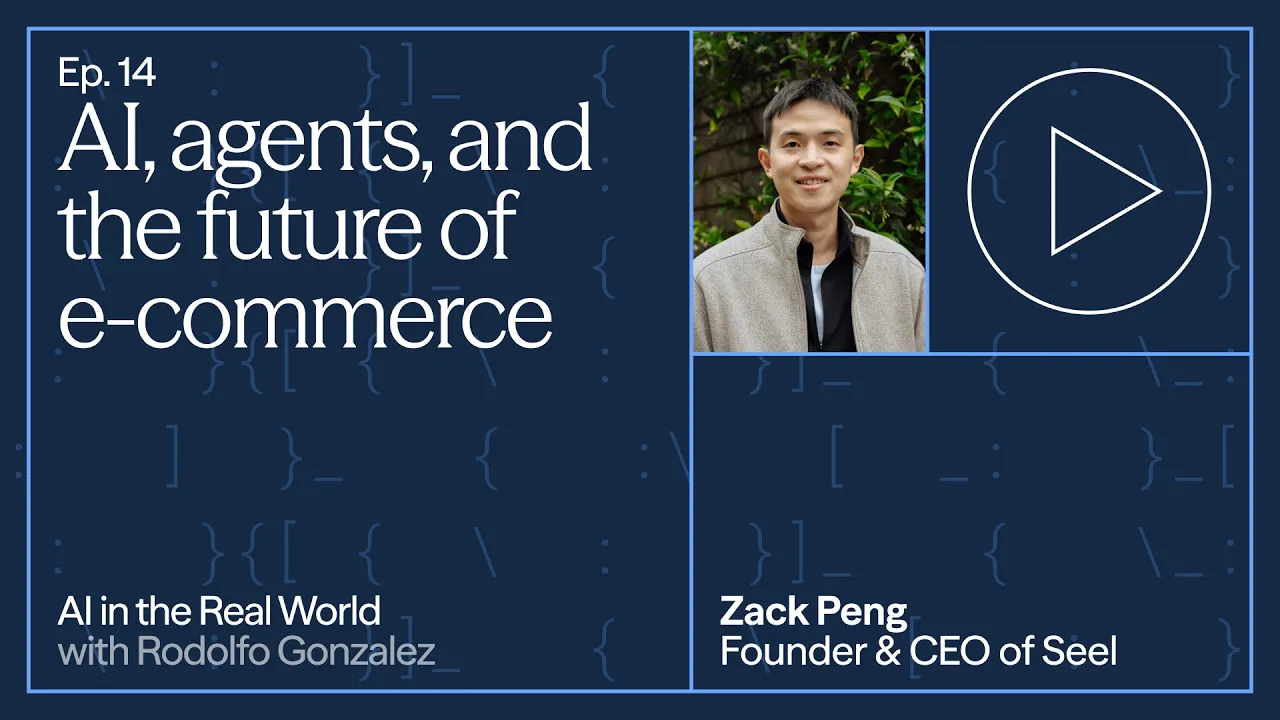
Zack Peng, co-founder and CEO of Seel, joins our General Partner Rodolfo to talk about what he’s learned from using AI to automate the operational work behind e-commerce. In 2026, Seel expects to service close to $10B in e-commerce GMV with fewer than ten operations reps, maintaining a 99%+ resolution rate. The company is an example of what becomes possible when AI starts delivering previously unimaginable experiences at scale.
Seel started with a simple but powerful insight: if you could predict returns and refunds, you could offer shoppers the option to make otherwise final-sale purchases refundable. That initial financial product became a wedge into a bigger problem: after realizing that more than 70% of the support requests Seel received had nothing to do with returns or refunds, the startup began taking on more of the work that happens post-purchase. Zack explains how today AI handles tasks human teams structurally can’t do in real time, like updating an address across disconnected systems or issuing instant refunds before a return even ships back.
Zack and Rodolfo also dig into why “insurance-like” options perform so well at checkout and what it actually takes to build agentic systems that operate at scale. They close with a candid look at Zack’s own founder journey, including a moment where the company deliberately walked back a million dollars in revenue to bet on a completely different path.
What we covered:
00:00 – Cold open: Zack on the psychology of hitting product-market fit
00:48 – Intro: Rodolfo introduces Zack
01:31 – What Seel does
03:26 – The origin insight: returns/refunds are 10-20% of GMV
07:24 – How Seel transformed after noticing 70% of support tickets had nothing to do with returns
11:08 – How agents enable new experiences not previously possible with human support reps
18:23 – The evolution of Seel's four Agencies
23:00 – Zack’s vision of a one-person billion-dollar brand
24:20 – The future of agentic shopping
27:54 – Seel’s two-time zero-to-one story
Read the transcript:
Zack: The first million of revenue was so painful. The second one was easier. Post-product-market fit is like an inflection point, and psychologically that's crazy.
Rodolfo: You were like, "Oh Jesus, nothing's working," and then suddenly it starts working.
Zack: End of '23, I remember we were doing something like $1 million of revenue. End of this year, 2026, we'll be doing close to $200 million. We serve about a third of US households. But the coolest thing to me is that despite all of that progress, we're serving well below 1% of the global commerce operation. Our goal is to hit a billion dollars of revenue in the next two years or so, but even then, we would still be just under 1% of global commerce operation. We want to be powering the majority of the world's commerce GMV.
Rodolfo: I am thrilled to be chatting with one of the founders in our portfolio this time around. He is Zack Peng, who is the co-founder and CEO of Seel. We're going to chat a lot about what the company does, how we got to meet Zack early on, where he's from, his life story, and the very nonlinear journey that took Zack and his team to start working in the e-commerce space after a number of attempts. And then from there, we're going to start digging into the AI components of the Seel solution, and we'll just take it from there. So, very excited — thank you, Zack, for joining us today.
Zack: Yeah. Thanks, Rodolfo, for having me.
Rodolfo: Let's start with a quick, brief version of what Seel does, and then I'll pull back and start the conversation around your background.
Zack: Seel is an AI operations platform that helps brands sell more and spend less. We have an AI workforce that can do pretty much anything from support and sales liquidation to marketing — all in a way that's as shopper-friendly as possible. We work with a few thousand brands like Reebok and Champion in the US, and Debenhams and Karen Millen in Europe, TikTok Shop, Poshmark, et cetera. Our vision is to power a majority of the global commerce GMV in the next five to 10 years with our commerce-optimized, almost infinitely scalable AI operations that make the shopping experience as smooth as possible.
Rodolfo: Super cool. And you're based out of San Francisco?
Zack: That's right. We have our headquarters in San Francisco — I'm in San Francisco — and we have offices across the world. I think commerce is global, and we want to be able to support merchants globally. So for a small team, we have a pretty large footprint across a few continents.
Rodolfo: And it's always interesting to hear input from folks in different geos, right? Because there are elements where you can learn local customs, and that brings interesting input for what you're bringing to the rest of the clients.
Zack: Absolutely. Consumer shopping behavior is different by culture, but we also see that the ways different brands and marketplaces operate across different cultures and countries are quite different too. That's one of the core reasons we think having a global team to support global merchants, brands, and marketplaces is pretty important.
Rodolfo: I'd love for you to chat a little about your background, and your unique insight around looking for low-severity, high-frequency events. To me, that's where the journey really gets interesting for what happened afterward.
Zack: We met an amazing founder who started an apparel marketplace business, and we saw that folks in that space spent a lot of time trying to predict chargebacks. We were thinking: chargebacks were like 0.5% of total GMV, and returns and refunds were like 10-20%. The effort folks put into predicting chargebacks — why wasn't anybody trying to figure out how to predict returns and refunds? That was the first insight. So we built a custom solution for that one marketplace, and it just sort of worked.
The initial wedge we got in was that we saw a lot of final-sale products on the marketplace, and if we could predict returns and refunds, we could offer people the option to pay a small fee at checkout and buy that final-sale item as refundable instead. When we launched that custom solution originally, we were pretty surprised by the attach rate. I thought maybe 3-5% of people would opt in, and that number was actually 10-20% without any optimization. Today it's much higher.
As a starting point, that was pretty amazing. So I did some digging, and it turns out financial or insurance-like options are the best-performing checkout add-on as a category. You see that when booking plane tickets, when you book hotels, when you rent a car — there's the liability waiver. When you buy an iPhone, there's AppleCare. We learned that financial options are the best checkout add-on that anybody can offer. That was kind of lucky. But we also looked at China, across their delivery platforms, and when you buy anything in China, there's that micro-insurance offer that people love opting into.
So we got in with the return-and-refund wedge, and at first the product was just about predicting returns and refunds better than anybody else. Later, that evolved into a more robust post-purchase service. That was how we got started, and the starting thesis for the company.
Rodolfo: It's so interesting, because when you look at what happens in China — you gave us examples back in the day of little add-ons people would be willing to pay for. A typical one would be in food delivery: whether the food arrives on time as promised or not. In the US, the biggest example would be Domino's Pizza with their 30-minute delivery guarantee. You've come up with multiple examples where you have, at some level, an ideal journey for an e-commerce transaction, and any deviation from that ideal journey can be optimized, monetized, or changed in a way that becomes a beautiful experience for the consumer — and probably a more profitable operation for the merchant.
I love how you've started peeling the layers of that huge problem, which is probably 20-30% of the P&L of any merchant: they don't know how much merchandise is going to come back. Can you chat about how you've been peeling that onion? If you could take the whole problem away from a merchant, that's the ideal end state, where they don't have to do anything. Where are you today in that long journey?
Zack: There are really three phases to the company. Initially, we became the only third party in the market willing to work with brands and marketplaces to offer a return option on their final-sale products. The original product was purely financial, and it still performed extremely well. The product-market fit allowed us to make a lot of other mistakes early on, including in go-to-market — so that's done phenomenally for us.
The second phase of the company came one day when I was looking at the support emails we were getting, and I noticed that over 70% of the tickets had nothing to do with returns, refunds, or what our financial option was supposed to cover. Through an insurance lens, that's problematic — the insurance model assumes that for 100 people who become customers, maybe one person ever files a claim, and you never see the other 99. But we took a different view: if we could resolve those tickets for merchants too, we'd not only help them generate more sales pre-purchase, we'd also help them lower operating expense.
So instead of deflecting those tickets back to the brands and marketplaces, we started trying to see how many we could answer with just public information. It turns out it's actually a lot.
About Rodolfo
Rodolfo is a general partner at Foundation Capital, where he co-leads the firm’s crypto and fintech practices. An early investor in Solana, Seel, Brale, CoverWallet, and Branch International, he backs founders building the future of money, from new financial products to the infrastructure that powers payments and capital markets.

Rodolfo: What would be an example of that, so folks can picture it?
Zack: Simple things like "Where's my order?" We have access to the brand's order management system, so we can actually answer that question for the brand, as opposed to saying, "Contact support@brand.com." Some other stuff includes: can they exchange instead of return? That policy is also listed on the merchant site — technically we can support that. Instead of giving refunds, we can place an order for a different product and ship it to them. Sometimes they have a question about store policy — to check that, you'd normally have to remember the store's URL, navigate to it, click a few buttons, and read a blob of text. We just noticed that a lot of these questions can be answered by our support agents, which lowers both ticket volume and chargeback ratio for the brands.
Rodolfo: One super interesting statistic you shared at some point was — across the millions of households you're serving each month — how many e-commerce websites do they interact with?
Zack: The average shopper buys from over 30 stores per year, and every store has a different tracking method they expect you to use, a different support SLA. Some have return shipping fees, some don't. Every brand has its own policy, and the consumer needs to learn that over 30 times a year. I think that's part of the appeal.
We look at Prime a lot as the gold standard of customer experience in commerce. One of the amazing things about Prime is that when I buy something from Amazon, I don't even think about who the seller is, because Prime provides the post-purchase service. Who the seller is becomes almost irrelevant. A lot of what we think about today is how to replicate that for direct-to-consumer brands and independent marketplaces.
Rodolfo: It's very clear at times that the customer rep also doesn't know all the details of every policy they have to keep track of, and they have to manually check whether a refund request is actually valid. That's very common.
Zack: Absolutely. At one point, we also had hundreds of support reps ourselves. One of the core reasons we really wanted to drive the AI initiative internally was that we realized using agents for commerce operations isn't really about saving money — it's about delivering experiences that are otherwise not possible.
For example, it's incredibly difficult to offer real-time support on something as simple as changing an address. Most of the time, if you want to change the address on an order you purchased, it's an email back-and-forth process. The rep needs to check the order management system for the order status, and often the fulfillment software is separate from the order management system. Then there's the risk team, which may get involved depending on AOV and customer profile. So it's just not possible to respond in two to five minutes to an address update request — the only way to deliver that experience quickly is with agentic processes.
Another good example is the instant refund feature we built. Instead of waiting a week for the return shipment to arrive at the merchant's warehouse and then another week for the credit card company to post the refund, we send a cash refund back to shoppers via Venmo, PayPal, or instant deposit. That's only possible with a really robust anti-fraud system — when we first tried to roll it out, an organized fraud group caught on within the following month. So to offer that feature sustainably requires significant investment in agentic processes.
That's been a theme for us the last couple of years: we're not a company that sells tools to brands — we service the shoppers directly, so there's nobody to blame if we can't deliver a great experience. That forced us to build services and processes for ourselves before making them available to our partners.
Rodolfo: As we go deeper into the AI question, it would help to share the scale — how many orders are you handling per month, for how many merchants? Give us the magnitude of what you're talking about.
Zack: In 2026, we'll serve about a third of US households. Within our category, we're one of the fastest companies to go from $1 million to $100 million in revenue — we're past that now. We'll be servicing close to $10 billion of GMV this year, and we work with some really amazing brands and marketplaces — household names. But the coolest thing to me is that despite all of that progress, we're serving well below 1% of the global commerce operation. Our goal is to hit a billion dollars of revenue in the next two years or so, and even then, we'd still be just under 1% of global commerce operation. We want to be powering the majority of the world's commerce GMV.
Rodolfo: When we think of AI use cases, this is one that resonates the most to me, because you have the throughput — millions of transactions every month — and the ability to track all of that. In many cases, these are small orders; the majority are below $100 in AOV. The margin on any of these orders is thin — 20 minutes of headcount from a customer rep can turn an order from profitable to unprofitable very quickly. You mentioned you used to have a lot of customer support agents, and then decided that wasn't scalable. How many do you have now to handle that $10 billion in GMV?
Zack: We have fewer than 10 support agents — a pretty insane ratio. Even just within support, we hear folks talk about 60-70% deflection or resolution rates, and we're at 99%-plus. That's driven by two things primarily: we're really focused on commerce specifically — this is the entirety of what we care about — and second, I think there's a structural advantage to building services for yourself.
When you build and sell tools, and those tools don't deliver good results, you have someone else to blame. Maybe the company using your tools isn't deploying it the right way, or their stakeholders have some conflict of interest and aren't giving you the data you need. You have somewhere to point. But when you build things for your own customers, and you don't deliver results, that's on you — there's nobody else to blame. So the focus on commerce specifically, across all our operations, and having to build things for ourselves, really forced us to do a good job on any operational process we create.
Rodolfo: It makes sense that once you remove the manual component, reduce human error, and enable faster resolution across more use cases, you're not just eliminating the human component — you're increasing customer satisfaction. Getting to a 99% resolution rate is something that didn't exist just a few years ago. And on the other side, it makes the whole transaction much more profitable for everybody involved.
Zack: Absolutely. No brand started what they're doing because they wanted to answer tickets, handle returns, or read data privacy policy in every country they operate in. Sometimes I think about how people talk about vibe coding enabling one-person billion-dollar companies. I think the next Alo, or the next billion-dollar brand, could and should be run by one person.
Today, Stripe has made accepting payments easy. Shopify made opening a store easy. You can find drop-shipping products from Alibaba, et cetera. It takes a couple of hours to open a store now — but running a large operation, you have to do it yourself. You can buy tools, but you have to figure out the right solution for yourself. If that layer is also removed and outsourced, the next billion-dollar brand's founding team can really just focus on what their customers want and how to deliver a physical product to them. It's about enabling them to focus more on what they do well, and less on running a return, sales, support, or compliance operation.
Rodolfo: Can we talk about the evolution of AI usage through the different stages of the company?
Zack: Absolutely. Going back to the three stages: initially, nobody could underwrite refunds, and we built an algorithm to do it — we were the first company that could underwrite refunds and offer that type of solution. That was phase one.
Phase two was realizing, from the support tickets, that since we're selling the financial option to consumers, we could also perform a lot of the post-purchase services instead of the merchant. That's where we went deep. We now have, in addition to all-day concierge, things like commission-free resale — meaning after a shopper buys, say, swimwear for the summer, and by October no longer wants it, instead of listing it across eight different marketplaces themselves, they click a button and our AI creates listings across marketplaces, runs Dutch auctions based on comparable product prices, and even contacts buyers.
For the shopper, it's one click to resell unused products. We have a dozen features like this that perform services for the shopper on behalf of the merchant — and these become really attractive benefits that bring shoppers back. These moments of service also become moments of sale. Let's say a shopper bought a camera — a very common question is which camera stand or accessory is compatible with their version.
Rodolfo: That is a nightmare. What's compatible with my version?
Zack: Exactly. Instead of our support agent just answering the question, they'd throw in a product link too. The more post-purchase traffic we generate with these AI-powered benefits, the more we turn moments of service into moments of sale — creating post-purchase sales and traffic for our brands. So they effectively triple-dip: checkout real estate is really valuable, and brands can sell premium shipping, subscription memberships, warranties, or other products, where the only value prop is upselling for profit or commission. They can do the same with us — but they also save on operating expenses because we reduce tickets and chargebacks for them. That's the double-dip. The triple-dip is that we also bring back traffic and generate additional sales that otherwise wouldn't happen. That's one of the key factors that's helped us win over some of the best brands and marketplaces in the world.
Earlier this year, we entered a third phase of the company: because we've been servicing shoppers for the last year or two, we have credibility with brands, who know we can execute these services well at scale. So we built a support agency that can be an extension of their in-house team to run support operations. We also have consigners to resell excess and returned inventory, which we can do for brands. We basically built four agencies that function as an extension of the brand's team — capabilities we originally built for ourselves. Refund underwriting was the wedge. Expansion from financial option to full-fledged post-purchase service came next. And now we have an AI operations platform that can either service shoppers directly, in a product that's free for merchants, or be an extension of the merchant team, running their own in-house operations more efficiently.
Rodolfo: Do clients believe you can actually do it? It's one of those things that sounds magical. How is it possible?
Zack: A really unique benefit we have from our first product is that brands have seen us do this for the last year or two. They don't care if it's through AI or human teams — they can see the results were good. That helped us establish a lot of credibility. We have a track record across relationships, tech stack, and actual performance to show this isn't a claim we're making — look at the data.

Rodolfo: What are some of the future ideas you're already planning ahead on?
Zack: In the long term, a different question I ask myself is: if someone is starting a new brand — like the Alo of the future — what do we need to do to make it possible for them to run that with one person? Then you get into the fulfillment and logistics back end. The great thing about this roadmap is that if you look at the individual capabilities required, they already exist in some form at other companies — so it's not a leap of faith that we're taking on something that completely doesn't exist today.
Take logistics as an example. Shein has done an incredible job taking consumer trends — from Instagram or elsewhere — and using that to inform factories to produce the exact thing they think will sell well. That capability exists within Shein, but not generally. Something like that would be incredibly valuable to brands and marketplaces more broadly. So the short-term version is: look at our current partner cohort, what they're spending a lot of money on, and how we help them do that more efficiently and better. What does it take to become the operational infrastructure for a one-person billion-dollar brand?
Rodolfo: On the consumer side, what are some of the additional moments of service or delight that the technology will deliver? Because there's a version of the future that doesn't sound super exciting to me — just robots making all the decisions, not necessarily including humans. When I'm shopping for something, I get delight from finally finding the unique product that really matches my personality. We hear that agents are going to be able to deliver that directly, and maybe that's part of the answer, but I doubt it's the whole answer.
Zack: I think a lot about e-commerce before agentic commerce. We're now, what, 30 years into e-commerce, and 15 years into mobile shopping. But offline commerce is still half of total commerce, and mobile commerce is about half of the e-commerce pie. That's interesting, because despite the convenience mobile shopping provides over e-commerce, and e-commerce over offline shopping, people still do a lot of the less convenient shopping.
My theory is that humans are visual animals — looking at something in 3D is better than looking at it in 2D, which is better than looking at it on a small 2D screen. I think shopping is like gaming in a way — you don't want to automate away the fun. But I think there's a lot of value in agentic shopping in automating away the legwork. Humans enjoy discovering products that finally click, as you said — they probably don't want to do the legwork of comparing prices, flipping through pages to check return policies, or dealing with the hassle of logistics if they want to return something. Our thesis on agentic shopping is: how do we automate away the legwork? We actually released a consumer app that has surprisingly good retention metrics for a utility product. The thesis is that this is your AI shopping sidekick.
Rodolfo: Consumer shopping behavior and experience is incredibly rich — the way I shop is different than my wife shops, or how you shop. But one thing that's been pretty consistent across folks is that a lot of repeat purchase behavior comes from avoiding pain more than finding joy. For example, I'll shop somewhere with a better return policy than another store, if it's something I do consistently.
Zack: 100%. I think that largely explains why financial options are the highest-performing checkout add-on across any purchase flow, across a lot of industries. Going back to the agentic shopping thesis — there are Chrome extensions that help you find coupon codes, extensions that do price and product comparison. There's a long tail of needs: some people care more about price, some about service, some about a dozen other factors. Individually, a lot of these features probably aren't substantial enough to be a standalone app or even a browser or phone extension. One of our agentic shopping app's theses is to aggregate that long tail of different shopping needs into one sidekick that does all of it.
Rodolfo: What's been the biggest surprise?
Zack: The first million of revenue was so painful. The second one was easier. Scale, or growth velocity, was incredibly difficult early on. Post-product-market fit is kind of an inflection point, and psychologically that's crazy — or maybe it's because I'm a first-time founder — but that curve was absolutely insane to me.
Rodolfo: Can you share, to wrap up, one of the painful stories from that zero-to-$1-million journey — where you thought, "Oh Jesus, nothing's working," and then suddenly it started working?
Zack: We hit the $1 million revenue mark twice. The first time was an unsustainable SMB motion. I remember a board meeting where I proposed we change the product direction entirely — build for SMB instead of going upmarket with our existing product. That speaks to how unwilling and painful it was to figure out enterprise sales. But we did it. The revenue dropped from $1 million back to something like $100K, and then we went all the way back up. Three years ago, end of '23, we were doing something like $1 million of revenue. By end of this year, 2026, we'll be doing close to $200 million. So 200x over three years — it's an incredible trajectory, and again, just shocking how fast things can go post-product-market fit.
Rodolfo: I love the Seel story, and it's so inspiring to see. I cannot wait to see Seel in so many more merchants over the coming years, and I'm very excited to keep using the consumer platform — it's actually pretty fun.
Zack: Yeah, absolutely. Let's go do this thing, Rodolfo.
Rodolfo: Thank you, Zack.
Zack: All right, thank you.