

Follow Along
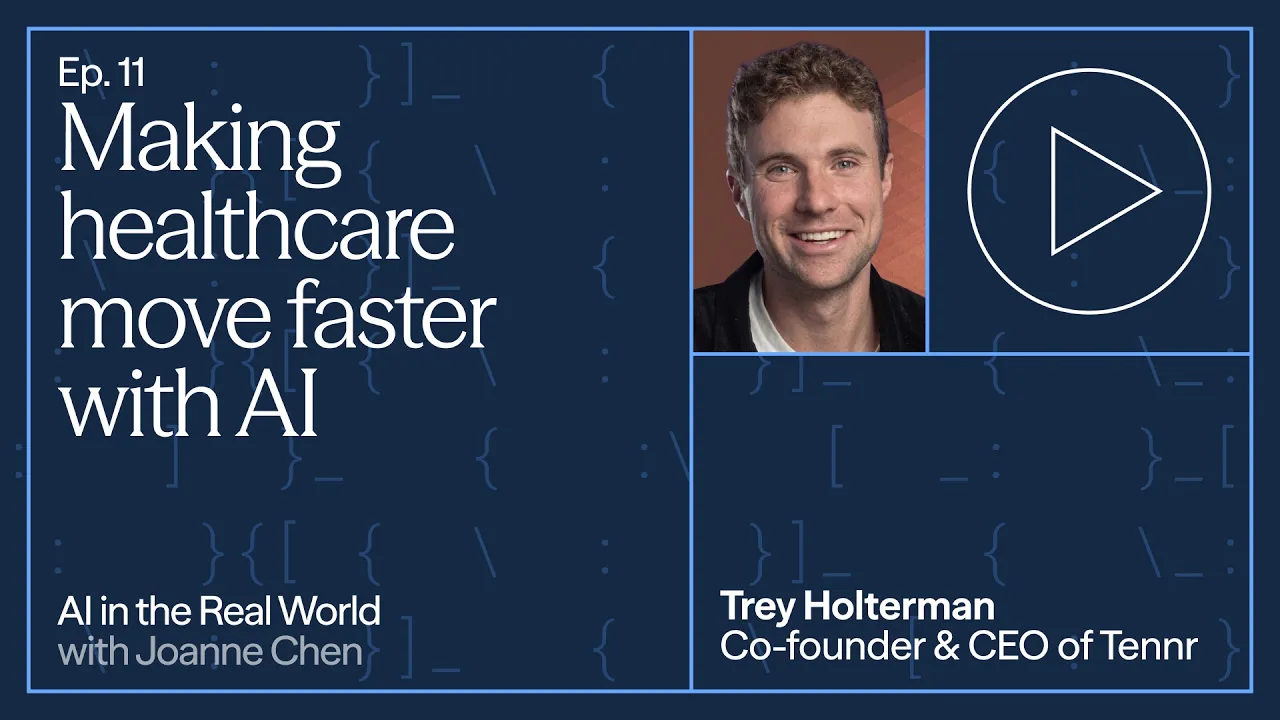
Tennr co-founder and CEO Trey Holterman joins Joanne to talk about what it takes to make AI work in healthcare, and why the answer is not simply "better models."
Tennr focuses on patient flow: the process of getting patients from one provider to the next with the right records, insurance information, clinical context, and scheduling in place. It's a problem that sits in the messy middle of healthcare, where delays, denials, missing documentation, and manual workflows are the norm. Today, its platform processes referrals and intake documentation for roughly 10% of Americans each year.
Healthcare has long been considered “too hard” for startups to crack. But advances in LLMs have made it possible to build products that can handle the unstructured, edge-case-heavy nature of healthcare administration. As Trey explains, those advances have created an opening for founders willing to stay close to customers and learn the market directly.
Tennr has built its own vision-language model, RaeLM, trained on over 100 million anonymized healthcare documents and 8,000+ sets of criteria. Even so, Trey is clear that he does not see Tennr as an "AI company." RaeLM exists because frontier models can't handle what patient flow requires: reason reliably across unstructured records, payer rules, and the long tail of edge cases that govern real-world healthcare admin workflows. That context, Trey argues, is what separates a product that compounds from a one-off pilot.
Trey also gets into his first-time founder lessons and Tennr’s path to scale. In the early days, he and his co-founders spent too much time building in isolation, then swung too far the other way by saying “yes” to nearly everything customers asked for. At one point, they were approaching $1M in revenue, only to realize they were spreading themselves across too many use cases. The decision to refocus resulted in a short-term hit to their revenue, but became the moment the team locked in and found product-market fit.
Along the way, Trey reflects on the discipline of questioning your own assumptions, how Tennr uses AI internally, and what the patient experience could look like if Tennr realizes its mission of making healthcare move faster.
What we covered:
00:00 Cold open
00:35 What Tennr does
03:20 Tennr’s road to PMF
07:40 Startup advice that is true but hard to follow
11:30 Going against conventional wisdom: why selling to healthcare was worth it
13:20 Why Tennr is not “an AI company”
16:21 What it takes to get AI to work in healthcare
17:44 How Tennr thinks about building an industry-level context graph
19:30 Why focused product companies beat general-purpose labs
21:10 The importance of fresh perspectives in regulated industries
22:40 Founders Trey looks up to
24:27 How Tennr uses AI internally
27:20 AI’s impact on productivity and the future of org charts
28:34 What Tennr could look like in five years
Read the transcript:
Trey: Be really honest with yourself about what the bottleneck to the business is. The bottleneck to the business for us, for a very long time, was understanding our customers.
Does building for months on end in a basement get you closer to solving that bottleneck? Absolutely not. But does it feel very comfy? Yes.
Be intellectually honest about what is stopping this business from growing, and then spend all your time being monomaniacal about uncorking that bottleneck.
If I had done that, I probably would have moved into just being in the field more, going to more events, and talking to more customers. But that is really uncomfortable as a technical co-founder, so nobody wants to do it.
Joanne: Thanks for being here, Trey. I love to start by having you tell us about Tennr. What is Tennr? Then we're going to dig into your story after.
Trey: If you think about the vast majority of healthcare visits, they are going from one provider to the next. The process of getting a patient from point A to point B is riddled with hoops to jump through to make sure that the therapy or the specialty visit is medically necessary.
That is where Tennr comes in. We streamline the whole process and want to make sure that patients get from A to B as efficiently as they can, and are not stuck in month-long wait queues.
We are processing over 10% of all Americans annually in our system, and we have been having fun doing it.
Joanne: That is awesome. 10% of Americans is quite a stat.
It has not always been this large, right? I would love to talk about your founder journey a little bit. I still remember the days when Tennr was still an idea, but maybe you could tell us about your journey to becoming a founder and why you ended up working on this problem.
Trey: Yeah. I think you obviously get asked the question of what the aha moment was, what the clear idea was, and then you work on the idea, you sell the idea, and you scale the idea.
The reality for us was very far from that. We were engineers, and what do engineers do? They think they are onto something, and we went and spent a lot of time building without challenging any of our assumptions, and without testing our product in the real world.
The good news was that we built an incredible amount from an early stage. The bad news was that it probably took us a couple of extra years to get to what would really be product-market fit.
You remember this. All of our Zoom calls when we first met were taken in front of my parents' basement. That was where we hung out. We caught onto some of these ideas, and we would talk to one person and then code for three to six months. Then we would go back, and they would be like, "Yeah, not really, buddy." And then we would be like, "Okay, well, let's hypothesize about it." We did not really talk to the outside world all that much.
That is how you can end up in that hell of early-stage startups, where you start second-guessing yourself and have no grounding truth for what you should be building and how you should be building it. We spent our fair share of time there before we quote-unquote figured things out.
About Joanne
Joanne is a general partner at Foundation Capital, where she invests in AI apps and data platforms that automate enterprise work. She was an early investor in Tennr, Jasper, SafelyYou, Tonkean, and CaptivateIQ. She brings her firsthand experience as an engineer and startup co-founder to her work with founders.

Joanne: When did you feel like you had product-market fit?
Trey: You know this story. This is the harrowing thing. We got our first referrals customers, and we started to work. Then we just kept saying yes to everything. We were like, "Holy crap, we have never had customers before. They want us to do this other thing? Yeah, we will do that. They want us to do this thing? Yeah, we will do that."
So we were doing all these things. We were trying to do all of it. I still see early-stage company websites trying to do 10 things, and we fell into that trap too. We did not want to say no to anything because we were in the land of scarcity when it came to customers for so long. We were saying yes to everything.
I will never forget this. We got to the point where we were like, "Oh my God, we are going to get to a million dollars in revenue." I was so excited about it that I ordered these Converse shoes for everybody on the team, just 10 of us. I ordered these million-dollar shoes.
Two days before they arrived, we decided that we were going to literally die because we could not support all these use cases. We were trying to do payment posting, and we were trying to do some billing stuff that people were asking us to do because they were seeing so much excitement on referrals and orders. We were dropping the ball.
It was the hardest thing we have ever done, but we had to go talk to our customers. We said, "Guys, we are going to ruin a good thing by trying to do all these things half-assed." So we said to our customers that we had to focus, and that brought us down from a million dollars of revenue to $200,000.
That was the most horrifying experience. I had all these shoes, and the thinking was: we had to get back to a million dollars before I could hand them out.
But that was it. We had so much conviction. We knew it was right, and we were willing to go through all that pain to accept reality for what it was. Whether or not that was the true product-market fit moment — honestly, I was so stressed I just thought, "It better be" — that was the moment we locked in. That was when it really started to work.
Joanne: That is awesome. You and Diego were rowers as well, and you guys really persisted through a lot of iterations. You have talked about some of the analogies between those two things. Maybe you can share some of that here.
Trey: Early on in the company, the reality was that it was so different from rowing, and it was really frustrating to me.
In rowing, you have this very clear input that leads to output. Every day, you get to wake up and have an incredibly disciplined schedule. For nine years, I was waking up at 4:08 a.m. every other day and 5:25 a.m. on the other days. I was very used to this idea that discipline leads to a good outcome.
That was what led to a lot of our failures early on. We were trying to be super focused, trying to be super disciplined, and trying to control everything in our favor.
The reality is that the real world, and I think company building, is so much more dynamic. There are so many factors going on that the thing you actually have to be the most disciplined about is questioning your baseline assumptions.
The moment we started getting really disciplined was when we started questioning our baseline assumptions and creating systems to validate our hypotheses. When we determined that the problem was that we were not talking to enough customers, I fully stopped coding and went into, "I am going to make sure my calendar is full every single day talking to providers and figuring it out."
You can basically see the calendar shift. We went from maybe talking to customers once every six months, to once every three months, to once a month, to once a day, to the whole day being filled.
That was rigor. That was systems. I was an SDR for a year there, just trying to figure out how to get in front of as many people as possible. At that point, the discipline and rigor came to our benefit a lot.
Today, it is super relevant because most days are hard and crappy. You are not smashing a gong, slamming a bell, and being celebratory. Most days are like, "I am tired. I want to go home." I feel like we are just very used to that emotion being most days.
Joanne: There is a lot of startup wisdom, right? You learn this in startup school of all sorts. What are some of the things you learned that ended up being true, and others that did not matter at all? What surprised you about that journey in the very beginning?
Trey: I tend to think that a lot of these truisms, if they have survived the test of time, there is probably more there. I think the problem is that most of the things that are true to hear and say are really hard to do. That is how you know something is actually really true.
Frank Slootman, who you introduced me to and who has become a big advisor and mentor of mine, will say something like, "If it is not a hell yes, it is a hell no." That sounds so good. It is such a feel-good thing. But when you have been interviewing for a new CFO for three months or six months, and you just cannot find a hell yes, it is so painful. You want to not listen to that advice.
That is a good signal that the advice is probably true. It is easy to say, and it sounds correct. Everybody says, "Of course. If it is not a hell yes, it is a hell no." But in practice, it is brutally, brutally difficult. I think that has ended up being true all over the place.
The other side of that is that, obviously, you are based in SF, Joanne, and I am not going to slam or smear SF. But a big thing for us was to minimize the inputs because in SF everybody is a startup guru. Everybody has some worldly wisdom, but it is very hard to separate who really knows what they are talking about from who is kind of just saying things.
What we did was say that we really only wanted to take inputs from folks we really trusted. We talked about Frank Slootman. Before I met him, I had a playlist of every single podcast he had ever been on, along with Ryan Petersen, along with Dave from Mongo. Those were the only input sources we wanted: folks who had clearly done it multiple times, clearly understood how to do it, and helped us minimize a lot of the advice from random folks.
Joanne: But your parents are in the Bay Area, Trey. That is a great source. I remember that your mom works in medicine, and that was one of the inspirations for getting into this space. Maybe you can tell that story a bit, because healthcare has been notoriously hard for tech founders.
Trey: Yeah. To be clear, I love the Bay Area. I will be back at some point, I think. If you have never lived there, you have never gotten that feeling of, "Oh my God, this is what Silicon Valley is all about. This is what it is like to really be optimistic and to see the future of things." You have to have that experience. You have to know what that is like.
But if you get too into it, it becomes less productive. If you are going to founder dinners more often than you are talking to customers, you have probably gone awry.
My mom was in medicine, and my dad ran a hedge fund. So there were two sides of the brain. One was, "Do something that really matters in the world." The other side was, "Make sure it is capital-efficient and a good business to actually run."
My mom basically gave me the idea for how a lot of this business would work. She explained how the black hole works at imaging centers — she would send referrals and orders out to different centers and they would not receive them. Growing up in the Bay Area was super helpful for understanding how the tech world really works.
Joanne: Were you at all concerned about selling to providers? Providers were not known to buy software historically.
Trey: We sort of graduated in the world of crypto, when everybody was really into crypto and everybody had this idea that Web2 was dead. There were no interesting problems left to be solved. We had to move on to Web3 because there were no more interesting problems.
They would say things like, "You cannot sell to healthcare. Healthcare does not adopt technology. You cannot sell to these services businesses." I am sure you have seen this. People would say, "You do not want to sell to freight or industrials or these old industries."
There was an insane amount of alpha in just not believing what everybody was saying or accepting as truth in that period of time. If you just believed, "That is great that it is really hard to sell into healthcare. I am just going to try because I do not have anything better to do," then you figure it out.
It is true that healthcare does not buy as fast as we do. We bought a new tool for automating GitHub actions, or an alternative, and we bought that thing in 17 minutes. In 17 minutes, we were up and running. We are a pretty good customer to try to sell to, so a lot of people try to sell to us.
Whereas we closed a customer that took 17 months. Every little fish in the ecosystem has to figure out what it is going to do. If a crocodile is not going to eat for 17 weeks, it better have a nice, slow digestive system. Everybody figures out how to adapt and survive, and we have really just done the same thing.
Joanne: In the grand scheme of things, one of the most impressive things is that providers loved what Tennr offered. I remember you saying specifically that you are not an AI company, you just solve problems for providers. Maybe talk about that a little bit. Are we an AI company today? Or are we still just a solution that solves the hardest problems?
Trey: That is funny. So much of our personality is borne out of this general disposition toward not trying to be the hot thing. Unfortunately, it tends to have the opposite effect, which is fine.
The reality is that we want to solve a problem. You look at the fact that, at some of these major health systems here in New York, if I wanted to get a neurology appointment or a cardiology appointment, it can take three to six months. For neuro-oncology — getting FaceTime with someone discussing some of the most serious diagnoses in the world — three weeks is a minimum standard at the major health systems we work with.
So we are just like, "We want to solve that problem." It turns out that if you are going to solve that problem, you better be really technical because it is all about being able to deal with unstructured flows of information and unstructured policy guidelines. You have to be able to say, based on these medical records and these insurance guidelines, do we have everything? Then you have to automate what to do next if you do not.
It turned out that this problem is so technical that it was logical for three engineers to be the right set of co-founders to build for it. But we have wanted to stay true to that idea. We need to solve that problem. Somebody has to solve that problem.
We are fascinated by technology because we cannot help it, and it is the tool to solve the problem. But we are not building technology for technology's sake.
So I regret to inform you, Joanne, that we are still not an AI company. We are going to solve patient flow in U.S. healthcare, and then maybe we will start a research incubation period that does something cool and call that an AI company. But right now, we have to be problem-obsessed.
By the way, I say that very tongue in cheek, obviously, Joanne. I know what our C deck looked like. We recognized that there was a huge gap in the ability of generalizable models to perform the type of actions that were necessary to solve this problem.
So we did not say, "Look at this problem. Let's try to solve it. Oh, great, there are these things called language models. Awesome." No, it was that these were things we had been studying in school for four years. We were fascinated by the technology, and we were absolutely a little bit like hammers looking for nails.
We happened to find one of the opportunities that I think folks will say was one of the great industry improvements, totally driven by the use of language models, that would not have been done before. But we were tongue in cheek with it.
Joanne: What is the hardest part about getting some of these language models, and over time multimodal models, to actually work in healthcare? There are so many edge cases we have to deal with.
Trey: There are so many edge cases. It changes because what you want to do and what you can do goes up and up, and your expectations for things go up and up.
There are all these little use cases that look nothing like ChatGPT or a generative model or reasoning model that you would ever think of. You have to be able to say, "What is the actual problem? What sort of models can I tune to solve for that edge case? And how can I build something robust enough to deal with it?"
If every insurance that was written down on a piece of paper was the correct one, denials would be a fraction of what they actually are. You have to say, "I see the insurances that are listed here for a patient, but based on the region the patient is in, and based on the secondary insurance and tertiary insurance, I am intuiting that..." You have to effectively walk down a logic tree to determine which payer it actually is.
That data is not getting read back into OpenAI's models. If you are not managing your own library for those sorts of rule sets, you are going to be in trouble. The whole thing is edge cases. If you do not really understand the models you are using and how to build and deploy them, these workflows are impossible to map to an automated process.
Joanne: We have been thinking about that a lot. We wrote this piece about context graphs, which is effectively the idea that to make decisions, there are decision traces that AI solutions are looking at and then making a decision based on that. This context is built up over time so they can effectively make better decisions for edge cases. Does Tennr think about this context graph?
Trey: One hundred percent. I think we just think about it on an industry level. Tennr is basically providing that context. That is why I always try to explain to folks, especially in the early days on the model side, that we are totally cool with GPT-7 being an all-knowing, intelligent reasoning machine.
The reality, though, is that the context needed to reliably point that intelligence at solving that problem in a way that leads to the fewest denials is why an intermediary like Tennr, a platform like Tennr, gets used. The context is necessary to those workflows. We are just aggregating it across hundreds of providers so they do not all have to do it.
Joanne: One of the things I struggle with as a patient myself is that I do not feel like there is a project manager for me. There are specific providers or specific solutions, but there is not this overarching context of who I am from a health standpoint and from a financial standpoint.
I am hoping that will change as we embrace more of these technologies, so that each person can get better care and not worry about how they are going to pay for it.
Trey: One hundred percent.
Joanne: How do you think about some of these model companies, like OpenAI and Anthropic? They are certainly very interested in healthcare, and they are partnering with some of the large health systems to figure out what to build as well. How does that world play out?
Trey: To be honest, what you end up seeing, and we obviously talk to these businesses that have gone down these routes, is this idea of, "We should get some really smart Palantir engineers, or Anthropic or OpenAI guys, and just let them cook."
The reality is that you end up doing a dev project. There is no product behind it. There is no long-term thinking about how this is actually going to last and build for a really long time.
I think the DNA of most of these companies is basically, "Let's build the biggest one-size-fits-all solution that can be done." Yet when you actually look at the enterprise operations of these businesses, if you do not have expertise, and if you have not done it 20 times, that is when you get to the 95% enterprise deployment failure. A lot of folks are trying to solve the same problems independently, and they are messing a lot of it up.
That is why I think it is important that product companies like Tennr are laser-focused on what they do incredibly well. You have to be able to show that you can create that value without all the risk associated with taking an IT team, or even a smart group of four deployed engineers, on a potential forced march that is going to run into all the same problems that have been battle-tested by 50 other providers.
Joanne: One of the things that is also interesting is that when you and Tyler and Diego started the company, you guys were not healthcare experts, right? You kind of defied conventional wisdom in many ways by starting a healthcare company.
How do you think about that for other young founders trying to tackle sectors that were previously thought of as sectors where you need a lot of expertise?
Trey: Also, by the way, we could not raise money from anybody in healthcare because everybody had a million very intelligent reasons why Tennr was not really going to succeed.
That is what I love about Foundation. That is what I love about Silicon Valley. There is a belief in technologists who are super curious, starting from a fresh slate, and going to figure it out.
Do I wish I had had some experience? Do I wish I was a little smarter and could have saved us all a lot of pain? Of course. But at the same time, healthcare really suffers from a kind of technology midwit syndrome sometimes. Everything is broken, but somehow this top-down system that is going to be overlaid on everything is going to fix everything. It never actually works that way.
Honestly, most other industries do not usually get fixed that way either. You have to let really good technology show up and rapidly adopt.
Joanne: That makes a lot of sense.
We talk about Frank Slootman quite a bit, and we have talked about some of his beliefs in running companies. Who are some other founders, or what are some other companies, that you think are doing a really good job?
Trey: Young Bill Gates. If you actually study what Microsoft was like in the early days from the standpoint of how they executed, they are the quintessential Silicon Valley startup. Obviously, everybody fanboys Apple, but if you are talking about a true technology business, especially when they started selling to enterprise and really invented the B2B motion, you cannot not admire Ballmer and what they built.
That said, in more present day, Daragh from Imprint. They are a bit bigger than us, and they are just a really fascinating business. I love the way he thinks about things.
Bill McDermott, the CEO of ServiceNow, is probably the greatest salesperson in the world right now, from what I can tell.
Then obviously, there is something about Ryan Petersen's vibe. I still have not met him, so I keep hoping I will speak that into existence. His energy gave me permission to have the energy that I approach things with, which is just being a human trying to figure this out. I am not going to BS anybody. I am not going to oversell. I just want to solve a problem and hope it matters. I am going to be pretty vicious in execution, but generally speaking, I do not need to pretend to be a certain way.
I would want to have the personality of Ryan Petersen, with the sales ability of Bill McDermott, with the industry intuition of a young Bill Gates, with the managerial execution of a Frank Slootman. Obviously, I am none of those things, but that is my stack.
Joanne: We are not going to need AGI if you are all of those things. That is awesome.

One of the things that we are really fascinated by is how organizations are changing from a structure standpoint because more and more can be done by machines. I am curious, what have we done at Tennr to use AI in our day-to-day operations?
Trey: I think there are probably elements of the SaaS apocalypse that are overblown, and there are probably elements that are incredibly real.
When it comes to this act of the finance team putting an incredible amount of thought into building a spreadsheet that really represents the source of truth, and then how we tell the story of that financial plan or the investment thesis of the business, those things have become 10 times easier.
We are able to pull every little breakdown, every little part of the business, and explain where we are investing and how we are investing. That probably would have been an amalgamation of a couple of other tools that we would have had to use. We were able to use Claude Cowork to bring that into one experience.
Every single side of the business has things like that. On the account partner side, there are folks who have to build decks and tell stories to customers about their usage. There are narratives there. There are narratives to draw.
I banned writing with AI in this company a long time ago, and we still keep that ban. But Claude Cowork and some of these tools have really turned a corner in their ability to produce assets that are actually quite interesting and meaningful.
You would never ship them in front of a client before deeply interrogating that everything is accurate and correct. But it is incredible how productive it has gotten for going from raw data to produced assets or materials that are really interesting.
That is on the go-to-market or business operations side. Research in sales has never really been easier or faster. That does not mean you should say, "We do not need SDRs anymore." I think that is ridiculous. They should just be able to research a little more effectively, maybe a lot more effectively, and make sure they are not wasting the time of people who do not need to know about our services.
Obviously, the engineering side is where it gets really crazy and where you do the most experimental, interesting things. We are hiring 100 engineers this year. That does not mean we are not getting more effective. We just might have otherwise hired 200.
For a growth-stage startup, you still need a lot of engineers. You still need a ton of people. You still need to be growing, and you still need to be building. So I am definitely not saying software engineers are not needed. I just wonder how much we seem to be able to do with a smaller amount of people, at the carrying capacity of the business.
Joanne: That makes a lot of sense. I think there is going to be an examination of what people are really good at and what machines are really good at, and I think we will see more of this bifurcation.
We joke internally that human resources is just going to be called resources in the future, and more and more of the burn for each company might shift to machine spend versus human spend. But at the same time, the opportunity is such that human ambition is still huge. Just imagine what more we can do with more people.
Trey: It feels a little bit like saying, "You are not going to need people because there are AI agents." Actually, it indicates that we think humanity is producing as much as it possibly could.
It is ridiculous. We have so many problems to solve. There is so much more. If every single person in our business was two to three times more productive, we would just do more. If we did not do more, our competitors would do more. It is a very negative worldview to say that there are not going to be any humans involved.
Joanne: We talked about having a $10 billion company and growing Tennr to that. What I am hearing is that we are going to be a $100 billion company instead.
What does Tennr look like in five years?
Trey: We have this joke that we have a problem to solve, and once we solve it, we can all go home and stop working so much.
Hopefully, in five years, we could have solved the problem for the majority of healthcare encounters. What does it mean to solve the problem? For us, it means you have some early indications of a serious disease state. You go to your PCP. By the time the PCP sends a referral to a specialist, and by the time you are in your car in the parking lot, you have been told exactly what the clinical pathway journey is likely to look like for you.
As you go to that specialist, that appointment is booked the next day. They have all your records that they need to make sure they can make an informed decision on that encounter, and you are not going to get some insane denial in the mail.
You go to that visit. They are able to prescribe you any procedures you need, and you are not going to sit in a four-week backlog while they hammer away at insurance and insurance hammers away back at them. You are getting scheduled for that in just a couple of days.
To be honest, nobody needs to use Tennr in that scenario other than the providers behind the scenes. Nobody needs to know about Tennr. The problem will be solved, and we can all go home and I can get some sleep.
Joanne: I love that.
Thank you so much for being here, Trey. I really enjoyed our conversation, and I will see you in just a few weeks.
Trey: One hundred percent. Thank you, Joanne.